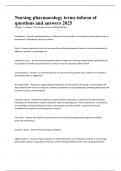
Nursing pharmacology terms inform of
questions and answers 2025
Chapter 1 - Answer The nursing process and drug therapy
Compliance - Answer Implementation or fulfillment of a prescriber's or caregiver's prescribed course of
treatment or therapeutic plan by a patient.
Goals - Answer statements that are time specific and describe generally what is to be accomplished to
address a specific nursing diagnosis
medication error - Answer any preventable adverse drug event involving inappropriate medication use
by a patient or health care professional; it may or may not cause the patient harm.
noncompliance - Answer an informed decision on the part of the patient not to adhere to or follow a
therapeutic plan or suggestion.
Nursing Process - Answer an organizational framework for the practice of nursing. it encompasses all
steps taken by the nurse in caring for a patient: assessment, nursing diagnoses, planning (with goals and
outcome criteria), and evaluation
outcome criteria - Answer Descriptions of specific patient behaviors or responses that demonstrate
meeting of or achievement of goals related to each nursing diagnosis. These statements, as with goals,
are verifiable, framed in behavioral terms, measurable, and time specific. outcome criteria are
considered to be specific, whereas goals are broad.
Prescriber - Answer Any health care professional licensed by the appropriate regulatory board to
prescribe medications.
chapter 2 terms - Answer Pharmacologic principles
additive effects - Answer Drug interactions in which the effect of a combination of two or more drugs
with similar actions is equivalent to the sum of the individual effects of the same drugs given alone.
, adverse drug event - Answer any undesirable occurrence related to administering or failing to
administer a prescribed medication
adverse drug reaction - Answer any unexpected, unintended, undesired, or excessive response to a
medication given at therapeutic dosages. (as apposed to overdose)
adverse effects - Answer a general term for any undesirable effects that are a direct response to one or
more drugs
agonist - Answer a drug that binds to and stimulates the activity of one or more receptors in the body
allergic reaction - Answer an immunologic hypersensitivity reaction resulting from the unusual
sensitivity of a patient to a particular medication; a type of adverse drug event
antagonist - Answer a drug that binds to and inhibits the activity of one or more receptors in the body.
antagonists are also called inhibitors
antagonistic effects - Answer drug interactions in which the effect of a combination of two or more
drugs is less than the sum of the individual effects of the same drugs given alone; its usually caused by
an antagonizing (blocking ro reducing) effect of one drug on another
Bioavailability - Answer a measure of the extent of drug absorption for a given drug and route (from 0%
to 100%)
Biotransformation - Answer one or more biochemical reactions involving a parent drug. Bio-
transformation occurs mainly in the liver and produces a metabolite that is either inactive or active. also
known as a metabolism
Blood-Brain barrier - Answer the barrier system that restricts the passage of various chemicals and
microscopic entities (eg bacteria, viruses) between the bloodstream and the central nervous system. it
still allows for the passage of essential substances such as oxygen
questions and answers 2025
Chapter 1 - Answer The nursing process and drug therapy
Compliance - Answer Implementation or fulfillment of a prescriber's or caregiver's prescribed course of
treatment or therapeutic plan by a patient.
Goals - Answer statements that are time specific and describe generally what is to be accomplished to
address a specific nursing diagnosis
medication error - Answer any preventable adverse drug event involving inappropriate medication use
by a patient or health care professional; it may or may not cause the patient harm.
noncompliance - Answer an informed decision on the part of the patient not to adhere to or follow a
therapeutic plan or suggestion.
Nursing Process - Answer an organizational framework for the practice of nursing. it encompasses all
steps taken by the nurse in caring for a patient: assessment, nursing diagnoses, planning (with goals and
outcome criteria), and evaluation
outcome criteria - Answer Descriptions of specific patient behaviors or responses that demonstrate
meeting of or achievement of goals related to each nursing diagnosis. These statements, as with goals,
are verifiable, framed in behavioral terms, measurable, and time specific. outcome criteria are
considered to be specific, whereas goals are broad.
Prescriber - Answer Any health care professional licensed by the appropriate regulatory board to
prescribe medications.
chapter 2 terms - Answer Pharmacologic principles
additive effects - Answer Drug interactions in which the effect of a combination of two or more drugs
with similar actions is equivalent to the sum of the individual effects of the same drugs given alone.
, adverse drug event - Answer any undesirable occurrence related to administering or failing to
administer a prescribed medication
adverse drug reaction - Answer any unexpected, unintended, undesired, or excessive response to a
medication given at therapeutic dosages. (as apposed to overdose)
adverse effects - Answer a general term for any undesirable effects that are a direct response to one or
more drugs
agonist - Answer a drug that binds to and stimulates the activity of one or more receptors in the body
allergic reaction - Answer an immunologic hypersensitivity reaction resulting from the unusual
sensitivity of a patient to a particular medication; a type of adverse drug event
antagonist - Answer a drug that binds to and inhibits the activity of one or more receptors in the body.
antagonists are also called inhibitors
antagonistic effects - Answer drug interactions in which the effect of a combination of two or more
drugs is less than the sum of the individual effects of the same drugs given alone; its usually caused by
an antagonizing (blocking ro reducing) effect of one drug on another
Bioavailability - Answer a measure of the extent of drug absorption for a given drug and route (from 0%
to 100%)
Biotransformation - Answer one or more biochemical reactions involving a parent drug. Bio-
transformation occurs mainly in the liver and produces a metabolite that is either inactive or active. also
known as a metabolism
Blood-Brain barrier - Answer the barrier system that restricts the passage of various chemicals and
microscopic entities (eg bacteria, viruses) between the bloodstream and the central nervous system. it
still allows for the passage of essential substances such as oxygen