

Logistics and supply chain operations summary
Lecture 1
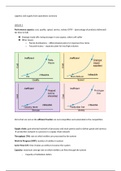
Performance aspects: cost, quality, speed, service, variety (OTIF – (percentage of products delivered)
On-time-in-full)
Strategic trade-offs: being stronger in one aspect, others will suffer
Other issues:
o Pareto distributions – differentiated policy for important few items
o Focused factory – separate plant for low/high volumes
Firms that are not on the efficient frontier are not competitive and vulnerable to the competition
Supply chain: goal-oriented network of processes and stock points used to deliver goods and services
production network is a process in a supply chain network
Throughput (TH): rate at which entities are processed by the system
Work-In-Progress (WIP): number of entities in system
Cycle Time (CT): time it takes an entity to traverse the system
Capacity: maximum average rate at which entities can flow through the system
- Capacity of individual station
, o Capacity = base capacity – detractors
Base capacity= rate of the process under ideal conditions
Detractors: anything that slows the output of the process
- Capacity of line or network
o Bottleneck constrains the capacity of the system
Bottleneck is the process with the highest utilization
Utilization = rate into station / capacity station
Capacity principles:
1. The output of a system cannot equal or exceed its capacity cannot equal capacity due to
variability
If arrival rate is exactly equal to true capacity (detractors taken into account)
- Performance no longer predictable
- WIP level low as nothing happens
- WIP will build rapidly if failure occurs no slack capacity to enable the system to catch
up
2. Utilization cycle time increases with utilization and does so sharply as utilization
approaches 100%
- Consequences when loading a system close to 100%
CT get too long and WIP too high
Overtime to reduce WIP (gives higher capacity lower cycle time)
After WIP reduction, back to normal capacity
Cycle starts again (overtime vicious cycle)
- Utilization can be brought closer to 100% by giving more WIP to the system, idle time can
then be used to process things from WIP, the more minutes of WIP the lower the chance
, that production will outstrip arrivals by that amount of minutes, the smaller the increase
in utilization amount of WIP and CT will increase faster than the utilization
Little’s law over the long time, average WIP, TH, and CT for any stable process relate as: WIP =TH x
CT
Two restrictions
1. Refers to long-term averages
2. Process must be stable
Queuing:
Waiting time (WT) = variability (V) * utilization (U) * average effective process time for entity at
station (T)
(G/G/1)
- U= UTIL / (1-UTIL)
- V = (cva^2 + cve^2)/2
- Cva^2= squared coefficient of variation of interarrival times
- Cve^2= squared coefficient of variation of process times
- When batching, in VUT formula T is processing time of complete batch, including setup
time
Higher variability waiting time increases faster when utilization increases
- Low variability allowing to increase throughput (utilization )without increasing waiting
times
- Low variability allowing to decrease waiting times, without lowering throughput
, Beide lijnen lopen uitelkaar overloaded resource
Beide lijnen lopen naar elkaar toe/over elkaar heen underloaded resource
Max inflow slope of cumulative input
Max capacity slope of cumulative output
Chapter 0
Pareto distribution: a high fraction of sales dollars comes from a small fraction of the end items
Benchmarking: common way to achieve efficiency by coping best practices of other firms
Cannot provide way to move efficiency beyond historical levels because it is imitative
Different levels: station – line – network
Chapter 1
Extent to which a given system achieves high throughput but low WIP and CT is a function of the
system’s overall efficiency
- Measure of efficiency inventory turns = TH/WIP
- Where TH is the cost of goods sold in year and WIP the dollar value of the average
amount of inventory held in the system
- How efficiently an operation converts inventory into output
Detractors for capacity: mechanical failures, setups, rework, operator unavailability
( if th=2/hour and 10% unavailable, capacity = 0,9*2 or 2-0.2)
Lecture 1
Performance aspects: cost, quality, speed, service, variety (OTIF – (percentage of products delivered)
On-time-in-full)
Strategic trade-offs: being stronger in one aspect, others will suffer
Other issues:
o Pareto distributions – differentiated policy for important few items
o Focused factory – separate plant for low/high volumes
Firms that are not on the efficient frontier are not competitive and vulnerable to the competition
Supply chain: goal-oriented network of processes and stock points used to deliver goods and services
production network is a process in a supply chain network
Throughput (TH): rate at which entities are processed by the system
Work-In-Progress (WIP): number of entities in system
Cycle Time (CT): time it takes an entity to traverse the system
Capacity: maximum average rate at which entities can flow through the system
- Capacity of individual station
, o Capacity = base capacity – detractors
Base capacity= rate of the process under ideal conditions
Detractors: anything that slows the output of the process
- Capacity of line or network
o Bottleneck constrains the capacity of the system
Bottleneck is the process with the highest utilization
Utilization = rate into station / capacity station
Capacity principles:
1. The output of a system cannot equal or exceed its capacity cannot equal capacity due to
variability
If arrival rate is exactly equal to true capacity (detractors taken into account)
- Performance no longer predictable
- WIP level low as nothing happens
- WIP will build rapidly if failure occurs no slack capacity to enable the system to catch
up
2. Utilization cycle time increases with utilization and does so sharply as utilization
approaches 100%
- Consequences when loading a system close to 100%
CT get too long and WIP too high
Overtime to reduce WIP (gives higher capacity lower cycle time)
After WIP reduction, back to normal capacity
Cycle starts again (overtime vicious cycle)
- Utilization can be brought closer to 100% by giving more WIP to the system, idle time can
then be used to process things from WIP, the more minutes of WIP the lower the chance
, that production will outstrip arrivals by that amount of minutes, the smaller the increase
in utilization amount of WIP and CT will increase faster than the utilization
Little’s law over the long time, average WIP, TH, and CT for any stable process relate as: WIP =TH x
CT
Two restrictions
1. Refers to long-term averages
2. Process must be stable
Queuing:
Waiting time (WT) = variability (V) * utilization (U) * average effective process time for entity at
station (T)
(G/G/1)
- U= UTIL / (1-UTIL)
- V = (cva^2 + cve^2)/2
- Cva^2= squared coefficient of variation of interarrival times
- Cve^2= squared coefficient of variation of process times
- When batching, in VUT formula T is processing time of complete batch, including setup
time
Higher variability waiting time increases faster when utilization increases
- Low variability allowing to increase throughput (utilization )without increasing waiting
times
- Low variability allowing to decrease waiting times, without lowering throughput
, Beide lijnen lopen uitelkaar overloaded resource
Beide lijnen lopen naar elkaar toe/over elkaar heen underloaded resource
Max inflow slope of cumulative input
Max capacity slope of cumulative output
Chapter 0
Pareto distribution: a high fraction of sales dollars comes from a small fraction of the end items
Benchmarking: common way to achieve efficiency by coping best practices of other firms
Cannot provide way to move efficiency beyond historical levels because it is imitative
Different levels: station – line – network
Chapter 1
Extent to which a given system achieves high throughput but low WIP and CT is a function of the
system’s overall efficiency
- Measure of efficiency inventory turns = TH/WIP
- Where TH is the cost of goods sold in year and WIP the dollar value of the average
amount of inventory held in the system
- How efficiently an operation converts inventory into output
Detractors for capacity: mechanical failures, setups, rework, operator unavailability
( if th=2/hour and 10% unavailable, capacity = 0,9*2 or 2-0.2)



