100% tevredenheidsgarantie Direct beschikbaar na je betaling Lees online óf als PDF Geen vaste maandelijkse kosten 4.2 TrustPilot
logo-home
Tentamen (uitwerkingen)

Musculoskeletal Exam 2025 Questions and Verified Accurate Solutions

Beoordeling
-
Verkocht
-
Pagina's
11
Cijfer
A+
Geüpload op
31-05-2025
Geschreven in
2024/2025

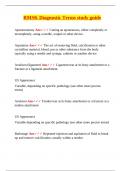
When caring for a client recovering from total hip replacement in which position would you place them? A) adduction and flexion B) abduction and extension C) adduction and internal rotation D) abduction and external rotation - Correct Ans-B) abduction and extension A client has a BKA and asks why the prosthesis is applied immediately after surgery? Which explanation is the primary reason? A) to decrease phantom limb sensations B) to encourage a normal walking pattern C) to reduce the incidence of wound infection D) to allow for the fitting of the prosthesis before discharge - Correct Ans-B) to encourage a normal walking pattern Which explanation does the nurse make for swollen finger joints in a client who is having an episode of rheumatoid arthritis? A) urate crystals in synovial tissue B) inflammation in the joints synovial lining C) formation of bony spurs on the joint surfaces D) erosion of cartilage that lines the inside of joints - Correct Ans-B) inflammation in the joints synovial lining urate crystals - Correct Ans-Gout disease, this is accumulated in joints and other body tissues comminuted fracture - Correct Ans-fracture in which the bone is splintered or crushed and skin is still intact Glucosamine - Correct Ans-a substance produced naturally in the body; often used as a supplement to maintain cartilage in the joints Which client shouldn't take glucosamine? A) osteoarthritis B) heart disease C) hyperthyroidism SKELETAL SKELETAL D) diabetes mellitus - Correct Ans-D) diabetes mellitus bony ankylosis - Correct Ans-abnormal adhesion and rigidity of the bones of the joint, resulting in stiffness and immobility rheumatoid arthritis - Correct Ans-a chronic autoimmune disorder in which the joints and some organs of other body systems are attacked Which site is most common source of major disability from osteoarthritis? A) hip B) knee C) spine D) fingers - Correct Ans-B) knee Which term describes the fracture sustained while a client with osteoporosis was walking up the stairs? A) stress B) pathological C) greenstick D) compound - Correct Ans-B) pathological stress fracture - Correct Ans-a small crack in the bone that often develops from chronic, excessive impact pathological fracture - Correct Ans-break in a bone weakened by some other disease greenstick fracture - Correct Ans-bending and incomplete break of a bone; most often seen in children compound fracture closed - Correct Ans-bone protrudes through skin compound fracture (open) - Correct Ans-bone is broken and a fragment of bone protrudes through an open wound in the skin The five steps of bone healing from fracture - Correct Ans-1. Hematoma formation (72 hours after fracture) 2. Fibrocartilage formation 3. Callus formation (1-4 weeks after fracture) 4. Ossification (permanent bone callus forms) 5. Distance between bone fragment closes hematoma formation - Correct Ans-Torn blood vessels hemorrhage, forming mass of clotted blood called a hematoma Site is swollen, painful, and inflamed SKELETAL SKELETAL Fibrocartilage formation - Correct Ans-3 days to 2 weeks callus formation - Correct Ans-mass of tissue that forms at a fracture site and connects the broken ends of the bone What is callus made of? - Correct Ans-cartilage, osteoblasts, calcium and phosphorus Osteoblasts - Correct Ans-bone forming cells Osteoclasts - Correct Ans-Bone-destroying cells Using a cane - Correct Ans-Flex elbow 30 degrees and hold handle; tip of cane should be 15cm lateral to the base of the 5th toe Hold in hand opposite affected extremity; advance cane and affected leg together; lean on cane when moving good leg UP= cane and good leg DOWN= cane and bad leg Goals of treatment expected in a care plan of a patient with a fracture - Correct Ans Pain relief Intact skin Good skin perfusion Maintenance of mobility Independence with ADL Prevention of complications Conditions that may result in amputation - Correct Ans-Gangrene Arteriosclerosis Diabetes mellitus Chronic osteomyelitis Peripheral vascular disease phantom limb pain - Correct Ans-pain in a limb (or extremity) that has been amputated Burning, stinging or crushing pain nonunion fracture - Correct Ans-break in a bone that has failed to unite and heal after 9 12 months Union fracture - Correct Ans-Bone mends properly Which sign is unique to a fat embolus and would need to be monitored in a client with a distal femoral shaft fracture? A) oliguria B) dyspnea SKELETAL SKELETAL C) petechiae D) confusion - Correct Ans-C) petechiae petechiae - Correct Ans-small, pinpoint hemorrhages purpose of traction - Correct Ans-Reduce muscle spasms Reduce, align, and immobilize fractures Reduce deformity Increase space between opposing forces Chvostek's sign - Correct Ans-Hypocalcemia (facial muscle spasm upon tapping) Hypocalcemia S/S - Correct Ans-C.A.T.S. C - Convulsions A- Arrhythmias T - Tetany (involuntary contraction of muscles) S - Spasms and stridor Drug that is derived from natural source and may be prescribed for treatment of osteoporosis - Correct Ans-Calcitonin Medications for osteoporosis - Correct Ans-*bisphosphonates* - inhibit bone resorption by suppressing osteoclast activity, thus increasing bone density and reducing the incidence of fractures by about 50% *selective estrogen receptor modulators (SERMs):* - bind to estrogen receptors and activate or inhibit them *calcitonin:* - increases bone density and reduces the risk of vertebral fractures Articulation (joint) - Correct Ans-the point at which two bones come together disarticulation amputation - Correct Ans-across a joint such as hip, wrist, elbow, or shoulder; an ankle synovial fluid - Correct Ans-joint-lubricating fluid secreted by the synovial membrane arthrocentesis - Correct Ans-surgical puncture to remove fluid from the joint space risk factors associated with musculoskeletal disorders - Correct Ans-autoimmune disorders calcium deficiency falls hyperuricemia infection SKELETAL SKELETAL medications metabolic disorders neoplastic disorders obesity postmenopausal states trauma and injury arthroscopy - Correct Ans-the visual examination of the internal structure of a joint bone scan - Correct Ans-uptake of a radioactive substance is measured in bone Bone or Muscle Biopsy - Correct Ans-Needle aspiration or surgical extraction of bone or muscle tissue Strains - Correct Ans-overstretching and tearing a muscle sprain - Correct Ans-stretching or tearing of ligaments complete fracture - Correct Ans-bone is broken all the way through compression fracture - Correct Ans-occurs when the bone is pressed together (compressed) on itself depressed fracture - Correct Ans-broken bone portion is pressed inward, typical of skull fracture impacted fracture - Correct Ans-broken bone ends are forced into each other incomplete fracture - Correct Ans-bone is not broken all the way through oblique fracture - Correct Ans-bone break in which fracture line runs along an angle to shaft of the bone spiral fracture - Correct Ans-ragged break occurs when excessive twisting forces are applied to a bone if a compound open fracture exists you should do what? - Correct Ans-splint extremity and cover wound with sterile dressing reduction closed - Correct Ans-reduction in which fractured bones are realigned by manipulation rather than surgery open reduction - Correct Ans-involves surgical exposure of the bone and the use of plates, screws, or pins to realign the fragments SKELETAL SKELETAL internal fixation - Correct Ans-a fracture treatment in which a plate or pins are placed directly into the bone to hold the broken pieces in place external fixation - Correct Ans-a fracture treatment procedure in which pins are placed through the soft tissues and bone so that an external applicance can be used to hold the pieces of bone firmly in place during healing traction splint - Correct Ans-a splint that applies constant pull along the length of a lower extremity to help stabilize the fractured bone and to reduce muscle spasm in the limb. Traction splints are used primarily on femoral shaft fractures. skeletal traction - Correct Ans-The most effective means of traction, applying to a bone with wire pins or tongs casting - Correct Ans-bone immobilization by application of a solid, stiff dressing formed with plaster of Paris or similar material skin traction - Correct Ans-pulling effect on the skeletal system by applying devices to the skin Fat embolism - Correct Ans-Freely floating fat globule in the blood stream, which can obstruct blood circulation to vital organs (e.g., heart, brain). Usually caused by injury to subcutaneous tissue or a bone fracture that allows fat release. complications of fracture - Correct Ans-1. Compartment syndrome 2. Fat emboli 3. DVT 4. Osteomyelitis 5. Avascular necrosis/Non-union 6. Localized infection at pin site Fat embolism is most important for first 48 hrs nursing action for fat embolism - Correct Ans-notify rn and phcp administer oxygen monitor vs and rr monitor prescribed iv fluids assist with intubation and mechanical ventilation if necessary follow up chest x-ray and CT document event actions taken client response compartment syndrome - Correct Ans-involves the compression of nerves and blood vessels due to swelling within the enclosed space created by the fascia that separates groups of muscles osteomyelitis - Correct Ans-inflammation of bone and bone marrow SKELETAL SKELETAL avascular necrosis - Correct Ans-an area of bone tissue death caused by insufficient blood flow total knee replacement - Correct Ans-a procedure in which all of the parts of the knee are replaced Joint dislocation (subluxations) - Correct Ans-Causes: Impact injury removing bones from proper joint alignment Conditions: Pain, Loss of sensation, Immobility Diagnosis: Physical exam, X-ray, MRI, CT Treatments: Realignment of bones, Immobilization, Physical therapy to strengthen surrounding muscles, Surgery for repeated incidences herniated disk - Correct Ans-protrusion of a degenerated or fragmented intervertebral disk so that the nucleus pulposus protrudes, causing compression on the nerve root Amputation of lower extremity - Correct Ans-1st 24 hrs: elevate foot of bed (support stump with pillows but not elevated by pillows!!) Prone position twice a day for 20-30 minutes- prevent contractures of the hip Osteoarthritis - Correct Ans-inflammation of the bone and joint osteoporosis - Correct Ans-A condition in which the body's bones become weak and break easily. Risk factors for osteoporosis - Correct Ans-age, skinny, smoking, alcoholics, steroids, menopause, malnutrition, family hx, Asians/whites skeletal muscle relaxants - Correct Ans-depress neural activity within skeletal muscle Baclofen - Correct Ans-muscle relaxant, causes drowsiness, muscle weakness, dont drink alcohol, dont drive car, dont be responsible for child under 12 Antigout Medications - Correct Ans-First Line: NSAIDs and prednisone (Deltasone) Purpose: Used as a first line defense to treat the pain and inflammation of gout attacks. Colchicine (Colgout): Purpose: Treat the inflammation and pain associated with gout. Just like NSAIDs, these meds can lead to GI distress and should be taken with foods. HINT: The word gout is right in the name Colgout. SKELETAL SKELETAL Allopurinol (Zyloprim): Purpose: This is the only medical preventative treatment for gout. Allopurinal prevents uric acid production. This can be an effective means of preventing gout attacks when diet alone is not effective. HINT: Examine the name allopurinol and you can see the word PURINE in the middle of the name. Note: There are many drug and food interactions associated with allopurinol: Potential serious interactions with the use of saliscylates, loop diuretics, phenylbutazamines and alcohol and potential for drug interactions with Warfarin (Coumadin). Antiarthritis Agents - Correct Ans-Prevent and suppress arthritis in selected patients with rheumatoid arthritis DMARDs (disease modifying anti-rheumatic drugs) - Correct Ans-A classification of medications that modify rheumatic disease, instead of just treating symptoms Osteoporosis treatment - Correct Ans-Calcium/vitamin D supplementation (prophylaxis); bisphosphonates, PTH analogs, SERMs, calcitonin, denosumab (treatment) Biphosphonates - Correct Ans-Alendronate (Fosamax) ankylosis - Correct Ans-abnormal condition of stiffness arthrodesis - Correct Ans-surgical fixation of a joint Hemiarthroplasty bipolar hip replacement - Correct Ans-surgical repair of a joint with a partial joint implant reconstruction blanching test - Correct Ans-A test of the rate of capillary refill; blanching means to cause to become pale by applying digital pressure. Colles fracture - Correct Ans-distal radius is broken by falling onto an outstretched hand creptius - Correct Ans-clicking or grating at a joint Fibromyalgia - Correct Ans-chronic condition with widespread aching and pain in the muscles and fibrous soft tissue SKELETAL kyphosis - Correct Ans-excessive outward curvature of the spine, causing hunching of the back. lordosis - Correct Ans-abnormal anterior curvature of the lumbar spine (sway-back condition) ORIF - Correct Ans-Open Reduction and Internal Fixation (orthopedic surgery) Scoliosis - Correct Ans-abnormal lateral curvature of the spine Sequestrum refers to - Correct Ans-dead bone tissue subluxation - Correct Ans-partial dislocation tophi - Correct Ans-Small, whitish yellow, hard, nontender nodules in or near helix or antihelix; contain greasy, chalky material of uric acid crystals and are a sign of gout. Volkmann's contracture - Correct Ans-Condition in which the muscles in the palm side of the forearm shorten, causing the fingers to form a fist and the wrist to bend 5 basic functions of skeletal system - Correct Ans-support, protection, movement, mineral storage, hematopoiesis Long bone examples - Correct Ans-femur, humerus short bone examples - Correct Ans-carpals and tarsals flat bone examples - Correct Ans-skull, ribs, sternum irregular bone examples - Correct Ans-vertebrae and hip bones Synarthrosis - Correct Ans-immovable joint Amphiarthrosis - Correct Ans-slightly movable joint Diarthrosis - Correct Ans-freely movable joint Abduction - Correct Ans-Movement away from the midline of the body Adduction - Correct Ans-Movement toward the midline of the body extension - Correct Ans-Straightening of a joint flexion - Correct Ans-bending a joint rotation - Correct Ans-movement of a bone around its longitudinal axis SKELETAL SKELETAL SKELETAL Supination - Correct Ans-movement that turns the palm up Pronation - Correct Ans-turning the palm downward Dorsiflexion - Correct Ans-bending of the foot or the toes upward plantar flexion - Correct Ans-bending of the sole of the foot by curling the toes toward the ground MRI - Correct Ans-a technique that uses magnetic fields and radio waves to produce computer-generated images that distinguish among different types of soft tissue; allows us to see structures within the brain Aspiration Procedure - Correct Ans-done to obtain a specimen of body fluid electromyogram - Correct Ans-record of the electrical activity in a muscle RA assessment - Correct Ans-joint pain and swelling limited joint movement contractures; deformities weakness, fatigue high fever and rheumatoid rash, particularly seen in juvenile RA nodules over bony prominences ulnar deviation periods of remissions and exacerbations Fibromyalgia Assessment - Correct Ans-Historically, fibromyalgia was misdiagnosed Symptoms can be subjective Thorough pain history and assessment Presence of anxiety, depression Fatigue Presence of IBS or TMJ 9 sets of tender points, must have 11 out of 18 for a diagnosis of fibromyalgia Tender points are assessed by applying moderate pressure to specific locations Hip fracture - Correct Ans-Most common type of fracture; may cause shortening or external rotation of the leg (The leg appears to be shortened and is adducted and externally rotated.) Dislocation - Correct Ans-displacement of a bone from its joint carpal tunnel syndrome - Correct Ans-compression of the median nerve as it passes between the ligament and the bones and tendons of the wrist SKELETAL Airbag Injuries - Correct Ans-Common injuries include abrasions to the face, chest and arms. Minor corrosive effects can occur because of the cornstarch on the airbag, and it may irritate the skin. tumors of the bone - Correct Ans-Osteoma and osteosarcoma are - Correct Ans- SKELETAL

Meer zien Lees minder
Instelling
RMSKS - Registered Musculoskeletal Sonographer
Vak
RMSKS - Registered Musculoskeletal Sonographer


Oeps! We kunnen je document nu niet laden. Probeer het nog eens of neem contact op met support.

Geschreven voor

Instelling
RMSKS - Registered Musculoskeletal Sonographer
Vak
RMSKS - Registered Musculoskeletal Sonographer

Documentinformatie

Geüpload op
31 mei 2025
Aantal pagina's
11
Geschreven in
2024/2025
Type
Tentamen (uitwerkingen)
Bevat
Vragen en antwoorden

Onderwerpen

Voorbeeld van de inhoud

SKELETAL


Musculoskeletal Exam 2025 Questions
and Verified Accurate Solutions
When caring for a client recovering from total hip replacement in which position would
you place them?

A) adduction and flexion
B) abduction and extension
C) adduction and internal rotation
D) abduction and external rotation - Correct Ans-B) abduction and extension

A client has a BKA and asks why the prosthesis is applied immediately after surgery?
Which explanation is the primary reason?

A) to decrease phantom limb sensations
B) to encourage a normal walking pattern
C) to reduce the incidence of wound infection
D) to allow for the fitting of the prosthesis before discharge - Correct Ans-B) to
encourage a normal walking pattern

Which explanation does the nurse make for swollen finger joints in a client who is
having an episode of rheumatoid arthritis?

A) urate crystals in synovial tissue
B) inflammation in the joints synovial lining
C) formation of bony spurs on the joint surfaces
D) erosion of cartilage that lines the inside of joints - Correct Ans-B) inflammation in the
joints synovial lining

urate crystals - Correct Ans-Gout disease, this is accumulated in joints and other body
tissues

comminuted fracture - Correct Ans-fracture in which the bone is splintered or crushed
and skin is still intact

Glucosamine - Correct Ans-a substance produced naturally in the body; often used as a
supplement to maintain cartilage in the joints

Which client shouldn't take glucosamine?

A) osteoarthritis
B) heart disease
C) hyperthyroidism

SKELETAL

, SKELETAL

D) diabetes mellitus - Correct Ans-D) diabetes mellitus

bony ankylosis - Correct Ans-abnormal adhesion and rigidity of the bones of the joint,
resulting in stiffness and immobility

rheumatoid arthritis - Correct Ans-a chronic autoimmune disorder in which the joints and
some organs of other body systems are attacked

Which site is most common source of major disability from osteoarthritis?

A) hip
B) knee
C) spine
D) fingers - Correct Ans-B) knee

Which term describes the fracture sustained while a client with osteoporosis was
walking up the stairs?

A) stress
B) pathological
C) greenstick
D) compound - Correct Ans-B) pathological

stress fracture - Correct Ans-a small crack in the bone that often develops from chronic,
excessive impact

pathological fracture - Correct Ans-break in a bone weakened by some other disease

greenstick fracture - Correct Ans-bending and incomplete break of a bone; most often
seen in children

compound fracture closed - Correct Ans-bone protrudes through skin

compound fracture (open) - Correct Ans-bone is broken and a fragment of bone
protrudes through an open wound in the skin

The five steps of bone healing from fracture - Correct Ans-1. Hematoma formation (72
hours after fracture)
2. Fibrocartilage formation
3. Callus formation (1-4 weeks after fracture)
4. Ossification (permanent bone callus forms)
5. Distance between bone fragment closes

hematoma formation - Correct Ans-Torn blood vessels hemorrhage, forming mass of
clotted blood called a hematoma
Site is swollen, painful, and inflamed

SKELETAL
$15.99
Krijg toegang tot het volledige document:

100% tevredenheidsgarantie
Direct beschikbaar na je betaling
Lees online óf als PDF
Geen vaste maandelijkse kosten

Maak kennis met de verkoper
Seller avatar
AlexScorer
4.0
(1)

Maak kennis met de verkoper

Seller avatar
AlexScorer Chamberlain College Of Nursing
Bekijk profiel
Volgen Je moet ingelogd zijn om studenten of vakken te kunnen volgen
Verkocht
5
Lid sinds
1 jaar
Aantal volgers
0
Documenten
1554
Laatst verkocht
3 maanden geleden
Best Scorers Review Guide

Hesitate not to get 100% Recent updated and Verified Documents .Total Guarantee to success

4.0

1 beoordelingen

5
0
4
1
3
0
2
0
1
0

Recent door jou bekeken

Waarom studenten kiezen voor Stuvia

Gemaakt door medestudenten, geverifieerd door reviews

Kwaliteit die je kunt vertrouwen: geschreven door studenten die slaagden en beoordeeld door anderen die dit document gebruikten.

Niet tevreden? Kies een ander document

Geen zorgen! Je kunt voor hetzelfde geld direct een ander document kiezen dat beter past bij wat je zoekt.

Betaal zoals je wilt, start meteen met leren

Geen abonnement, geen verplichtingen. Betaal zoals je gewend bent via iDeal of creditcard en download je PDF-document meteen.

Student with book image

“Gekocht, gedownload en geslaagd. Zo makkelijk kan het dus zijn.”

Alisha Student

Veelgestelde vragen