

Chapter: 1
Sexual Reproduction in
Flowering Plants
Introduction
Sexual reproduction in flowering plants (angiosperms)
involves the formation of male and female gametes, their
fusion (fertilization), and the development of seeds and
fruits. It ensures genetic diversity through meiosis and
fertilization.
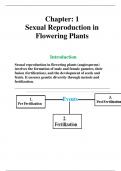
, 🌱 1. Pre-Fertilization Events
(a) Structure of Flower
Flower is the reproductive unit.
It contains:
o Androecium (male reproductive part) → Stamens
(anther + filament)
o Gynoecium (female reproductive part) → Carpel
(stigma + style + ovary)
(b) Microsporogenesis (Male gamete formation)
🌱 Anther Structure
Bilobed, tetrasporangiate.
Four layers: Epidermis, Endothecium, Middle layer,
Tapetum.
o Tapetum: Nutrient-rich layer, nourishes pollen.
🌱 Process of Microsporogenesis
Pollen mother cells (PMCs) → undergo meiosis → form
microspore tetrads.
Each microspore develops into a pollen grain.
🌱 Important Terms:
Pollen Grain: Male gametophyte (2-celled stage:
vegetative cell + generative cell)
Pollination: Transfer of pollen to stigma
Sexual Reproduction in
Flowering Plants
Introduction
Sexual reproduction in flowering plants (angiosperms)
involves the formation of male and female gametes, their
fusion (fertilization), and the development of seeds and
fruits. It ensures genetic diversity through meiosis and
fertilization.
, 🌱 1. Pre-Fertilization Events
(a) Structure of Flower
Flower is the reproductive unit.
It contains:
o Androecium (male reproductive part) → Stamens
(anther + filament)
o Gynoecium (female reproductive part) → Carpel
(stigma + style + ovary)
(b) Microsporogenesis (Male gamete formation)
🌱 Anther Structure
Bilobed, tetrasporangiate.
Four layers: Epidermis, Endothecium, Middle layer,
Tapetum.
o Tapetum: Nutrient-rich layer, nourishes pollen.
🌱 Process of Microsporogenesis
Pollen mother cells (PMCs) → undergo meiosis → form
microspore tetrads.
Each microspore develops into a pollen grain.
🌱 Important Terms:
Pollen Grain: Male gametophyte (2-celled stage:
vegetative cell + generative cell)
Pollination: Transfer of pollen to stigma


