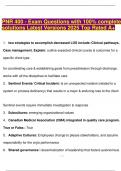
PNR 400 - Exam Questions with 100% complete
solutions Latest Versions 2025 Top Rated A+
1. two strategies to accomplish decreased LOS include: Clinical pathways,
Case management. Explain: outline expected clinical course & outcomes for a
specific client type
for coordinating care & establishing goals from preadmission through discharge.
works with all the disciplines to facilitate care
2. Sentinel Events/ Critical Incident: Is an unexpected incident (related to a
system or process deficiency) that results in a major & enduring loss to the client
Sentinel events require immediate investigation & response
3. Subcultures: emerging organizational values
4. Canadian Medical Association (CMA) integrated in quality care program.
True or False.: True
5. Adaptive Cultures: Employees change to please stakeholders, and assume
responsibility for the org's performance
6. Shared governance:: decentralization of leadership that fosters autonomous
,decision making and professional nursing practice
7. Five stages that groups progress through: Forming
Storming begins to work together
Norming work more effectively as a team
Performing at a very high level
Adjourning moving off into different directions
8. initiates provincial universal public hospital insurance plan (known today
as OHIP): 1947: Saskatchewan
9. 'Father' of medicare in Canada in 1962: Tommy Douglas
10. establish 5 basic principles of Canada Health Act: Universality available to
all eligible residents of Canada
Comprehensive coverage for hospital and physician services
Accessible without financial and other barriers; available to all Canadians on the
basis of need
Portable within the country and during travel abroad
Publicly Administered public authority administers and operates the plan on a
non-profit basis
,11. Canada Health and Social Transfer (CHST): is block funding that combines
health care/postsecondary education/social services/social assistance
Effort to allow provinces to provide reasonably comparable levels of service at
reasonably comparable levels of taxation
12. Who were instrumental in ensuring the passage of the bill that resulted in
CHA: Nurses & CNA
13. OPHA: the Ontario Public Health Association.
Legislated by the Health Protection and Promotion Act
provide for the organization and delivery of public health programs and services, to
prevent the spread of disease, to promote and protect the health of the people of
Ontario.
14. 28 CCACs operating across Ontario.
CCAC boundaries align with the geographic boundaries of Ontario's 14 Local
Health Integration Networks. Community Care Access Centre.
T or F: F
14
15. What agency are governed by a board of clients, community members,
health providers and community leaders, and enables health services to be
, more easily oriented towards what community members identify as their most
important needs.: Community Health Centres - CHCs
120 Primary health care centres in Ontario
16. Health can be categorized into four levels: Health Promotion
Disease and Injury Prevention (Protection)
Diagnosis and Treatment of Existing Health Problems (Primary, Secondary, Tertiary)
Rehabilitation
17. Accreditation Canada (AC): Assists health service organizations across Cana-
da to examine and improve quality of care they provide.
Accreditation (AC) has focused on patient safety:
Culture
Communication
Medication Use
Worklife/workforce
Infection Control
Falls prevention
Risk Assessment
solutions Latest Versions 2025 Top Rated A+
1. two strategies to accomplish decreased LOS include: Clinical pathways,
Case management. Explain: outline expected clinical course & outcomes for a
specific client type
for coordinating care & establishing goals from preadmission through discharge.
works with all the disciplines to facilitate care
2. Sentinel Events/ Critical Incident: Is an unexpected incident (related to a
system or process deficiency) that results in a major & enduring loss to the client
Sentinel events require immediate investigation & response
3. Subcultures: emerging organizational values
4. Canadian Medical Association (CMA) integrated in quality care program.
True or False.: True
5. Adaptive Cultures: Employees change to please stakeholders, and assume
responsibility for the org's performance
6. Shared governance:: decentralization of leadership that fosters autonomous
,decision making and professional nursing practice
7. Five stages that groups progress through: Forming
Storming begins to work together
Norming work more effectively as a team
Performing at a very high level
Adjourning moving off into different directions
8. initiates provincial universal public hospital insurance plan (known today
as OHIP): 1947: Saskatchewan
9. 'Father' of medicare in Canada in 1962: Tommy Douglas
10. establish 5 basic principles of Canada Health Act: Universality available to
all eligible residents of Canada
Comprehensive coverage for hospital and physician services
Accessible without financial and other barriers; available to all Canadians on the
basis of need
Portable within the country and during travel abroad
Publicly Administered public authority administers and operates the plan on a
non-profit basis
,11. Canada Health and Social Transfer (CHST): is block funding that combines
health care/postsecondary education/social services/social assistance
Effort to allow provinces to provide reasonably comparable levels of service at
reasonably comparable levels of taxation
12. Who were instrumental in ensuring the passage of the bill that resulted in
CHA: Nurses & CNA
13. OPHA: the Ontario Public Health Association.
Legislated by the Health Protection and Promotion Act
provide for the organization and delivery of public health programs and services, to
prevent the spread of disease, to promote and protect the health of the people of
Ontario.
14. 28 CCACs operating across Ontario.
CCAC boundaries align with the geographic boundaries of Ontario's 14 Local
Health Integration Networks. Community Care Access Centre.
T or F: F
14
15. What agency are governed by a board of clients, community members,
health providers and community leaders, and enables health services to be
, more easily oriented towards what community members identify as their most
important needs.: Community Health Centres - CHCs
120 Primary health care centres in Ontario
16. Health can be categorized into four levels: Health Promotion
Disease and Injury Prevention (Protection)
Diagnosis and Treatment of Existing Health Problems (Primary, Secondary, Tertiary)
Rehabilitation
17. Accreditation Canada (AC): Assists health service organizations across Cana-
da to examine and improve quality of care they provide.
Accreditation (AC) has focused on patient safety:
Culture
Communication
Medication Use
Worklife/workforce
Infection Control
Falls prevention
Risk Assessment