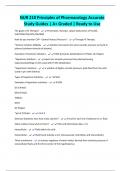
NUR 210 Principles of Pharmacology Accurate
Study Guides | A+ Graded | Ready to Use
The goals of IV Therapy? - Promotote, maintain, rplace body stores of FLUIDS,
ELECTROLYTES,FATS,CALORIES
How do you monitor CVP---Central Venous Pressure? - Through IV Therapy
*Isotonic Solution (EQUAL) - Solution that eexrts the same osmotic pressure as found in
plasma (solutions=tonicity of plasma)
Examples of Isontonic Solutions - D5W (prevents dehydration), 0.9 NaCl, LR, Ringers
*Hypotonic Solutions - exerts less osmotic pressure than plasma/causing
expansion(swelling) of cells used with Pt W/ dehydration.
*Hypertonic Solutions - a solution of higher osmotic pressure; pulls fluid from the cells.
(used in pt's with Edema)
Types of Hypotonic Solutions - .45 NaCl
Examples of hypertonic solutions - D10W
D5 0.9 NaCl
D50.45 NaCl
3%NaCl
D5LR
D5 Ringers
*pH of IV fluids - 3.4-6.2
Dextrose Solutions have how many calories? - 34 cal for each 1% of dextrose in a L fluid
Saline soltions have what in them? - H2O and Electrolytes (Na+, Cl-)
Intracellular - Fluid within the cells
Extracellular - fluid found outside a cell. (intravascular, interstitial, and transcellular)
Thirst mechanism - primary regulator of water intake; derived from osmotic pressure of
extracellular fluids and the thirst center of the hypothalamus
, Antidiuretic hormone (ADH) - influences the absorption of water by kidney tubules and
controls how much fluid leaves the body in the urine.
Aldosterone & Atrial Natriuretic peptide (ANP) - Regulate reabsorbtion of water and
sodium.
Diffusion - the process by which sub move stances from an area of higher concentration
to an area of lower concentration (EX: Lasix moves fluids out of the body, O2 leaving arteries
going in to capillaries)
Filteration - Movement of H2O & other smaller molocules through a semipermiable
membrane
Osmosis - diffusion of H2O of water from lower concentration to higher concentration.
Early signs and symptoms of dehydration - Thirst, poor skin, weight loss, weakness, C/O
dizzininess, postural hypotension, decrease urine output.
Thisrt is a late sign of what in an eldery adult? - Dehydration
Late signs and symptoms of dehydration. - Dark concentrated urine, dry cracked
lips/toungue, dry MM, thick saliva, dry scaly skin, flat neck veins, rapid, weak/thready pulse,
elevated temp > 100.6, increased HCT & BUN, high urine specific gravity w/ low volume (kidney
attempts to conserve water)
What is the most accuarate measure of fluid gain or loss for any age? - weight change
(2.2 lbs is the cue)
Fluid volume Excess Causes - poorly controlled IV Fluids, excessive intake of fluids,
excesssive irragation of body cavity, renal failure, heart failure.
Overhydration Signs and symptoms - WEIGHT GAIN, EDEMA, FIRM SUBCUTANEOUS
TISSUE, CRACKLES IN LUNGS, lethargy, JVD, decreased sodium, decreased HCT, Low urine
specific gravity, SLOW BOUNDING PULSE, ELEVATED BP
Treatment for overhydration - Elevate HOB (High Fowlers), O2 as Rx'd, Lasix as Rx'd by
MD, Fluid restriction, 2mg Na Diet, I/O monitoring, Assess for edema and weight gain.
Cations (+) - ions that carry a positive charge and include sodium (Na+), potassium (K+),
calcium (Ca++), and magnesium (Mg++)
Anions (-) - ions carrying a negative charge and include chloride, bicarbonate, phosphate,
and sulfate
Study Guides | A+ Graded | Ready to Use
The goals of IV Therapy? - Promotote, maintain, rplace body stores of FLUIDS,
ELECTROLYTES,FATS,CALORIES
How do you monitor CVP---Central Venous Pressure? - Through IV Therapy
*Isotonic Solution (EQUAL) - Solution that eexrts the same osmotic pressure as found in
plasma (solutions=tonicity of plasma)
Examples of Isontonic Solutions - D5W (prevents dehydration), 0.9 NaCl, LR, Ringers
*Hypotonic Solutions - exerts less osmotic pressure than plasma/causing
expansion(swelling) of cells used with Pt W/ dehydration.
*Hypertonic Solutions - a solution of higher osmotic pressure; pulls fluid from the cells.
(used in pt's with Edema)
Types of Hypotonic Solutions - .45 NaCl
Examples of hypertonic solutions - D10W
D5 0.9 NaCl
D50.45 NaCl
3%NaCl
D5LR
D5 Ringers
*pH of IV fluids - 3.4-6.2
Dextrose Solutions have how many calories? - 34 cal for each 1% of dextrose in a L fluid
Saline soltions have what in them? - H2O and Electrolytes (Na+, Cl-)
Intracellular - Fluid within the cells
Extracellular - fluid found outside a cell. (intravascular, interstitial, and transcellular)
Thirst mechanism - primary regulator of water intake; derived from osmotic pressure of
extracellular fluids and the thirst center of the hypothalamus
, Antidiuretic hormone (ADH) - influences the absorption of water by kidney tubules and
controls how much fluid leaves the body in the urine.
Aldosterone & Atrial Natriuretic peptide (ANP) - Regulate reabsorbtion of water and
sodium.
Diffusion - the process by which sub move stances from an area of higher concentration
to an area of lower concentration (EX: Lasix moves fluids out of the body, O2 leaving arteries
going in to capillaries)
Filteration - Movement of H2O & other smaller molocules through a semipermiable
membrane
Osmosis - diffusion of H2O of water from lower concentration to higher concentration.
Early signs and symptoms of dehydration - Thirst, poor skin, weight loss, weakness, C/O
dizzininess, postural hypotension, decrease urine output.
Thisrt is a late sign of what in an eldery adult? - Dehydration
Late signs and symptoms of dehydration. - Dark concentrated urine, dry cracked
lips/toungue, dry MM, thick saliva, dry scaly skin, flat neck veins, rapid, weak/thready pulse,
elevated temp > 100.6, increased HCT & BUN, high urine specific gravity w/ low volume (kidney
attempts to conserve water)
What is the most accuarate measure of fluid gain or loss for any age? - weight change
(2.2 lbs is the cue)
Fluid volume Excess Causes - poorly controlled IV Fluids, excessive intake of fluids,
excesssive irragation of body cavity, renal failure, heart failure.
Overhydration Signs and symptoms - WEIGHT GAIN, EDEMA, FIRM SUBCUTANEOUS
TISSUE, CRACKLES IN LUNGS, lethargy, JVD, decreased sodium, decreased HCT, Low urine
specific gravity, SLOW BOUNDING PULSE, ELEVATED BP
Treatment for overhydration - Elevate HOB (High Fowlers), O2 as Rx'd, Lasix as Rx'd by
MD, Fluid restriction, 2mg Na Diet, I/O monitoring, Assess for edema and weight gain.
Cations (+) - ions that carry a positive charge and include sodium (Na+), potassium (K+),
calcium (Ca++), and magnesium (Mg++)
Anions (-) - ions carrying a negative charge and include chloride, bicarbonate, phosphate,
and sulfate