

L2: Cleavage to Gastrulation
EMBRYOLOGY
NOTES
L2.docx EMBRYOLOGY%20L2%20PART%202.docx
CLASS
LECTURE
MODE
Completed
What is cleavage?
Series of rapid cell division, without growth in embryo size, that divides the
embryo up into numerous small cells.
What are the two types of cleavage?
Holoblastic- Complete cleavage that happens in mammals and amphibians.
L2: Cleavage to Gastrulation 1
, Meroblastic- Incomplete cleavage that happens in fish, reptiles and insects.
What is required during holoblastic cleavage?
Absence of a large concentration of yolk.
What happens during holoblastic cleavage?
Cleavage plans pass all the way through zygotes during cytokinesis.
First cleavage occurs along the vegetal-animal axis of the egg.
The second cleavage is perpendicular to the first.
What is formed at the end of cleavage?
The blastocyst/blastomere. Spacial arrangement of these structures follow
various patterns due to different cleavage planes in organisms.
What is meroblastic cleavage?
Where cleavage cannot go all the way through due to large amount of yolk.
What is a syncytium?
An egg with multiple nuclei.
What are the two different types of meroblastic cleavage?
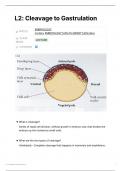
1. Discoidal: The embryo forms a disc of cells known as the blastodisc-
that sits on top of the yolk. This happens in fish and chick embryo.
2. Superficial: Mitosis occurs but not cytokinesis. We have a polynuclear
cell. The nuclei migrate to the periphery of the cell which causes a
L2: Cleavage to Gastrulation 2
, gradient of genes being expressed in different areas of the cell.
(Syncytium).
What is the 16-32 cell stage known as?
Morula. The Morula turns into a blastocyst which is then implanted into the
uterus.
What are the two main components of a blastocyst?
Inner cell mass: Where the embryo develops (where cells are)
Trophoblast: Where non embryonic tissue is formed, such as the placenta
(hollow area)
When does cleavage start in humans?
When the fertilised egg passes from the ovary into the oviduct.
What is gastrulation?
Rearrangment of cells by migration and division, resulting in the formation
of the 3 embryonic germ layers: ectoderm, mesoderm and endoderm.
What are the 3 germ layers and what do they give rise to?
Ectoderm:
Neural tissue, epidermis (skin).
Mesoderm:
Somites, Notochord, intermidate mesoderm, lateral plates.
L2: Cleavage to Gastrulation 3
, Endoderm:
Respiratory tract, digestive tract.
What are maternal determiniants?
mRNA proteins that are inherited from the mother that control early
patterning of cells up until the blastula stage in certain animals like the fly
and worm.
This means the fate of cells are already speicified.
These are only required during early patterning. By early division zygotic
signalling takes over.
What genes are required for cell specification?
Gene Coco is required for the specification of the ectoderm. (Animal)
Gene VegT is required for the specification of the mesoderm and
endoderm. (Vegetable)
Why do mammals not use maternal determinants?
Fate of cells is not initially specified.
What is zygotic sygnalling?
Cell patterning that occurs from transcription right after fertilisation.
What does moving cells in mammals do during early stages of
development?
Moving cells alters fate which means that the cell is not yet specified.
L2: Cleavage to Gastrulation 4
EMBRYOLOGY
NOTES
L2.docx EMBRYOLOGY%20L2%20PART%202.docx
CLASS
LECTURE
MODE
Completed
What is cleavage?
Series of rapid cell division, without growth in embryo size, that divides the
embryo up into numerous small cells.
What are the two types of cleavage?
Holoblastic- Complete cleavage that happens in mammals and amphibians.
L2: Cleavage to Gastrulation 1
, Meroblastic- Incomplete cleavage that happens in fish, reptiles and insects.
What is required during holoblastic cleavage?
Absence of a large concentration of yolk.
What happens during holoblastic cleavage?
Cleavage plans pass all the way through zygotes during cytokinesis.
First cleavage occurs along the vegetal-animal axis of the egg.
The second cleavage is perpendicular to the first.
What is formed at the end of cleavage?
The blastocyst/blastomere. Spacial arrangement of these structures follow
various patterns due to different cleavage planes in organisms.
What is meroblastic cleavage?
Where cleavage cannot go all the way through due to large amount of yolk.
What is a syncytium?
An egg with multiple nuclei.
What are the two different types of meroblastic cleavage?
1. Discoidal: The embryo forms a disc of cells known as the blastodisc-
that sits on top of the yolk. This happens in fish and chick embryo.
2. Superficial: Mitosis occurs but not cytokinesis. We have a polynuclear
cell. The nuclei migrate to the periphery of the cell which causes a
L2: Cleavage to Gastrulation 2
, gradient of genes being expressed in different areas of the cell.
(Syncytium).
What is the 16-32 cell stage known as?
Morula. The Morula turns into a blastocyst which is then implanted into the
uterus.
What are the two main components of a blastocyst?
Inner cell mass: Where the embryo develops (where cells are)
Trophoblast: Where non embryonic tissue is formed, such as the placenta
(hollow area)
When does cleavage start in humans?
When the fertilised egg passes from the ovary into the oviduct.
What is gastrulation?
Rearrangment of cells by migration and division, resulting in the formation
of the 3 embryonic germ layers: ectoderm, mesoderm and endoderm.
What are the 3 germ layers and what do they give rise to?
Ectoderm:
Neural tissue, epidermis (skin).
Mesoderm:
Somites, Notochord, intermidate mesoderm, lateral plates.
L2: Cleavage to Gastrulation 3
, Endoderm:
Respiratory tract, digestive tract.
What are maternal determiniants?
mRNA proteins that are inherited from the mother that control early
patterning of cells up until the blastula stage in certain animals like the fly
and worm.
This means the fate of cells are already speicified.
These are only required during early patterning. By early division zygotic
signalling takes over.
What genes are required for cell specification?
Gene Coco is required for the specification of the ectoderm. (Animal)
Gene VegT is required for the specification of the mesoderm and
endoderm. (Vegetable)
Why do mammals not use maternal determinants?
Fate of cells is not initially specified.
What is zygotic sygnalling?
Cell patterning that occurs from transcription right after fertilisation.
What does moving cells in mammals do during early stages of
development?
Moving cells alters fate which means that the cell is not yet specified.
L2: Cleavage to Gastrulation 4


