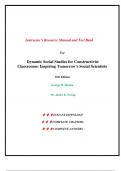
Instructor’s Resource Manual and Test Bank
For
Dynamic Social Studies for Constructivist Classrooms:
Inspiring Tomorrow's Social Scientists
11th Edition
George W. Maxim
@
Dr. Janice K. Ewing ,
Wichita State University
Te
st
Boston Columbus Indianapolis New York San Francisco Upper Saddle River
ba
Amsterdam Cape Town Dubai London Madrid Milan Munich Paris Montreal Toronto
Delhi Mexico City Sao Paulo Sydney Hong Kong Seoul Singapore Taipei Tokyo
nk
sm
af
ia
@Testbanksmafia
, Table of Contents
Chapter 1 Social Studies: The Subject You Will Teach 1
Chapter 2 Effective Instructional Planning 5
Chapter 3 Social Constructivism: Constructing Meaning via Collaborative Encounters 9
Chapter 4 Cognitive Constructivism: A Spotlight on Project-Based Learning 14
Chapter 5 Beyond the Ordinary: Teaching and Learning with Concrete Instructional
Resources 17
Chapter 6 Beyond the Ordinary: Teaching and Learning with Representational Instructional
Resources 21
Chapter 7 Beyond the Ordinary: Teaching and Learning with Informational and Persuasive
Text 24
@
Chapter 8 Beyond the Ordinary: Teaching and Learning with Narrative Text 28
Chapter 9 Young Historians: Learning to Unlock the Past 31
Te
Chapter 10 Geography: Exploring the People-Place Connection 35
Chapter 11 Civics: Young Citizens in Action 39
Chapter 12 Economics: Thinking and Choosing Responsibly 43
st
Chapter 13 Sociology and Anthropology: Social Structures and Culture 46
ba
Test Bank 51
nk
sm
af
iii
Copyright © 2018, 2014, 2010 by Pearson Education, Inc. All Rights Reserved
ia
@Testbanksmafia
, Chapter 1
Social Studies: The Subject You Will Teach
Chapter Outline
I. Memories of Elementary School Social Studies
II. Attribute 1: Social Studies as a School Subject
A. Integrated Social Studies
B. Major Social Studies Goals
III. Attribute 2: The Origin, Erosion and Rebirth of Social Studies
A. Social Studies is Born
B. Social Studies in Decline
IV. Attribute 3: Instructional Practices That Promote and Support Learning
A. Powerful and Purposeful Social Studies Instruction
B. Constructivist Teaching Practices
V. Attribute 4: Democratic Classroom Communities
A. A Democratic Classroom
VI. A Final Thought
VII. References
Chapter 1: The Subject You Will Teach models a constructivist approach, asking students to first reflect on the
qualities of a good social studies teacher, using a fourth grade learning adventure. Next, students consider the
question, What Do You Remember about Social Studies? and identify the best and the worst social studies
elementary experiences. Through these two reflective tasks, students review classroom examples and consider the
context and policies as well as the dilemmas and opportunities facing them as social studies teachers.
@
Chapter Overview
Attribute 1: Social Studies as a School Subject
Te
A social science is any of several disciplines that examine how people interact and develop as societies.
Six major social sciences
These contribute to the backbone of elementary social studies programs: geography, history, civics
(political science), anthropology, sociology, and economics.
st
The Goals of Elementary School Social Studies
The overriding purpose of social studies is to ready students for the most important duty they will have as
ba
adults, what Thomas Jefferson called the “office of citizen” with civic competence as a central aim. The
NCSS Task Force on Early Childhood/Elementary Social Studies (1989) suggests that the traditional
skills of reading, writing, and computing are necessary but insufficient to help young citizens to
participate in a complex world. Social studies specialized goals help children accomplish what other
subjects cannot help them achieve. The task force recommended essential goals be divided into three broad
nk
areas:
Knowledge-The knowledge base should include rich, accurate information across the social
sciences
Skills-Map and globe skills are primary to social studies. Other skills including communication
skills are also shared with other parts of the curriculum.
sm
Values and Beliefs-The early years are ideal for children to understand core civic
principles, particularly in terms of smaller social entities such as the family, classroom,
and community along with positive attitudes toward learning and a spirit of inquiry.
Attribute 2: The Origin, Erosion and Rebirth of Social Studies
af
1
Copyright © 2018, 2014, 2010 by Pearson Education, Inc. All Rights Reserved
ia
@Testbanksmafia
, At the beginning of the 20th century American schools focused on ensuring that immigrant children were exposed to
“American customs, standards of behavior, and morals.” The National Education Association (NEA) proposed a
new school subject called social studies.
Social Studies is Born
The Progressive Social Studies Curriculum. This curriculum grew out of the progressive
movement work of John Dewey (1896). Lucy Sprague Mitchell’s (1934) “Here-and-Now” social
studies curriculum began with children’s experiences and built on the natural progression of
children’s understandings.
The Expanding Environments Approach. This is the basic structure commonly organizing
elementary social studies, dominating it for over 50 years. Paul Hanna (1963) conceived the
“Expanding Communities” format, building on Mitchell’s work, presenting content as a series of
concentric circles starting with the self at the center and progressing to the family, school,
neighborhood until reaching the international community. In the mid 1980’s the approach was
criticized as being redundant and in 2009, a NCSS position statement referred to the curriculum as
“insufficient for today’s young learners”; however, it remains in frequent use.
The Spiral Curriculum. Introduced by Jerome S. Bruner (1966) as a pattern where students return
to key topics introduced in earlier grades throughout the curriculum with greater depth and
difficulty. Key concepts such as culture, heritage, authority, interdependence, and scarcity are
selected for their ability to synthesize a large amount of information and ease of use on different
levels of complexity or abstraction. A dynamic social studies curriculum, expanding or spiral, is
consistent, cumulative, and enriched at each level.
Social Studies in Decline
@
Social studies curriculum came under heavy criticism during the 1980’s with the publication of A Nation at
Risk. For social studies in particular, standardized test results indicated America’s students did not have the
knowledge to make decisions. In response, some argued social studies move “back to the basics” and teach
essential elements of lasting knowledge.
Te
NCSS National Curriculum Standards. The NCSS Standards, revised in 2010, focus on 10 themes
that constitute the organizing strands that should thread through social studies programs from pre-
K through grade 12.
st
Individual Discipline and State Standards. Individual states and most of the individual social
sciences (history, geography, civics, economics) have also created standards to present a
consistent understanding of what students are expected to learn or be able to do.
ba
No Child Left Behind (NCLB). With an increased focus on reading and mathematics, social
studies was frequently viewed as a non-essential subject. The rebirth of social students came with
the Common Core Standards and the release of the NCSS (2013) College, Career and Civic Life
Framework (C3). Using an interdisciplinary lens, NCSS introduced the concept of an “inquiry arc”
as means of engaging students in the experiences that support their development of problem-
nk
solving and critical thinking as well as other skills needed for active citizens in the 21 st century..
Attribute 3: Instructional Practices That Promote and Support Learning
Social studies must be delivered in a developmentally appropriate way during the elementary years. This mission,
sm
referred to throughout the text as dynamic social studies, encourages young students to discover the young social
scientists within themselves. Children are curious about their world and seek answers to their questions in order to
obtain knowledge about their social environment.
Powerful and Purposeful Social Studies Instruction.
The NCSS position statements provide guidelines for engaging students and encouraging them to connect
af
what they learn to authentic situations. This means instruction should be:
2
Copyright © 2018, 2014, 2010 by Pearson Education, Inc. All Rights Reserved
ia
@Testbanksmafia
For
Dynamic Social Studies for Constructivist Classrooms:
Inspiring Tomorrow's Social Scientists
11th Edition
George W. Maxim
@
Dr. Janice K. Ewing ,
Wichita State University
Te
st
Boston Columbus Indianapolis New York San Francisco Upper Saddle River
ba
Amsterdam Cape Town Dubai London Madrid Milan Munich Paris Montreal Toronto
Delhi Mexico City Sao Paulo Sydney Hong Kong Seoul Singapore Taipei Tokyo
nk
sm
af
ia
@Testbanksmafia
, Table of Contents
Chapter 1 Social Studies: The Subject You Will Teach 1
Chapter 2 Effective Instructional Planning 5
Chapter 3 Social Constructivism: Constructing Meaning via Collaborative Encounters 9
Chapter 4 Cognitive Constructivism: A Spotlight on Project-Based Learning 14
Chapter 5 Beyond the Ordinary: Teaching and Learning with Concrete Instructional
Resources 17
Chapter 6 Beyond the Ordinary: Teaching and Learning with Representational Instructional
Resources 21
Chapter 7 Beyond the Ordinary: Teaching and Learning with Informational and Persuasive
Text 24
@
Chapter 8 Beyond the Ordinary: Teaching and Learning with Narrative Text 28
Chapter 9 Young Historians: Learning to Unlock the Past 31
Te
Chapter 10 Geography: Exploring the People-Place Connection 35
Chapter 11 Civics: Young Citizens in Action 39
Chapter 12 Economics: Thinking and Choosing Responsibly 43
st
Chapter 13 Sociology and Anthropology: Social Structures and Culture 46
ba
Test Bank 51
nk
sm
af
iii
Copyright © 2018, 2014, 2010 by Pearson Education, Inc. All Rights Reserved
ia
@Testbanksmafia
, Chapter 1
Social Studies: The Subject You Will Teach
Chapter Outline
I. Memories of Elementary School Social Studies
II. Attribute 1: Social Studies as a School Subject
A. Integrated Social Studies
B. Major Social Studies Goals
III. Attribute 2: The Origin, Erosion and Rebirth of Social Studies
A. Social Studies is Born
B. Social Studies in Decline
IV. Attribute 3: Instructional Practices That Promote and Support Learning
A. Powerful and Purposeful Social Studies Instruction
B. Constructivist Teaching Practices
V. Attribute 4: Democratic Classroom Communities
A. A Democratic Classroom
VI. A Final Thought
VII. References
Chapter 1: The Subject You Will Teach models a constructivist approach, asking students to first reflect on the
qualities of a good social studies teacher, using a fourth grade learning adventure. Next, students consider the
question, What Do You Remember about Social Studies? and identify the best and the worst social studies
elementary experiences. Through these two reflective tasks, students review classroom examples and consider the
context and policies as well as the dilemmas and opportunities facing them as social studies teachers.
@
Chapter Overview
Attribute 1: Social Studies as a School Subject
Te
A social science is any of several disciplines that examine how people interact and develop as societies.
Six major social sciences
These contribute to the backbone of elementary social studies programs: geography, history, civics
(political science), anthropology, sociology, and economics.
st
The Goals of Elementary School Social Studies
The overriding purpose of social studies is to ready students for the most important duty they will have as
ba
adults, what Thomas Jefferson called the “office of citizen” with civic competence as a central aim. The
NCSS Task Force on Early Childhood/Elementary Social Studies (1989) suggests that the traditional
skills of reading, writing, and computing are necessary but insufficient to help young citizens to
participate in a complex world. Social studies specialized goals help children accomplish what other
subjects cannot help them achieve. The task force recommended essential goals be divided into three broad
nk
areas:
Knowledge-The knowledge base should include rich, accurate information across the social
sciences
Skills-Map and globe skills are primary to social studies. Other skills including communication
skills are also shared with other parts of the curriculum.
sm
Values and Beliefs-The early years are ideal for children to understand core civic
principles, particularly in terms of smaller social entities such as the family, classroom,
and community along with positive attitudes toward learning and a spirit of inquiry.
Attribute 2: The Origin, Erosion and Rebirth of Social Studies
af
1
Copyright © 2018, 2014, 2010 by Pearson Education, Inc. All Rights Reserved
ia
@Testbanksmafia
, At the beginning of the 20th century American schools focused on ensuring that immigrant children were exposed to
“American customs, standards of behavior, and morals.” The National Education Association (NEA) proposed a
new school subject called social studies.
Social Studies is Born
The Progressive Social Studies Curriculum. This curriculum grew out of the progressive
movement work of John Dewey (1896). Lucy Sprague Mitchell’s (1934) “Here-and-Now” social
studies curriculum began with children’s experiences and built on the natural progression of
children’s understandings.
The Expanding Environments Approach. This is the basic structure commonly organizing
elementary social studies, dominating it for over 50 years. Paul Hanna (1963) conceived the
“Expanding Communities” format, building on Mitchell’s work, presenting content as a series of
concentric circles starting with the self at the center and progressing to the family, school,
neighborhood until reaching the international community. In the mid 1980’s the approach was
criticized as being redundant and in 2009, a NCSS position statement referred to the curriculum as
“insufficient for today’s young learners”; however, it remains in frequent use.
The Spiral Curriculum. Introduced by Jerome S. Bruner (1966) as a pattern where students return
to key topics introduced in earlier grades throughout the curriculum with greater depth and
difficulty. Key concepts such as culture, heritage, authority, interdependence, and scarcity are
selected for their ability to synthesize a large amount of information and ease of use on different
levels of complexity or abstraction. A dynamic social studies curriculum, expanding or spiral, is
consistent, cumulative, and enriched at each level.
Social Studies in Decline
@
Social studies curriculum came under heavy criticism during the 1980’s with the publication of A Nation at
Risk. For social studies in particular, standardized test results indicated America’s students did not have the
knowledge to make decisions. In response, some argued social studies move “back to the basics” and teach
essential elements of lasting knowledge.
Te
NCSS National Curriculum Standards. The NCSS Standards, revised in 2010, focus on 10 themes
that constitute the organizing strands that should thread through social studies programs from pre-
K through grade 12.
st
Individual Discipline and State Standards. Individual states and most of the individual social
sciences (history, geography, civics, economics) have also created standards to present a
consistent understanding of what students are expected to learn or be able to do.
ba
No Child Left Behind (NCLB). With an increased focus on reading and mathematics, social
studies was frequently viewed as a non-essential subject. The rebirth of social students came with
the Common Core Standards and the release of the NCSS (2013) College, Career and Civic Life
Framework (C3). Using an interdisciplinary lens, NCSS introduced the concept of an “inquiry arc”
as means of engaging students in the experiences that support their development of problem-
nk
solving and critical thinking as well as other skills needed for active citizens in the 21 st century..
Attribute 3: Instructional Practices That Promote and Support Learning
Social studies must be delivered in a developmentally appropriate way during the elementary years. This mission,
sm
referred to throughout the text as dynamic social studies, encourages young students to discover the young social
scientists within themselves. Children are curious about their world and seek answers to their questions in order to
obtain knowledge about their social environment.
Powerful and Purposeful Social Studies Instruction.
The NCSS position statements provide guidelines for engaging students and encouraging them to connect
af
what they learn to authentic situations. This means instruction should be:
2
Copyright © 2018, 2014, 2010 by Pearson Education, Inc. All Rights Reserved
ia
@Testbanksmafia