100% satisfaction guarantee Immediately available after payment Both online and in PDF No strings attached 4.6 TrustPilot
logo-home
Exam (elaborations)

BIOD 171- Exam 2 100% Correct Answers Save

Rating
-
Sold
-
Pages
3
Grade
A+
Uploaded on
26-05-2025
Written in
2024/2025

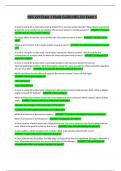
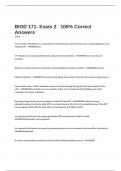
True or False: Metabolism is a controlled set of biochemical reactions that occur in living organisms in to maintain life - ANSWERSTrue T/F: Enzymes are polysaccharides that catalyze chemical reactions - ANSWERSFalse (enzymes are proteins) What are usually metal ions and assists enzyme during the catalysis reaction? - ANSWERSCofactors Define catabolism - ANSWERSThe process of breaking down larger molecules into useful energy sources. Upon cellular injury, which metabolic process is involved during the growth and repair phases of the cell? - ANSWERSThe anabolic process would be active as it is involved in the building up of small complexes into larger complexes Describe energy transfer process relative to both ATP and ADP - ANSWERSATP has the energy (phosphate group) to donate while ADP can accept energy in the form of a phosphate group. Thus ATP can be reduced (ATP-ADP+Pi) while ADP can be built into ATP (ADP+Pi-ATP) An organism that derives its energy (generates ATP) from photons of light is called - ANSWERSPhototrophic microorganism An organism that derives its energy by removing electrons from elemental sulfur would be classified as - ANSWERSLithotroph A reactive intermediate would be present in which phosphorylation process - ANSWERS? The chemical compound losing the phosphate group is referred to as the - ANSWERSphosphorylated reactive intermediate The catabolism of a single molecule of glucose goes through what 3 distinct transitions - ANSWERSGlycolysis, Fermentation or Respiration, then the ETC- electron transport chain What is the most energetic transition in the catabolism of glucose? - ANSWERSThe electron transport chain yields 34 ATP while both glycolysis and fermentation (or respiration) each yield only 2 ATP Identify the reactants of the following chemical equation: Glucose + 2NAD+ -> 2 NADH + 2 Pyruvate + 2ATP - ANSWERSThe reactants are to the left of the arrow: Glucose and 2NAD+ The presence of what molecule 'signals' to the cell that glycolysis is about to start? - ANSWERSGlucose-6-phosphate (G6P) T/F: In absence of oxygen fermentation produces only 2 ATP - ANSWERSFalse. Fermentation only reduces NADH back to NAD+ What is the primary byproduct of the TCA cycle? - ANSWERSC and D- TCA cycle produces an abundance of reduces electron carriers (NADH and FADH2) T/F: The reactants of the TCA cycle directly enter and fuel the electron transport system - ANSWERSFalse. The products of the TCA cycle (reduced electron carriers) enter and drive the production of ATP via the electron transport system. In the absence of glucose, which of the following can be used as alternative energy sources? Select all that apply - ANSWERSLactose, Carbohydrates, Lipids For the catabolism of proteins and lipids, which of the following enzymes are used? - ANSWERSProteases and Lipases, proteases breakdown proteins while lipases breakdown lipids. T/F- The B-oxidation pathway catabolizes the fatty acid chains of lipids - ANSWERSTrue Describe the relationship between chloroplasts and chlorophyll - ANSWERSBoth chloroplasts and chlorophyll are associated with photosynthesis. Chloroplasts are the double membrane-enclosed organelles that contain the photosynthetic pigment chlorophyll. T/F- Chloroplasts are specific to algae and plants - ANSWERSTrue The process of photophosphorylation produces which of the following: - ANSWERSATP, NADPH In phosphorylation, the light reactions always occur where? - ANSWERSThe process of converting light energy into chemical energy (photophosphorylation) always occurs in the membrane. T/F- The Calvin cycle must occur in the absence of light - ANSWERSFalse: the term "dark reactions" (also known as the Calvin Cycle) simply denotes the second stage in photosynthesis- dark reactions do not actually require darkness in order to occur. How many turns (or repetitions) of the Calvin Cycle are required to generate one molecule of glucose? - ANSWERSSix Complete the following equation by placing the appropriate numbers where indicated: __C02+ __ATP+ __NADPH+ __H2O -> __C6H12O6 + __ADP+ __NADP+ - ANSWERS6 C02+ 18 ATP+ 12 NADPH+ 12 H2O -> C6H12O6 + 18 ADP+ 12 NADP+ Match the following reactions to its corresponding enzyme - ANSWERS1D= A-B+H2O -> A-OH + B-H: Hydrolases 2F= A-B -> B-A: Isomerases 3E= A+B -> A-B: Ligases 4A= A-B -> A+B: Lyases

Show more Read less
Institution
Biod
Course
Biod


Whoops! We can’t load your doc right now. Try again or contact support.

Written for

Institution
Biod
Course
Biod

Document information

Uploaded on
May 26, 2025
Number of pages
3
Written in
2024/2025
Type
Exam (elaborations)
Contains
Questions & answers

Subjects

Content preview

BIOD 171- Exam 2 100% Correct
Answers
Save

True or False: Metabolism is a controlled set of biochemical reactions that occur in living organisms in to
maintain life - ANSWERSTrue


T/F: Enzymes are polysaccharides that catalyze chemical reactions - ANSWERSFalse (enzymes are
proteins)


What are usually metal ions and assists enzyme during the catalysis reaction? - ANSWERSCofactors


Define catabolism - ANSWERSThe process of breaking down larger molecules into useful energy sources.


Upon cellular injury, which metabolic process is involved during the growth and repair phases of the
cell? - ANSWERSThe anabolic process would be active as it is involved in the building up of small
complexes into larger complexes


Describe energy transfer process relative to both ATP and ADP - ANSWERSATP has the energy
(phosphate group) to donate while ADP can accept energy in the form of a phosphate group. Thus ATP
can be reduced (ATP-ADP+Pi) while ADP can be built into ATP (ADP+Pi-ATP)


An organism that derives its energy (generates ATP) from photons of light is called -
ANSWERSPhototrophic microorganism


An organism that derives its energy by removing electrons from elemental sulfur would be classified as -
ANSWERSLithotroph


A reactive intermediate would be present in which phosphorylation process - ANSWERS?
$15.99
Get access to the full document:

100% satisfaction guarantee
Immediately available after payment
Both online and in PDF
No strings attached

Get to know the seller
Seller avatar
paugrades1479
2.0
(1)

Also available in package deal

Thumbnail
Package deal
A PACKAGE DEAL OF BIOD 171 EXAM DISTINCTION GUAranteed
-
9 2025
$ 143.91 More info

Get to know the seller

Seller avatar
paugrades1479 Nursing
View profile
Follow You need to be logged in order to follow users or courses
Sold
1
Member since
2 year
Number of followers
1
Documents
470
Last sold
2 year ago

2.0

1 reviews

5
0
4
0
3
0
2
1
1
0

Recently viewed by you

Why students choose Stuvia

Created by fellow students, verified by reviews

Quality you can trust: written by students who passed their tests and reviewed by others who've used these notes.

Didn't get what you expected? Choose another document

No worries! You can instantly pick a different document that better fits what you're looking for.

Pay as you like, start learning right away

No subscription, no commitments. Pay the way you're used to via credit card and download your PDF document instantly.

Student with book image

“Bought, downloaded, and aced it. It really can be that simple.”

Alisha Student

Frequently asked questions