lOMoAR cPSD| 56342273
Eating Disorder/Electrolyte Imbalances
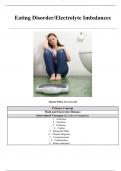
Mandy White, 16 years old
Primary Concept
Fluid and Electrolyte Balance
Interrelated Concepts (In order of emphasis)
1. Acid-base
2. Nutrition
3. Perfusion
4. Coping
5. Mood and Affect
6. Clinical Judgment
7. Communication
8. Collaboration
9. Patient education
, lOMoAR cPSD| 56342273
UNFOLDING Reasoning Case Study: STUDENT
Eating Disorder/Electrolyte Imbalances History
of Present Problem:
Mandy White is a 16-year-old adolescent who has struggled with anorexia nervosa since the age of 11. She admits to
drinking several large glasses of water daily. Mandy has also been recently engaging in self injurious behavior (SIB) of
cutting both forearms and thighs with broken glass, causing numerous lacerations and scars.
Mandy presents to the emergency department (ED) with increasing weakness, lightheadedness and a near syncopal
episode this evening. She admits to inducing vomiting after meals the past three weeks. She is 5’ 5” and weighs 83
lbs/37.7 kg (BMI 13.8). Mandy is reluctantly brought in by her mother and does not want to be treated. As the primary
nurse responsible for the care of Mandy, you overhear her say to her mother, “I hate everything about me! I am so tired
of living, I wish I were dead!”
Personal/Social History:
Mandy was sexually abused by her stepfather from the age of six to twelve. She confided what was taking place to her
mother and lives with her mother, who is now divorced. Mandy is sexually active and promiscuous. She uses the Tinder
app to meet older men for anonymous sexual encounters when her mother is working.
What data from the histories are RELEVANT and has clinical significance to the nurse?
RELEVANT Data from Present Problem: Clinical Significance:
RELEVANT Data from Social History: Clinical Significance:
What is the RELATIONSHIP of your patient’s past medical history (PMH) and current meds?
(Which medication treats which condition? Draw lines to connect.)
PMH: Home Meds: Pharm. Classification: Expected Outcome:
Anorexia nervosa Citalopram 20 mg PO daily
Depression
Self-injurious behavior (SIB)
Sexually abused as a child
What medications treat which conditions?
Draw a line to identify what illness is being managed by what medication?
, lOMoAR cPSD| 56342273
One disease process often influences the development of other illnesses. Based on your knowledge of
pathophysiology, (if applicable), which disease likely developed FIRST that created a “domino effect” in his/her
life? x Circle what PMH problem likely started FIRST.
x Underline what PMH problem(s) FOLLOWED as domino(s).
Patient Care Begins:
Current VS: P-Q-R-S-T Pain Assessment (5th VS):
T: 96.2 F/35.7 C (oral) Provoking/Palliative: Denies
P: 50 (regular) Quality:
R: 16 (regular) Region/Radiation:
BP: 86/44 MAP: 58 Severity:
O2 sat: 99% room air Timing:
Orthostatic BP’s
Position: HR: BP:
Lying 50 86/44
Standing 78 72/40
What VS data is RELEVANT and must be recognized as clinically significant by the nurse?
RELEVANT VS Data: Clinical Significance:
Current PHYSICAL Assessment:
RESP: Breath sounds clear with equal aeration bilaterally, non-labored respiratory effort
CARDIAC: Pale-pink, cool and dry, 2+ bilateral pitting edema of feet and ankles, heart sounds
regular with no abnormal beats, pulses weak, equal with palpation at
radial/pedal/post-tibial landmarks, cap refill <3 seconds
GI: Abdomen scaphoid, several 1 cm open ulcers present on oral mucosa that are also dry and
tacky, soft and tender to gentle palpation in epigastrium, bowel sounds hypoactive
and audible per auscultation in all four quadrants
GU: Voiding without difficulty, urine clear/dark amber, she has not had her menses the
past 6 months
SKIN: Numerous vertical old scars from SIB present on both forearms, has several recent
vertical lacerations that are partial thickness on her left forearm, hair on head is
thinning, skin is dry with lanugo body hair apparent on both arms.
What PHYSICAL assessment data is RELEVANT and must be recognized as clinically significant by the nurse?
RELEVANT Assessment Data: Clinical Significance:
Eating Disorder/Electrolyte Imbalances
Mandy White, 16 years old
Primary Concept
Fluid and Electrolyte Balance
Interrelated Concepts (In order of emphasis)
1. Acid-base
2. Nutrition
3. Perfusion
4. Coping
5. Mood and Affect
6. Clinical Judgment
7. Communication
8. Collaboration
9. Patient education
, lOMoAR cPSD| 56342273
UNFOLDING Reasoning Case Study: STUDENT
Eating Disorder/Electrolyte Imbalances History
of Present Problem:
Mandy White is a 16-year-old adolescent who has struggled with anorexia nervosa since the age of 11. She admits to
drinking several large glasses of water daily. Mandy has also been recently engaging in self injurious behavior (SIB) of
cutting both forearms and thighs with broken glass, causing numerous lacerations and scars.
Mandy presents to the emergency department (ED) with increasing weakness, lightheadedness and a near syncopal
episode this evening. She admits to inducing vomiting after meals the past three weeks. She is 5’ 5” and weighs 83
lbs/37.7 kg (BMI 13.8). Mandy is reluctantly brought in by her mother and does not want to be treated. As the primary
nurse responsible for the care of Mandy, you overhear her say to her mother, “I hate everything about me! I am so tired
of living, I wish I were dead!”
Personal/Social History:
Mandy was sexually abused by her stepfather from the age of six to twelve. She confided what was taking place to her
mother and lives with her mother, who is now divorced. Mandy is sexually active and promiscuous. She uses the Tinder
app to meet older men for anonymous sexual encounters when her mother is working.
What data from the histories are RELEVANT and has clinical significance to the nurse?
RELEVANT Data from Present Problem: Clinical Significance:
RELEVANT Data from Social History: Clinical Significance:
What is the RELATIONSHIP of your patient’s past medical history (PMH) and current meds?
(Which medication treats which condition? Draw lines to connect.)
PMH: Home Meds: Pharm. Classification: Expected Outcome:
Anorexia nervosa Citalopram 20 mg PO daily
Depression
Self-injurious behavior (SIB)
Sexually abused as a child
What medications treat which conditions?
Draw a line to identify what illness is being managed by what medication?
, lOMoAR cPSD| 56342273
One disease process often influences the development of other illnesses. Based on your knowledge of
pathophysiology, (if applicable), which disease likely developed FIRST that created a “domino effect” in his/her
life? x Circle what PMH problem likely started FIRST.
x Underline what PMH problem(s) FOLLOWED as domino(s).
Patient Care Begins:
Current VS: P-Q-R-S-T Pain Assessment (5th VS):
T: 96.2 F/35.7 C (oral) Provoking/Palliative: Denies
P: 50 (regular) Quality:
R: 16 (regular) Region/Radiation:
BP: 86/44 MAP: 58 Severity:
O2 sat: 99% room air Timing:
Orthostatic BP’s
Position: HR: BP:
Lying 50 86/44
Standing 78 72/40
What VS data is RELEVANT and must be recognized as clinically significant by the nurse?
RELEVANT VS Data: Clinical Significance:
Current PHYSICAL Assessment:
RESP: Breath sounds clear with equal aeration bilaterally, non-labored respiratory effort
CARDIAC: Pale-pink, cool and dry, 2+ bilateral pitting edema of feet and ankles, heart sounds
regular with no abnormal beats, pulses weak, equal with palpation at
radial/pedal/post-tibial landmarks, cap refill <3 seconds
GI: Abdomen scaphoid, several 1 cm open ulcers present on oral mucosa that are also dry and
tacky, soft and tender to gentle palpation in epigastrium, bowel sounds hypoactive
and audible per auscultation in all four quadrants
GU: Voiding without difficulty, urine clear/dark amber, she has not had her menses the
past 6 months
SKIN: Numerous vertical old scars from SIB present on both forearms, has several recent
vertical lacerations that are partial thickness on her left forearm, hair on head is
thinning, skin is dry with lanugo body hair apparent on both arms.
What PHYSICAL assessment data is RELEVANT and must be recognized as clinically significant by the nurse?
RELEVANT Assessment Data: Clinical Significance: