[
]
0.0.00.2em
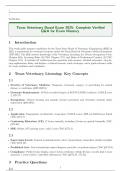
Texas Veterinary Board Exam 2025: Complete Verified
Q&A for Exam Mastery
1 Introduction
This study guide prepares candidates for the Texas State Board of Veterinary Examination (SBE) in
2025, a requirement for veterinary licensure under the Texas Board of Veterinary Medical Examiners
(TBVME). The SBE assesses knowledge of the Veterinary Licensing Act (Texas Occupations Code,
Chapter 801), Licensing Rules (22 TAC Chapter 571), and Rules of Professional Conduct (22 TAC
Chapter 573). It includes 50 verified practice questions with answers, detailed rationales, step-by-
step explanations, hints, and helpers, a clinical scenario, study strategies, and a quick-reference table
for exam readiness and compliance.
2 Texas Veterinary Licensing: Key Concepts
2.1
• Practice of Veterinary Medicine: Diagnosis, treatment, surgery, or prescribing for animal
disease or conditions (ğ801.002(5)).
• Licensure Requirements: AVMA-accredited degree or ECFVG/PAVE certificate, NAVLE score
≥ 425 (75
• Exemptions: Owners treating own animals (except castration) and veterinary students under
supervision (ğ801.004).
2.2
• Application: Fingerprints via IdentoGo, transcripts, NAVLE scores, SBE via Self-Service Portal
(TAC ğ571.7).
• Continuing Education (CE): 17 hours annually, including 2 hours on opioids biennially (TAC
ğ573.64).
• SBE: Online, 85% passing score, valid 1 year (TAC ğ571.3).
2.3
• Supervision Levels: General (communication), direct (on-premises), immediate (within eyesight)
(TAC ğ573.10).
• Prohibited Acts: Non-veterinarians cannot diagnose, prescribe, or perform surgery (TAC ğ573.19).
• Compliance: Public license display, report stolen certificates within 30 days, records kept 3 years
(general), 5 years (rabies, controlled substances) (TAC ğğ573.35, 573.52).
3 Practice Questions
1
3.1
, b) Analyze options: Fecal flotation is a diagnostic test; others are non-medical.
c) Confirm: Only fecal flotation fits the legal definition.
Hint: Focus on diagnostic or medical procedures.
Helper: See ğ801.002(5) on TBVMEs website.
3.2
What supervision is required for a technician to administer a prescribed subcutaneous fluid?
a) General supervision
b) Direct supervision
c) Immediate supervision
d) No supervision
Answer: b) Direct supervision
Rationale supervision: TAC ğ573.10 mandates direct supervision (veterinarian on premises) for
administering subcutaneous fluids due to potential complications. Immediate supervision is for high-
risk tasks like anesthesia; general supervision is for communication only.
Step-by-Step Explanation:
• Review TAC ğ573.10: Defines supervision levels for technician tasks.
• Assess subcutaneous fluids: Involves fluid administration, requiring oversight for safety.
• Eliminate: General supervision is too lax; immediate supervision is excessive.
Hint: Consider the procedures medical risk.
Helper: See TAC ğ573.10 on TBVMEs website.
3.3
What is the SBEs minimum passing score and validity period?
a) 75%, 6 months
b) 85%, 1 year
c) 75%, 1 year
d) 85%, 2 years
Answer: b) 85%, 1 year
Rationale: TAC ğ571.3 requires an 85% SBE passing score, valid for 1 year. The NAVLE requires
75% (425).
Step-by-Step Explanation:
a) Check TAC ğ571.3: SBE requires 85% and 1-year validity.
b) Compare NAVLE: 75% is lower than SBEs standard.
c) Eliminate: 75% or 2 years are incorrect for SBE.
Hint: SBE has stricter criteria than NAVLE.
Helper: Check TAC ğ571.3 on TBVMEs website.
2
]
0.0.00.2em
Texas Veterinary Board Exam 2025: Complete Verified
Q&A for Exam Mastery
1 Introduction
This study guide prepares candidates for the Texas State Board of Veterinary Examination (SBE) in
2025, a requirement for veterinary licensure under the Texas Board of Veterinary Medical Examiners
(TBVME). The SBE assesses knowledge of the Veterinary Licensing Act (Texas Occupations Code,
Chapter 801), Licensing Rules (22 TAC Chapter 571), and Rules of Professional Conduct (22 TAC
Chapter 573). It includes 50 verified practice questions with answers, detailed rationales, step-by-
step explanations, hints, and helpers, a clinical scenario, study strategies, and a quick-reference table
for exam readiness and compliance.
2 Texas Veterinary Licensing: Key Concepts
2.1
• Practice of Veterinary Medicine: Diagnosis, treatment, surgery, or prescribing for animal
disease or conditions (ğ801.002(5)).
• Licensure Requirements: AVMA-accredited degree or ECFVG/PAVE certificate, NAVLE score
≥ 425 (75
• Exemptions: Owners treating own animals (except castration) and veterinary students under
supervision (ğ801.004).
2.2
• Application: Fingerprints via IdentoGo, transcripts, NAVLE scores, SBE via Self-Service Portal
(TAC ğ571.7).
• Continuing Education (CE): 17 hours annually, including 2 hours on opioids biennially (TAC
ğ573.64).
• SBE: Online, 85% passing score, valid 1 year (TAC ğ571.3).
2.3
• Supervision Levels: General (communication), direct (on-premises), immediate (within eyesight)
(TAC ğ573.10).
• Prohibited Acts: Non-veterinarians cannot diagnose, prescribe, or perform surgery (TAC ğ573.19).
• Compliance: Public license display, report stolen certificates within 30 days, records kept 3 years
(general), 5 years (rabies, controlled substances) (TAC ğğ573.35, 573.52).
3 Practice Questions
1
3.1
, b) Analyze options: Fecal flotation is a diagnostic test; others are non-medical.
c) Confirm: Only fecal flotation fits the legal definition.
Hint: Focus on diagnostic or medical procedures.
Helper: See ğ801.002(5) on TBVMEs website.
3.2
What supervision is required for a technician to administer a prescribed subcutaneous fluid?
a) General supervision
b) Direct supervision
c) Immediate supervision
d) No supervision
Answer: b) Direct supervision
Rationale supervision: TAC ğ573.10 mandates direct supervision (veterinarian on premises) for
administering subcutaneous fluids due to potential complications. Immediate supervision is for high-
risk tasks like anesthesia; general supervision is for communication only.
Step-by-Step Explanation:
• Review TAC ğ573.10: Defines supervision levels for technician tasks.
• Assess subcutaneous fluids: Involves fluid administration, requiring oversight for safety.
• Eliminate: General supervision is too lax; immediate supervision is excessive.
Hint: Consider the procedures medical risk.
Helper: See TAC ğ573.10 on TBVMEs website.
3.3
What is the SBEs minimum passing score and validity period?
a) 75%, 6 months
b) 85%, 1 year
c) 75%, 1 year
d) 85%, 2 years
Answer: b) 85%, 1 year
Rationale: TAC ğ571.3 requires an 85% SBE passing score, valid for 1 year. The NAVLE requires
75% (425).
Step-by-Step Explanation:
a) Check TAC ğ571.3: SBE requires 85% and 1-year validity.
b) Compare NAVLE: 75% is lower than SBEs standard.
c) Eliminate: 75% or 2 years are incorrect for SBE.
Hint: SBE has stricter criteria than NAVLE.
Helper: Check TAC ğ571.3 on TBVMEs website.
2