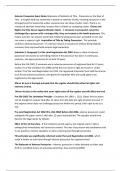
Adverse Possession Exam Notes Relevance of Relativity of Title - Possession as the Root of
Title - In English land law, ownership is based on relativity of title, meaning possession is the
strongest proof of ownership unless someone else can show a better claim. There is no
concept of absolute ownership; instead, title is relative to competing claims. Claims and
Rights Are Only Secure Against Weaker Claims - If someone in possession cannot be
challenged by a person with a stronger title, they are treated as the lawful possessor. This
means a person can acquire ownership simply by taking possession, provided no one else
can prove a superior right. Acquisition of Title by Taking Possession - This principle
underlies adverse possession—if a person remains in possession without being lawfully
removed, they may eventually acquire legal ownership.
Schedule 3, Paragraph 2 of the Land Registration Act 2002 allows a claim of adverse
possession to become an overriding interest if the possessor has been in continuous,
exclusive, and open possession for at least 10 years.
Before the LRA 2002, if someone was in adverse possession of registered land for 12 years,
section 15 of the Limitation Act 1980 barred the true owner’s right to recover it. Under
section 75 of the Land Registration Act 1925, the registered proprietor then held the land on
trust for the adverse possessor, who gained an equitable title and could apply to be
registered as the legal owner.
Mirror de jure is the legal principle that the register should fully reflect all rights and
interests in land.
Mirror de facto is the reality that some rights exist off the register and still affect the land.
Pre LRA 2002 The Limitation Principle : Limitation Act 1980, s. 15(1): States that no action
can be brought to recover land after 12 years from the date the right of action accrued. If
the original owner does not challenge possession within this period, their right to do so is
lost.
Pre-Land Registration Act 2002 (Pre-LRA 2002) Before LRA 2002, adverse possession could
extinguish the paper owner’s title after 12 years automatically. The squatter would then
become the legal owner by default.
Effect of the 12-Year Rule - If the limitation period expires, the original owner’s title is
extinguished immediately and cannot be revived. This was a key reason why landowners had
to act quickly to remove squatters or others claiming land through possession.
This principle was significantly reformed under the Land Registration Act 2002, which
made it harder to claim land through adverse possession for registered land.
The Rationale of Adverse Possession - Adverse possession is often debated as either land
theft or a justified means of acquiring ownership. Gray and Gray (2009)
, Legal Certainty and Finality: Gray and Gray argue that adverse possession ensures stability by
recognizing long-term control over land, clearing disputes, and promoting efficient transfer
of property.
Social Utility and Land Use: They emphasize that adverse possession rewards those who put
land to valuable use, discouraging waste and ensuring land serves a social purpose.
Moral Considerations and Fault: The doctrine reflects a moral judgment that neglectful
owners deserve to lose rights, while active, responsible possessors should be rewarded.
Psychological Factors
Primal Territorial Instinct: Long-term possession of land creates a psychological sense of
ownership.
Demerit of the Original Owner: Adverse possession penalizes landowners who neglect their
property rather than rewarding trespassers.
Stabilisation and Certainty of Title
Certainty as a Social Need: Secure land titles are vital for purchasers, tenants, and mortgage
lenders. Without adverse possession, land might remain indefinitely abandoned.
Trade-Off Between Moral Right and Social Utility
Moral Argument: Some argue that taking land wrongfully should never create a legal right.
Social Utility Argument: Ensuring that land is used productively outweighs passive
ownership.
Social and Economic Engineering - Against Lazy Landowners: Law disfavors owners who fail
to monitor or defend their land.
Butler v Fairclough [1951] 1 KB 264 Facts: the claimant, Mr. Butler, occupied a strip of land
adjoining his own property under the mistaken belief that it formed part of his land. Relying
on that belief, he fenced the land, maintained it, and used it as part of his garden. His
occupation was continuous, exclusive, and open for a period exceeding 12 years. The true
owner, Mr. Fairclough, took no steps to challenge or interrupt this use during that time. After
the 12 years had passed, Fairclough attempted to assert ownership and recover the land.
Held: The Court of Appeal held that Butler had acquired title to the land by adverse
possession. The court ruled that a mistaken belief of ownership does not prevent a claim for
adverse possession from succeeding. Lord Goddard CJ explained that what matters is the
fact of possession, not the possessor’s knowledge or intention regarding ownership.
The Reality of Adverse Possession
Title - In English land law, ownership is based on relativity of title, meaning possession is the
strongest proof of ownership unless someone else can show a better claim. There is no
concept of absolute ownership; instead, title is relative to competing claims. Claims and
Rights Are Only Secure Against Weaker Claims - If someone in possession cannot be
challenged by a person with a stronger title, they are treated as the lawful possessor. This
means a person can acquire ownership simply by taking possession, provided no one else
can prove a superior right. Acquisition of Title by Taking Possession - This principle
underlies adverse possession—if a person remains in possession without being lawfully
removed, they may eventually acquire legal ownership.
Schedule 3, Paragraph 2 of the Land Registration Act 2002 allows a claim of adverse
possession to become an overriding interest if the possessor has been in continuous,
exclusive, and open possession for at least 10 years.
Before the LRA 2002, if someone was in adverse possession of registered land for 12 years,
section 15 of the Limitation Act 1980 barred the true owner’s right to recover it. Under
section 75 of the Land Registration Act 1925, the registered proprietor then held the land on
trust for the adverse possessor, who gained an equitable title and could apply to be
registered as the legal owner.
Mirror de jure is the legal principle that the register should fully reflect all rights and
interests in land.
Mirror de facto is the reality that some rights exist off the register and still affect the land.
Pre LRA 2002 The Limitation Principle : Limitation Act 1980, s. 15(1): States that no action
can be brought to recover land after 12 years from the date the right of action accrued. If
the original owner does not challenge possession within this period, their right to do so is
lost.
Pre-Land Registration Act 2002 (Pre-LRA 2002) Before LRA 2002, adverse possession could
extinguish the paper owner’s title after 12 years automatically. The squatter would then
become the legal owner by default.
Effect of the 12-Year Rule - If the limitation period expires, the original owner’s title is
extinguished immediately and cannot be revived. This was a key reason why landowners had
to act quickly to remove squatters or others claiming land through possession.
This principle was significantly reformed under the Land Registration Act 2002, which
made it harder to claim land through adverse possession for registered land.
The Rationale of Adverse Possession - Adverse possession is often debated as either land
theft or a justified means of acquiring ownership. Gray and Gray (2009)
, Legal Certainty and Finality: Gray and Gray argue that adverse possession ensures stability by
recognizing long-term control over land, clearing disputes, and promoting efficient transfer
of property.
Social Utility and Land Use: They emphasize that adverse possession rewards those who put
land to valuable use, discouraging waste and ensuring land serves a social purpose.
Moral Considerations and Fault: The doctrine reflects a moral judgment that neglectful
owners deserve to lose rights, while active, responsible possessors should be rewarded.
Psychological Factors
Primal Territorial Instinct: Long-term possession of land creates a psychological sense of
ownership.
Demerit of the Original Owner: Adverse possession penalizes landowners who neglect their
property rather than rewarding trespassers.
Stabilisation and Certainty of Title
Certainty as a Social Need: Secure land titles are vital for purchasers, tenants, and mortgage
lenders. Without adverse possession, land might remain indefinitely abandoned.
Trade-Off Between Moral Right and Social Utility
Moral Argument: Some argue that taking land wrongfully should never create a legal right.
Social Utility Argument: Ensuring that land is used productively outweighs passive
ownership.
Social and Economic Engineering - Against Lazy Landowners: Law disfavors owners who fail
to monitor or defend their land.
Butler v Fairclough [1951] 1 KB 264 Facts: the claimant, Mr. Butler, occupied a strip of land
adjoining his own property under the mistaken belief that it formed part of his land. Relying
on that belief, he fenced the land, maintained it, and used it as part of his garden. His
occupation was continuous, exclusive, and open for a period exceeding 12 years. The true
owner, Mr. Fairclough, took no steps to challenge or interrupt this use during that time. After
the 12 years had passed, Fairclough attempted to assert ownership and recover the land.
Held: The Court of Appeal held that Butler had acquired title to the land by adverse
possession. The court ruled that a mistaken belief of ownership does not prevent a claim for
adverse possession from succeeding. Lord Goddard CJ explained that what matters is the
fact of possession, not the possessor’s knowledge or intention regarding ownership.
The Reality of Adverse Possession