

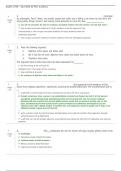
Exam 2 PHI - 103 Intro to Phil. & Ethics
✓ 1. Contempor
ary philosopher, Paul K. Moser, has recently argued that unless one is willing to be known by God which will,
Points
: 1/1
among other things, result in God making moral demands on one’s life, then .
one will not encounter the kind of conclusive perceptual evidence that will convince one that God exists ✓
one can get conclusive evidence for God’s existence from the argument from
consciousness one can get conclusive evidence for God’s existence from the
ontological argument
one can get conclusive evidence for God’s existence from the teleological argument
✓ 2. Read the following argument:
Points 1. Objective moral values and duties exist.
: 1/1
2. But if God did not exist, objective moral values and duties would not exist.
3. Therefore, God exists.
This argument aims to show that God is the best explanation for .
the fine-tuning of the universe for
intelligent life the origin of the universe
why anything at all exists
the existence of objective moral values and duties in the world ✓
✓ 3. One argument for the existence of God
Points comes from religious experience—specifically, receiving the transformative gift. The transformative gift is
: 1/1 .
a gift that is small enough to fit into a stocking but too big to fit into a coat pocket
through conscience, when a person is (a) authoritatively convicted and forgiven by God of all that person's
wrongdoing and (b) thereby being authoritatively called and led by God both into non-coerced volitional
fellowship with God in perfect love and into rightful worship toward God as worthy of worship and, on that
basis, transformed by God from (i) that person's previous tendencies to selfishness and despair to (ii) a new
volitional center with a default position of unselfish love and forgiveness toward all people and of hope in the
ultimate triumph of good over evil by God.
✓
when a person reads the top three best self-help books and is able to transform their approach towards
achieving goals more effectively
a gift that can only be brought about by a psychiatrist prescribing the right kind of medication and exercise
program
✓ 4. The emphasizes the role the human will plays towards getting certain kinds
Points of knowledge.
: 1/1
Perceptual model of belief formation
Volitional model of belief formation ✓
Memory model of belief formation
Testimonial model of belief formation
, ✓ 5.The problem of is trying to understand how descriptions of physical states in the brain can
Points capture the what- it's-like experiences in a subject's mind.
: 1/1
natural
evil qualia
✓ free
will
personal identity
✓ 1. Contempor
ary philosopher, Paul K. Moser, has recently argued that unless one is willing to be known by God which will,
Points
: 1/1
among other things, result in God making moral demands on one’s life, then .
one will not encounter the kind of conclusive perceptual evidence that will convince one that God exists ✓
one can get conclusive evidence for God’s existence from the argument from
consciousness one can get conclusive evidence for God’s existence from the
ontological argument
one can get conclusive evidence for God’s existence from the teleological argument
✓ 2. Read the following argument:
Points 1. Objective moral values and duties exist.
: 1/1
2. But if God did not exist, objective moral values and duties would not exist.
3. Therefore, God exists.
This argument aims to show that God is the best explanation for .
the fine-tuning of the universe for
intelligent life the origin of the universe
why anything at all exists
the existence of objective moral values and duties in the world ✓
✓ 3. One argument for the existence of God
Points comes from religious experience—specifically, receiving the transformative gift. The transformative gift is
: 1/1 .
a gift that is small enough to fit into a stocking but too big to fit into a coat pocket
through conscience, when a person is (a) authoritatively convicted and forgiven by God of all that person's
wrongdoing and (b) thereby being authoritatively called and led by God both into non-coerced volitional
fellowship with God in perfect love and into rightful worship toward God as worthy of worship and, on that
basis, transformed by God from (i) that person's previous tendencies to selfishness and despair to (ii) a new
volitional center with a default position of unselfish love and forgiveness toward all people and of hope in the
ultimate triumph of good over evil by God.
✓
when a person reads the top three best self-help books and is able to transform their approach towards
achieving goals more effectively
a gift that can only be brought about by a psychiatrist prescribing the right kind of medication and exercise
program
✓ 4. The emphasizes the role the human will plays towards getting certain kinds
Points of knowledge.
: 1/1
Perceptual model of belief formation
Volitional model of belief formation ✓
Memory model of belief formation
Testimonial model of belief formation
, ✓ 5.The problem of is trying to understand how descriptions of physical states in the brain can
Points capture the what- it's-like experiences in a subject's mind.
: 1/1
natural
evil qualia
✓ free
will
personal identity


