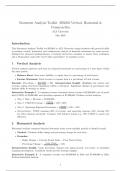
Statement Analysis Toolkit BS2203 Vertical, Horizontal &
Common-Size
ALX University
May 2025
Introduction
This Statement Analysis Toolkit for BS2203 at ALX University equips students with practical skills
to perform vertical, horizontal, and common-size analysis of financial statements for exam success.
Designed for advanced undergraduates, it includes interactive examples to master these techniques
and a 30-question exam with "secret hints and helpers" to maximize scores.
1 Vertical Analysis
Vertical analysis expresses each item in a financial statement as a percentage of a base figure within
the same period:
• Balance Sheet: Each asset, liability, or equity item is a percentage of total assets.
• Income Statement: Each revenue or expense item is a percentage of total revenue.
Value × 100. Interpretation Insight: Highlights the relative size
Item Value
Formula: Percentage = Base
of items, aiding structural comparison within a statement. Significant changes in percentages may
indicate shifts in strategy or issues.
Interactive Example 1: A companys income statement shows revenue of $5,000,000, cost of goods
sold (COGS) of $3,000,000, and operating expenses of $1,200,000. Perform vertical analysis.
• Step 1 : Base = Revenue = $5,000,000.
3,000,000
• Step 2 : COGS Percentage = 5,000,000 × 100 = 60%.
1,200,000
• Step 3 : Operating Expenses Percentage = 5,000,000 × 100 = 24%.
• Interpretation: COGS consumes 60% of revenue, and operating expenses 24%, leaving 16%
for other expenses and profit. Compare with industry norms (e.g., 50% COGS) to assess cost
efficiency.
2 Horizontal Analysis
Horizontal analysis compares financial statement items across multiple periods to identify trends:
• Method: Calculate dollar change and percentage change for each item.
• Formulas:
– Dollar Change = Current Period Value − Prior Period Value.
Dollar Change
– Percentage Change = Prior Period Value × 100.
Interpretation Insight: Large percentage changes may signal growth, cost issues, or anomalies
requiring investigation. Consistent trends provide strategic insights.
Interactive Example 2: A companys revenue was $4,000,000 in 2023 and $5,000,000 in 2024.
Perform horizontal analysis.
1
, BS2203 Financial Analysis ALX University
• Step 1 : Dollar Change = 5, 000, 000 − 4, 000, 000 = $1, 000, 000.
1,000,000
• Step 2 : Percentage Change = 4,000,000 × 100 = 25%.
• Interpretation: A 25% revenue increase suggests strong growth. Investigate sales drivers (e.g.,
volume, pricing) and compare with industry trends (e.g., 10% growth) to assess performance.
3 Common-Size Analysis
Common-size analysis standardizes financial statements as percentages to facilitate comparisons across
companies or periods:
• Balance Sheet: Items as percentages of total assets (same as vertical analysis for a single
period).
• Income Statement: Items as percentages of total revenue (same as vertical analysis for a
single period).
• Application: Enables comparison of firms of different sizes or the same firm over time.
Interpretation Insight: Differences in common-size percentages highlight structural variations,
aiding competitor or trend analysis.
Interactive Example 3: Two companies balance sheets show: Company A (Total Assets: $10,000,000,
Current Assets: $4,000,000); Company B (Total Assets: $20,000,000, Current Assets: $6,000,000).
Perform common-size analysis for current assets.
4,000,000
• Step 1 : Company A Current Assets = 10,000,000 × 100 = 40%.
6,000,000
• Step 2 : Company B Current Assets = 20,000,000 × 100 = 30%.
• Interpretation: Company A has a higher proportion of current assets (40% vs. 30%), suggesting
greater liquidity but potentially lower investment in long-term assets. Compare with industry
averages (e.g., 35%) for context.
BS2203 Exam Statement Analysis
This exam tests BS2203 statement analysis skills using vertical, horizontal, and common-size tech-
niques. It includes 30 questions: 20 multiple-choice (2 marks each, 40 marks), 5 calculation (4 marks
each, 20 marks), and 5 analysis (4 marks each, 20 marks). Total: 80 marks. Use a separate answer
sheet for multiple-choice and start each question in Sections B and C on a new page. Only Casio
FX-83/85 calculators are permitted.
Section A: Multiple-Choice Questions (40 marks)
Answer all questions. Select the best answer. No negative marking. Allow for minor rounding
differences.
1. Vertical analysis of an income statement uses what base?
A) Total Assets B) Total Revenue C) Net Income D) Total Equity
Secret Hint: The base is the top line of the income statement.
Answer: B. Total Revenue.
2. Horizontal analysis calculates:
A) Percentages within a period B) Changes across periods C) Ratios of assets D) Common-
size percentages
Secret Hint: Focus on tracking trends over time.
Answer: B. Changes across periods.
3. Common-size balance sheets express items as percentages of:
A) Total Revenue B) Total Assets C) Total Liabilities D) Total Equity
2
Common-Size
ALX University
May 2025
Introduction
This Statement Analysis Toolkit for BS2203 at ALX University equips students with practical skills
to perform vertical, horizontal, and common-size analysis of financial statements for exam success.
Designed for advanced undergraduates, it includes interactive examples to master these techniques
and a 30-question exam with "secret hints and helpers" to maximize scores.
1 Vertical Analysis
Vertical analysis expresses each item in a financial statement as a percentage of a base figure within
the same period:
• Balance Sheet: Each asset, liability, or equity item is a percentage of total assets.
• Income Statement: Each revenue or expense item is a percentage of total revenue.
Value × 100. Interpretation Insight: Highlights the relative size
Item Value
Formula: Percentage = Base
of items, aiding structural comparison within a statement. Significant changes in percentages may
indicate shifts in strategy or issues.
Interactive Example 1: A companys income statement shows revenue of $5,000,000, cost of goods
sold (COGS) of $3,000,000, and operating expenses of $1,200,000. Perform vertical analysis.
• Step 1 : Base = Revenue = $5,000,000.
3,000,000
• Step 2 : COGS Percentage = 5,000,000 × 100 = 60%.
1,200,000
• Step 3 : Operating Expenses Percentage = 5,000,000 × 100 = 24%.
• Interpretation: COGS consumes 60% of revenue, and operating expenses 24%, leaving 16%
for other expenses and profit. Compare with industry norms (e.g., 50% COGS) to assess cost
efficiency.
2 Horizontal Analysis
Horizontal analysis compares financial statement items across multiple periods to identify trends:
• Method: Calculate dollar change and percentage change for each item.
• Formulas:
– Dollar Change = Current Period Value − Prior Period Value.
Dollar Change
– Percentage Change = Prior Period Value × 100.
Interpretation Insight: Large percentage changes may signal growth, cost issues, or anomalies
requiring investigation. Consistent trends provide strategic insights.
Interactive Example 2: A companys revenue was $4,000,000 in 2023 and $5,000,000 in 2024.
Perform horizontal analysis.
1
, BS2203 Financial Analysis ALX University
• Step 1 : Dollar Change = 5, 000, 000 − 4, 000, 000 = $1, 000, 000.
1,000,000
• Step 2 : Percentage Change = 4,000,000 × 100 = 25%.
• Interpretation: A 25% revenue increase suggests strong growth. Investigate sales drivers (e.g.,
volume, pricing) and compare with industry trends (e.g., 10% growth) to assess performance.
3 Common-Size Analysis
Common-size analysis standardizes financial statements as percentages to facilitate comparisons across
companies or periods:
• Balance Sheet: Items as percentages of total assets (same as vertical analysis for a single
period).
• Income Statement: Items as percentages of total revenue (same as vertical analysis for a
single period).
• Application: Enables comparison of firms of different sizes or the same firm over time.
Interpretation Insight: Differences in common-size percentages highlight structural variations,
aiding competitor or trend analysis.
Interactive Example 3: Two companies balance sheets show: Company A (Total Assets: $10,000,000,
Current Assets: $4,000,000); Company B (Total Assets: $20,000,000, Current Assets: $6,000,000).
Perform common-size analysis for current assets.
4,000,000
• Step 1 : Company A Current Assets = 10,000,000 × 100 = 40%.
6,000,000
• Step 2 : Company B Current Assets = 20,000,000 × 100 = 30%.
• Interpretation: Company A has a higher proportion of current assets (40% vs. 30%), suggesting
greater liquidity but potentially lower investment in long-term assets. Compare with industry
averages (e.g., 35%) for context.
BS2203 Exam Statement Analysis
This exam tests BS2203 statement analysis skills using vertical, horizontal, and common-size tech-
niques. It includes 30 questions: 20 multiple-choice (2 marks each, 40 marks), 5 calculation (4 marks
each, 20 marks), and 5 analysis (4 marks each, 20 marks). Total: 80 marks. Use a separate answer
sheet for multiple-choice and start each question in Sections B and C on a new page. Only Casio
FX-83/85 calculators are permitted.
Section A: Multiple-Choice Questions (40 marks)
Answer all questions. Select the best answer. No negative marking. Allow for minor rounding
differences.
1. Vertical analysis of an income statement uses what base?
A) Total Assets B) Total Revenue C) Net Income D) Total Equity
Secret Hint: The base is the top line of the income statement.
Answer: B. Total Revenue.
2. Horizontal analysis calculates:
A) Percentages within a period B) Changes across periods C) Ratios of assets D) Common-
size percentages
Secret Hint: Focus on tracking trends over time.
Answer: B. Changes across periods.
3. Common-size balance sheets express items as percentages of:
A) Total Revenue B) Total Assets C) Total Liabilities D) Total Equity
2