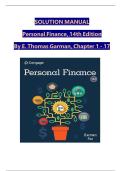
SOLUTION AND ANSWER GUIDE
GARMAN/FOX’S PERSONAL FINANCE, 14TH EDITION
ALL CHAPTERS COVERED GRADED A+
NEWEST VERSION.
© 2024 Cengage. All Rights Reserved. May not be scanned, copied, or duplicated, or posted to a publicly accessible 1
website, in whole or in part.
,TABLE OF CONTENTS
Answers to Chapter Concept Checks .................................................................................................... 2
What Do You Recommend Now? .......................................................................................................... 4
Let’s Talk About It ................................................................................................................................ 5
Do the Math ........................................................................................................................................... 6
Financial Planning Cases ....................................................................................................................... 8
Extended Learning .............................................................................................................................. 10
© 2024 Cengage. All Rights Reserved. May not be scanned, copied, or duplicated, or posted to a publicly accessible 2
website, in whole or in part.
,ANSWERS TO CHAPTER CONCEPT CHECKS
LO1.1 Recognize the keys to achieving financial success.
1. Explain the five steps in the financial planning process.
Answer: There are five fundamental steps to the personal financial planning process: (1) evaluate your
financial health to your education and career choice; (2) define your financial goals; (3) develop a plan of
action to achieve your goals; (4) implement spending and saving plans to monitor and control progress
toward your goals; and (5) review your financial progress and make changes as appropriate.
2. Distinguish among financial success, financial security, and financial happiness.
Answer: Financial success is the achievement of financial aspirations that are desired, planned, or
attempted. Success is defined by the individual or family that seeks it. Financial success may be defined as
being able to live according to one’s standard of living. Financial security is that comfortable feeling that
your financial resources will be adequate to fulfill any needs you have as well as your wants. Financial
happiness is the experience you have when you are satisfied with money matters. People who are happy
about their finances will see a spillover into positive feelings about life in general.
3. Summarize what you will accomplish studying personal finance.
Answer: Several things can be accomplished by studying personal finance. Recognize how to manage
unexpected and expected financial events. Pay as little as possible in income taxes. Understand how to
effectively comparison shop for vehicles and homes. Protect what we own. Invest wisely. Accumulate and
protect the wealth that we may choose to spend during our non-working years (e.g., retirement) or donate.
4. What are the building blocks to achieving financial success?
Answer: The building blocks for achieving financial success include a foundation of regular income that
provides the means to support your lifestyle and save for desired goals in the future. The foundation
supports a base of various banking accounts, insurance protection, and employee benefits. Then we can
establish goals, a recordkeeping system, a budget, and an emergency savings fund. We will also manage
various expenses such as housing, transportation, insurance, and the payment of taxes. We will also need to
handle credit, savings, and educational costs. Finally, we invest in various investment alternatives such as
mutual funds, stocks, and bonds, often for retirement. As a result of all these building blocks, we are more
apt to have a financially successful life.
LO1.2 Understand how the economy affects your personal financial success.
1. Summarize the phases of the business cycle.
Answer: The business cycle entails a wavelike pattern of rising and falling economic activity as measured
by economic indicators like unemployment rates or the gross domestic product. The phases of the business
cycle include expansion (preferred stage—production is high, unemployment low, interest rates low or
falling, stock market and consumer demand high), peak, contraction, downturn, trough, and recovery.
2. Describe two statistics that help predict the future direction of the economy.
Answer: Forecasting the state of the economy involves predicting, estimating, or calculating what will
happen in advance. We need to be able to forecast the state of the economy, inflation, and interest rates so
that we have advance warning of the directions and strength of changes in economic trends since they will
affect our personal finances. Two statistics we could watch are the consumer confidence index (how
consumers feel about the economy and their personal finances) and the index of leading economic
indicators (composite index, averages ten components of economic growth).
© 2024 Cengage. All Rights Reserved. May not be scanned, copied, or duplicated, or posted to a publicly accessible 3
website, in whole or in part.
, 3. Give an example of how inflation affects income and consumption.
Answer: Inflation reduces the purchasing power of the dollar. This means that our income will not go as
far and, thus, in real terms will be lowered by inflation. Because items cost more, we will have to consume
less and may cut back on some expenditures to be able to afford those with a higher priority.
LO1.3 Think like an economist when making financial decisions.
1. Define opportunity cost and give an example of how opportunity costs might affect your financial
decision making.
Answer: The opportunity cost of a decision is measured as the value of the next-best alternative that must
be forgone. If we, for example, put our retirement savings in a regular savings account instead of in a tax-
sheltered retirement account, we may be forgoing the tax benefits associated with investing in retirement
accounts such as IRAs or 401(k) plans. In another example, if we decide to borrow the maximum student
loan amount for which we qualify to live a bit more comfortably while in college, we will not be able to
live as nicely, save as much for the down payment on a home or save for retirement once we graduate
because of the higher loan payments.
2. Explain and give an example of how marginal utility and marginal cost make some financial
decisions easier.
Answer: Marginal analysis focuses on the next increment of usefulness or cost when making financial
decisions. Marginal utility is the extra satisfaction derived from having one more incremental unit of a
product or service. Marginal cost is the additional cost of that unit. When marginal utility exceeds
marginal cost, and we compare the two, we can make better financial decisions. As an example, if you must
fly to some destination, is the marginal cost of checking a bag using a carry-on worth the marginal utility?
3. Describe and give an example of how your marginal income tax rate can affect financial decision
making.
Answer: As our income rises, we will find ourselves in higher and higher tax brackets. One type of
decision that is affected by income taxes is how we should invest for retirement. We might want to invest
through a 401(k) plan instead of keeping our retirement money in a savings account, which is taxable.
Since most types of income are taxable, it is important that we understand the impact of income taxes on
financial decisions. Of particular importance is the marginal tax rate (the tax rate at which our last dollar
earned is taxed). If we are in the 25 percent marginal tax bracket, we will get to keep 75 percent (100
percent minus 25 percent) of our last taxable dollar earned. If the income is tax-free income, on the other
hand, we would get to keep 100 percent of it. Therefore, it is important to know our marginal tax rate as
well as what types of income are subject to federal income taxes. It is also important to remember the
impact of state income taxes and Social Security taxes.
LO1.4 Perform time value of money calculations in personal financial decision making.
1. What are the two common questions about money?
Answer: The two common questions about money are its future value and present value. Future value is
what investment or series of investments will be at a point in the future. Present value is how much we
would need to invest today and/or in a series of future investments to provide some amount in the future.
2. Explain the difference between simple interest and compound interest, and describe why that
difference is critical.
Answer: Simple interest is money paid on a principal amount for a given number of years. The interest is
paid only on the principal (the original amount invested). For example, we might put $1,000 in a bank
savings account at 5 percent interest for one year. We would have accumulated $50 in that year.
© 2024 Cengage. All Rights Reserved. May not be scanned, copied, or duplicated, or posted to a publicly accessible 4
website, in whole or in part.
GARMAN/FOX’S PERSONAL FINANCE, 14TH EDITION
ALL CHAPTERS COVERED GRADED A+
NEWEST VERSION.
© 2024 Cengage. All Rights Reserved. May not be scanned, copied, or duplicated, or posted to a publicly accessible 1
website, in whole or in part.
,TABLE OF CONTENTS
Answers to Chapter Concept Checks .................................................................................................... 2
What Do You Recommend Now? .......................................................................................................... 4
Let’s Talk About It ................................................................................................................................ 5
Do the Math ........................................................................................................................................... 6
Financial Planning Cases ....................................................................................................................... 8
Extended Learning .............................................................................................................................. 10
© 2024 Cengage. All Rights Reserved. May not be scanned, copied, or duplicated, or posted to a publicly accessible 2
website, in whole or in part.
,ANSWERS TO CHAPTER CONCEPT CHECKS
LO1.1 Recognize the keys to achieving financial success.
1. Explain the five steps in the financial planning process.
Answer: There are five fundamental steps to the personal financial planning process: (1) evaluate your
financial health to your education and career choice; (2) define your financial goals; (3) develop a plan of
action to achieve your goals; (4) implement spending and saving plans to monitor and control progress
toward your goals; and (5) review your financial progress and make changes as appropriate.
2. Distinguish among financial success, financial security, and financial happiness.
Answer: Financial success is the achievement of financial aspirations that are desired, planned, or
attempted. Success is defined by the individual or family that seeks it. Financial success may be defined as
being able to live according to one’s standard of living. Financial security is that comfortable feeling that
your financial resources will be adequate to fulfill any needs you have as well as your wants. Financial
happiness is the experience you have when you are satisfied with money matters. People who are happy
about their finances will see a spillover into positive feelings about life in general.
3. Summarize what you will accomplish studying personal finance.
Answer: Several things can be accomplished by studying personal finance. Recognize how to manage
unexpected and expected financial events. Pay as little as possible in income taxes. Understand how to
effectively comparison shop for vehicles and homes. Protect what we own. Invest wisely. Accumulate and
protect the wealth that we may choose to spend during our non-working years (e.g., retirement) or donate.
4. What are the building blocks to achieving financial success?
Answer: The building blocks for achieving financial success include a foundation of regular income that
provides the means to support your lifestyle and save for desired goals in the future. The foundation
supports a base of various banking accounts, insurance protection, and employee benefits. Then we can
establish goals, a recordkeeping system, a budget, and an emergency savings fund. We will also manage
various expenses such as housing, transportation, insurance, and the payment of taxes. We will also need to
handle credit, savings, and educational costs. Finally, we invest in various investment alternatives such as
mutual funds, stocks, and bonds, often for retirement. As a result of all these building blocks, we are more
apt to have a financially successful life.
LO1.2 Understand how the economy affects your personal financial success.
1. Summarize the phases of the business cycle.
Answer: The business cycle entails a wavelike pattern of rising and falling economic activity as measured
by economic indicators like unemployment rates or the gross domestic product. The phases of the business
cycle include expansion (preferred stage—production is high, unemployment low, interest rates low or
falling, stock market and consumer demand high), peak, contraction, downturn, trough, and recovery.
2. Describe two statistics that help predict the future direction of the economy.
Answer: Forecasting the state of the economy involves predicting, estimating, or calculating what will
happen in advance. We need to be able to forecast the state of the economy, inflation, and interest rates so
that we have advance warning of the directions and strength of changes in economic trends since they will
affect our personal finances. Two statistics we could watch are the consumer confidence index (how
consumers feel about the economy and their personal finances) and the index of leading economic
indicators (composite index, averages ten components of economic growth).
© 2024 Cengage. All Rights Reserved. May not be scanned, copied, or duplicated, or posted to a publicly accessible 3
website, in whole or in part.
, 3. Give an example of how inflation affects income and consumption.
Answer: Inflation reduces the purchasing power of the dollar. This means that our income will not go as
far and, thus, in real terms will be lowered by inflation. Because items cost more, we will have to consume
less and may cut back on some expenditures to be able to afford those with a higher priority.
LO1.3 Think like an economist when making financial decisions.
1. Define opportunity cost and give an example of how opportunity costs might affect your financial
decision making.
Answer: The opportunity cost of a decision is measured as the value of the next-best alternative that must
be forgone. If we, for example, put our retirement savings in a regular savings account instead of in a tax-
sheltered retirement account, we may be forgoing the tax benefits associated with investing in retirement
accounts such as IRAs or 401(k) plans. In another example, if we decide to borrow the maximum student
loan amount for which we qualify to live a bit more comfortably while in college, we will not be able to
live as nicely, save as much for the down payment on a home or save for retirement once we graduate
because of the higher loan payments.
2. Explain and give an example of how marginal utility and marginal cost make some financial
decisions easier.
Answer: Marginal analysis focuses on the next increment of usefulness or cost when making financial
decisions. Marginal utility is the extra satisfaction derived from having one more incremental unit of a
product or service. Marginal cost is the additional cost of that unit. When marginal utility exceeds
marginal cost, and we compare the two, we can make better financial decisions. As an example, if you must
fly to some destination, is the marginal cost of checking a bag using a carry-on worth the marginal utility?
3. Describe and give an example of how your marginal income tax rate can affect financial decision
making.
Answer: As our income rises, we will find ourselves in higher and higher tax brackets. One type of
decision that is affected by income taxes is how we should invest for retirement. We might want to invest
through a 401(k) plan instead of keeping our retirement money in a savings account, which is taxable.
Since most types of income are taxable, it is important that we understand the impact of income taxes on
financial decisions. Of particular importance is the marginal tax rate (the tax rate at which our last dollar
earned is taxed). If we are in the 25 percent marginal tax bracket, we will get to keep 75 percent (100
percent minus 25 percent) of our last taxable dollar earned. If the income is tax-free income, on the other
hand, we would get to keep 100 percent of it. Therefore, it is important to know our marginal tax rate as
well as what types of income are subject to federal income taxes. It is also important to remember the
impact of state income taxes and Social Security taxes.
LO1.4 Perform time value of money calculations in personal financial decision making.
1. What are the two common questions about money?
Answer: The two common questions about money are its future value and present value. Future value is
what investment or series of investments will be at a point in the future. Present value is how much we
would need to invest today and/or in a series of future investments to provide some amount in the future.
2. Explain the difference between simple interest and compound interest, and describe why that
difference is critical.
Answer: Simple interest is money paid on a principal amount for a given number of years. The interest is
paid only on the principal (the original amount invested). For example, we might put $1,000 in a bank
savings account at 5 percent interest for one year. We would have accumulated $50 in that year.
© 2024 Cengage. All Rights Reserved. May not be scanned, copied, or duplicated, or posted to a publicly accessible 4
website, in whole or in part.