

For this assignment, I watched a TedX video called “How to get your brain to focus” by Chris
Bailey. https://www.youtube.com/watch?v=Hu4Yvq-g7_Y This video starts with how screen
time hugely impacts our lives.
It also states how limiting screen
time, results in a better attention
span, more ideas, and more
plans. It further states that
research was conducted to
better understand what it takes
to focus and how technology
influences our attention. This
showed that when we are e.g.
sitting behind a computer, we
only focus for 40 seconds,
before switching or getting
distracted by something else.
This is not caused because we
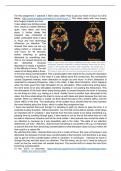
are distracted, because Figure 1: Left: a brain scan before meditating and right a brain scan while
meditating. Research conducted by Andrew Newberg shows that the brain
distraction is merely a symptom activity in the frontal lobe increases while meditating. The frontal lobe is
of the difficulty in focus. The real known to be responsible for concentration and focusing attention. In short.
cause of not being able to focus, This confirms that when the mind isn’t overstimulated we can focus better[1].
is the brain being overstimulated. This overstimulation then leads to the craving for distraction
resulting in not focusing. In the video it is also talked about the novelty bias, this mechanism
causes Dopamine release, when distraction is sought out and found. In short, distraction is
rewarded by releasing Dopamine. Later in the video, it talks about boredom, which happens
when the brain goes from high stimulation to low stimulation. When performing boring tasks,
the mind tends to be less stimulated, therefore resulting in not seeking the distractions. This
low stimulation of the brain when doing boring tasks is caused because the brain is focusing
on one thing at a time, e.g. staring at a clock. Scatter focus is another topic discussed in the
video, this focus state allows the brain to come up with ideas and plans because the mind can
wander. When our attention is rested, we think about the past (12%), present (28%), and the
future (48%) of the time. This distribution of the scatter focus showed that the mind wanders
the most thinking about the future, which is called the prospective bias.
I have now learned that even though it is tempting to grab my phone to pass the time, it is
essential to allow boredom. Without boredom, my mind will not be able to wander, which plays
an important role in creativity. I also learned how the brain wants to be doing something e.g.
passing time by scrolling through apps, it also needs to not do that at the same time so it will
be able to rediscover boredom and let the mind scatter. I also learned how crucial the state of
our attention is, because as it was beautifully said in the video “The state of our attention
determines our lives”. With this, I learned how everything is connected in life e.g. it is important
to prevent the brain from becoming overstimulated so that distraction does not occur which will
then result in a calmer life.
By watching this video, I learned that every time I could not focus, this was not because I was
distracted, but because my brain was overstimulated at that moment. And that there is an easy
way to get rid of this overstimulation which is: boredom. In conclusion, I learned we have to
change the way we think about our attention. The first being, we do not to need be doing so
much so that our mind does not wander anymore. The second shift is to keep the mind from
becoming overstimulated.
[1] Npr. (2010, 15 december). https://www.npr.org/2010/12/15/132078267/neurotheology-where-
religion-and-science-collide
Bailey. https://www.youtube.com/watch?v=Hu4Yvq-g7_Y This video starts with how screen
time hugely impacts our lives.
It also states how limiting screen
time, results in a better attention
span, more ideas, and more
plans. It further states that
research was conducted to
better understand what it takes
to focus and how technology
influences our attention. This
showed that when we are e.g.
sitting behind a computer, we
only focus for 40 seconds,
before switching or getting
distracted by something else.
This is not caused because we
are distracted, because Figure 1: Left: a brain scan before meditating and right a brain scan while
meditating. Research conducted by Andrew Newberg shows that the brain
distraction is merely a symptom activity in the frontal lobe increases while meditating. The frontal lobe is
of the difficulty in focus. The real known to be responsible for concentration and focusing attention. In short.
cause of not being able to focus, This confirms that when the mind isn’t overstimulated we can focus better[1].
is the brain being overstimulated. This overstimulation then leads to the craving for distraction
resulting in not focusing. In the video it is also talked about the novelty bias, this mechanism
causes Dopamine release, when distraction is sought out and found. In short, distraction is
rewarded by releasing Dopamine. Later in the video, it talks about boredom, which happens
when the brain goes from high stimulation to low stimulation. When performing boring tasks,
the mind tends to be less stimulated, therefore resulting in not seeking the distractions. This
low stimulation of the brain when doing boring tasks is caused because the brain is focusing
on one thing at a time, e.g. staring at a clock. Scatter focus is another topic discussed in the
video, this focus state allows the brain to come up with ideas and plans because the mind can
wander. When our attention is rested, we think about the past (12%), present (28%), and the
future (48%) of the time. This distribution of the scatter focus showed that the mind wanders
the most thinking about the future, which is called the prospective bias.
I have now learned that even though it is tempting to grab my phone to pass the time, it is
essential to allow boredom. Without boredom, my mind will not be able to wander, which plays
an important role in creativity. I also learned how the brain wants to be doing something e.g.
passing time by scrolling through apps, it also needs to not do that at the same time so it will
be able to rediscover boredom and let the mind scatter. I also learned how crucial the state of
our attention is, because as it was beautifully said in the video “The state of our attention
determines our lives”. With this, I learned how everything is connected in life e.g. it is important
to prevent the brain from becoming overstimulated so that distraction does not occur which will
then result in a calmer life.
By watching this video, I learned that every time I could not focus, this was not because I was
distracted, but because my brain was overstimulated at that moment. And that there is an easy
way to get rid of this overstimulation which is: boredom. In conclusion, I learned we have to
change the way we think about our attention. The first being, we do not to need be doing so
much so that our mind does not wander anymore. The second shift is to keep the mind from
becoming overstimulated.
[1] Npr. (2010, 15 december). https://www.npr.org/2010/12/15/132078267/neurotheology-where-
religion-and-science-collide


