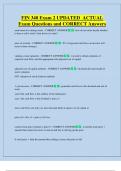
FIN 340 Exam 2 UPDATED ACTUAL
Exam Questions and CORRECT Answers
motivation for valuing stocks - CORRECT ANSWER - how do investors decide whether
to buy or sell a stock? what drives its value?
price of security - CORRECT ANSWER - PV of expected cash flows an investor will
receive from owning it
valuing a stock (general) - CORRECT ANSWER - we need to obtain estimates of
expected cash flows and the appropriate risk adjusted cost of capital
adjusted cost of capital methods - CORRECT ANSWER - dividend discount model of
stock valuation
FCF valuation of stock (indirect method)
1 year investor - CORRECT ANSWER - potential cash flows is the dividend and sale of
stock
year 0 the cash flow is the outflow of the initial price
year 1 the cash flow is the dividend + price y1
since cash flows are risky we must discount them at equity cost of capital so
price y0 = (div y1 + price y1)/(1+re)
current stock price relation to price 0 - CORRECT ANSWER - if current stock price <
amount then expect investors to rush in and buy it, driving up the price
if stock price > than the amount then selling it causes the price to fall
,equity cost of capital - CORRECT ANSWER - re= ((Div y1 + price y1)/price y0 )-1
or div yield + capital gain rate
use CAPM re=rf+be*market risk premium or div discount model re=e[div1]/po+g
div yield - CORRECT ANSWER - div y1 / price y0
capital gain rate - CORRECT ANSWER - (price y1 - price y0)/price y0
total return - CORRECT ANSWER - dividend yield + capital gain rate
the expected total return of stock should = the expected return of other investments available in
market w equivalent risk
dividend discount model - CORRECT ANSWER - multi year investors for N years
Po = div y1/(1+re) + div y2 /(1+re)^2 + ... + (divn + price n)/(1+re)^n
holds for any horizon N thus all investors attach the same value to a stock
the sum to infinity is the DivN / (1+re)^n
relies on market efficiency. the prices should reflect the fundamental value otherwise if price is
lower people will rush in and it will go up. if greater than, then people sell and would need ot be
able to short (sell what they don't have).
formula itself not very useful bc need a method to forecast future divs
special case: constant dividend growth - CORRECT ANSWER - simplest forecast for the
firms future divs growing at a constant rate g forever
,Po = div y1 / (re -g)
re = Div y1 / Po + g
g represents the capital gains rate
value of firm depends on dividend level, cost of equity and growth rate
need to be at a steady state and giving out dividends
dividend payout ratio - CORRECT ANSWER - fraction of earnings paid as dividends each
year
simple model of growth - CORRECT ANSWER - Div t = earnings / shares outstanding t
*dividend payout rate t
assuming # shares outstanding is constant, to increase the dividends you have to increase
earnings (net income) or increase dividend payout rate
what to do with earnings - CORRECT ANSWER - 1. can pay out to investors
2. can retain/reinvest
dividend payout rate = 1-retention rate
retention rate = 1- dividend payout rate
dividend policy - CORRECT ANSWER - determines rate of growth in future
earnings/dividends for a firm
, changing growth rate - CORRECT ANSWER - at some point the growth rate becomes
constant growth in terms of one years dividends
cash flows are div 1, div 2.... divn + price n , divn+1, divn+1 * (1+g) + div n+1 * (1+g)^2 ...
Pn = divn+1 / (re-g)
leads into dividend discount model w constant long term growth
dividend discount model w constant long term growth - CORRECT ANSWER - Po = div1
/ (1+re) + div2/(1+re)^2 + ... + (div N + (divN+1/re-g))/(1+re)^n
remember that the divn+1 has to be multiplied by (1+re)^n and then for div N you have to take
price of N+1 and discount
common stock - CORRECT ANSWER - share of ownership w rights to common
dividends and vote in elections
ticker symbol - CORRECT ANSWER - abbrev assigned to publically traded company
straight voting - CORRECT ANSWER - # of votes = # of shares
cumulative voting - CORRECT ANSWER - # of votes = # of open spots * # of shares
classes of common stock - CORRECT ANSWER - have different voting rights
proxy - CORRECT ANSWER - instructions on voting
Exam Questions and CORRECT Answers
motivation for valuing stocks - CORRECT ANSWER - how do investors decide whether
to buy or sell a stock? what drives its value?
price of security - CORRECT ANSWER - PV of expected cash flows an investor will
receive from owning it
valuing a stock (general) - CORRECT ANSWER - we need to obtain estimates of
expected cash flows and the appropriate risk adjusted cost of capital
adjusted cost of capital methods - CORRECT ANSWER - dividend discount model of
stock valuation
FCF valuation of stock (indirect method)
1 year investor - CORRECT ANSWER - potential cash flows is the dividend and sale of
stock
year 0 the cash flow is the outflow of the initial price
year 1 the cash flow is the dividend + price y1
since cash flows are risky we must discount them at equity cost of capital so
price y0 = (div y1 + price y1)/(1+re)
current stock price relation to price 0 - CORRECT ANSWER - if current stock price <
amount then expect investors to rush in and buy it, driving up the price
if stock price > than the amount then selling it causes the price to fall
,equity cost of capital - CORRECT ANSWER - re= ((Div y1 + price y1)/price y0 )-1
or div yield + capital gain rate
use CAPM re=rf+be*market risk premium or div discount model re=e[div1]/po+g
div yield - CORRECT ANSWER - div y1 / price y0
capital gain rate - CORRECT ANSWER - (price y1 - price y0)/price y0
total return - CORRECT ANSWER - dividend yield + capital gain rate
the expected total return of stock should = the expected return of other investments available in
market w equivalent risk
dividend discount model - CORRECT ANSWER - multi year investors for N years
Po = div y1/(1+re) + div y2 /(1+re)^2 + ... + (divn + price n)/(1+re)^n
holds for any horizon N thus all investors attach the same value to a stock
the sum to infinity is the DivN / (1+re)^n
relies on market efficiency. the prices should reflect the fundamental value otherwise if price is
lower people will rush in and it will go up. if greater than, then people sell and would need ot be
able to short (sell what they don't have).
formula itself not very useful bc need a method to forecast future divs
special case: constant dividend growth - CORRECT ANSWER - simplest forecast for the
firms future divs growing at a constant rate g forever
,Po = div y1 / (re -g)
re = Div y1 / Po + g
g represents the capital gains rate
value of firm depends on dividend level, cost of equity and growth rate
need to be at a steady state and giving out dividends
dividend payout ratio - CORRECT ANSWER - fraction of earnings paid as dividends each
year
simple model of growth - CORRECT ANSWER - Div t = earnings / shares outstanding t
*dividend payout rate t
assuming # shares outstanding is constant, to increase the dividends you have to increase
earnings (net income) or increase dividend payout rate
what to do with earnings - CORRECT ANSWER - 1. can pay out to investors
2. can retain/reinvest
dividend payout rate = 1-retention rate
retention rate = 1- dividend payout rate
dividend policy - CORRECT ANSWER - determines rate of growth in future
earnings/dividends for a firm
, changing growth rate - CORRECT ANSWER - at some point the growth rate becomes
constant growth in terms of one years dividends
cash flows are div 1, div 2.... divn + price n , divn+1, divn+1 * (1+g) + div n+1 * (1+g)^2 ...
Pn = divn+1 / (re-g)
leads into dividend discount model w constant long term growth
dividend discount model w constant long term growth - CORRECT ANSWER - Po = div1
/ (1+re) + div2/(1+re)^2 + ... + (div N + (divN+1/re-g))/(1+re)^n
remember that the divn+1 has to be multiplied by (1+re)^n and then for div N you have to take
price of N+1 and discount
common stock - CORRECT ANSWER - share of ownership w rights to common
dividends and vote in elections
ticker symbol - CORRECT ANSWER - abbrev assigned to publically traded company
straight voting - CORRECT ANSWER - # of votes = # of shares
cumulative voting - CORRECT ANSWER - # of votes = # of open spots * # of shares
classes of common stock - CORRECT ANSWER - have different voting rights
proxy - CORRECT ANSWER - instructions on voting