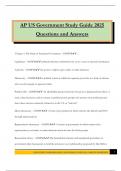
AP US Government Study Guide 2025
Questions and Answers
Chapter 1: The Study of American Government - ANSWER✔✔-...
Legitimacy - ANSWER✔✔-political authority conferred by law or by a state or national constitution
Authority - ANSWER✔✔-the power or right to give orders or make decisions
Democracy - ANSWER✔✔-a political system in which the supreme power lies in a body of citizens
who can elect people to represent them
Political elite - ANSWER✔✔-An identifiable group of persons who poses a disproportional share of
some valued resource, such as money or political power; people who possess more political power
than others and are commonly referred to in the U.S. as "activists"
Direct democracy - ANSWER✔✔-A form of government in which citizens rule directly and NOT
through representatives
Representative democracy - ANSWER✔✔-A system of government in which citizens elect
representatives, or leaders, to make decisions about the laws for all the people.
Bureaucratic theory - ANSWER✔✔-The hierarchical structure and standarized procedures of
government allow bureaucrats to hold the real power over public policy; proposed by Max Weber
FOR STUDY PURPOSES ONLY COPYRIGHT © 2025 ALL RIGHTS RESERVED 1
,Power elite theory - ANSWER✔✔-the theory that a small number of very wealthy individuals,
powerful corporate interest groups, and large financial institutions dominate key policy areas.
Pluralist theory - ANSWER✔✔-A theory of government and politics emphasizing that politics is
mainly a competition among groups, each one pressing for its own preferred policies.
Marxist theory - ANSWER✔✔-the ideology espoused by Karl Marx which holds that government is
a reflection of economic forces, primarily ownershop of the means of production
Chapter 2: The Constitution - ANSWER✔✔-...
Unalienable - ANSWER✔✔-incapable of being repudiated or transferred to another, natural rights
that belong to everyone and cannot be taken away
Federalists - ANSWER✔✔-Supporters of the Constitution that were led by Alexander Hamilton
and John Adams. They firmly believed the national government should be strong. They didn't want
the Bill of Rights because they felt citizens' rights were already well protected by the Constitution.
Articles of Confederation - ANSWER✔✔-this document, the nations first constitution, was adopted
by the second continental congress in 1781during the revolution. the document was limited because
states held most of the power, and congress lacked the power to tax, regulate trade, or control
coinage
Anti-Federalists - ANSWER✔✔-They opposed the ratification of the Constitution because it gave
more power to the federal government and less to the states, and because it did not ensure
individual rights. Many wanted to keep the Articles of Confederation. The Antifederalists were
instrumental in obtaining passage of the Bill of Rights as a prerequisite to ratification of the
FOR STUDY PURPOSES ONLY COPYRIGHT © 2025 ALL RIGHTS RESERVED 2
,Constitution in several states. After the ratification of the Constitution, the Antifederalists regrouped
as the Democratic-Republican (or simply Republican) party.
Declaration of Independence - ANSWER✔✔-the document recording the proclamation of the
second Continental Congress (4 July 1776) asserting the independence of the colonies from Great
Britain
The Federalist Papers - ANSWER✔✔-This collection of essays by John Jay, Alexander Hamilton,
and James Madison, explained the importance of a strong central government. It was published to
convince New York to ratify the Constitution.
Constitutional Convention - ANSWER✔✔-The meeting of state delegates in 1787 in Philadelphia
called to revise the Articles of Confederation. It instead designed a new plan of government, the US
Constitution.
Separation of powers - ANSWER✔✔-Constitutional division of powers among the legislative,
executive, and judicial branches, with the legislative branch making law, the executive applying and
enforcing the law, and the judiciary interpreting the law
Shays's Rebellion - ANSWER✔✔-Rebellion led by Daniel Shays of farmers in western
Massachusetts in 1786-1787, protesting mortgage foreclosures. It highlighted the need for a strong
national government just as the call for the Constitutional Convention went out; Rebellion led by
Daniel Shays of farmers in western Massachusetts in 1786-1787, protesting mortgage foreclosures. It
highlighted the need for a strong national government just as the call for the Constitutional
Convention went out.
Bill of attainder - ANSWER✔✔-A law that declares a person, without a trial, to be guilty of a crime
FOR STUDY PURPOSES ONLY COPYRIGHT © 2025 ALL RIGHTS RESERVED 3
, Great Compromise - ANSWER✔✔-Compromise made by Constitutional Convention in which
states would have equal representation in one house of the legislature and representation based on
population in the other house
Writ of habeas corpus - ANSWER✔✔-a court order that requires police to bring a prisoner to court
to explain why they are holding the person
Bill of Rights - ANSWER✔✔-The first ten amendments of the U.S. Constitution, containing a list
of individual rights and liberties, such as freedom of speech, religion, and the press.
Ex post facto law - ANSWER✔✔-a law that would allow a person to be punished for an action that
was not against the law when it was committed
Line-item veto - ANSWER✔✔-an executive's ability to block a particular provision in a bill passed
by the legislature
Federalism - ANSWER✔✔-a form of government in which power is divided between the federal, or
national, government and the states
Republic - ANSWER✔✔-a political system in which the supreme power lies in a body of citizens
who can elect people to represent them
Amendment - ANSWER✔✔-a change in, or addition to, a constitution or law
Checks and balances - ANSWER✔✔-A system that allows each branch of government to limit the
powers of the other branches in order to prevent abuse of power
FOR STUDY PURPOSES ONLY COPYRIGHT © 2025 ALL RIGHTS RESERVED 4
Questions and Answers
Chapter 1: The Study of American Government - ANSWER✔✔-...
Legitimacy - ANSWER✔✔-political authority conferred by law or by a state or national constitution
Authority - ANSWER✔✔-the power or right to give orders or make decisions
Democracy - ANSWER✔✔-a political system in which the supreme power lies in a body of citizens
who can elect people to represent them
Political elite - ANSWER✔✔-An identifiable group of persons who poses a disproportional share of
some valued resource, such as money or political power; people who possess more political power
than others and are commonly referred to in the U.S. as "activists"
Direct democracy - ANSWER✔✔-A form of government in which citizens rule directly and NOT
through representatives
Representative democracy - ANSWER✔✔-A system of government in which citizens elect
representatives, or leaders, to make decisions about the laws for all the people.
Bureaucratic theory - ANSWER✔✔-The hierarchical structure and standarized procedures of
government allow bureaucrats to hold the real power over public policy; proposed by Max Weber
FOR STUDY PURPOSES ONLY COPYRIGHT © 2025 ALL RIGHTS RESERVED 1
,Power elite theory - ANSWER✔✔-the theory that a small number of very wealthy individuals,
powerful corporate interest groups, and large financial institutions dominate key policy areas.
Pluralist theory - ANSWER✔✔-A theory of government and politics emphasizing that politics is
mainly a competition among groups, each one pressing for its own preferred policies.
Marxist theory - ANSWER✔✔-the ideology espoused by Karl Marx which holds that government is
a reflection of economic forces, primarily ownershop of the means of production
Chapter 2: The Constitution - ANSWER✔✔-...
Unalienable - ANSWER✔✔-incapable of being repudiated or transferred to another, natural rights
that belong to everyone and cannot be taken away
Federalists - ANSWER✔✔-Supporters of the Constitution that were led by Alexander Hamilton
and John Adams. They firmly believed the national government should be strong. They didn't want
the Bill of Rights because they felt citizens' rights were already well protected by the Constitution.
Articles of Confederation - ANSWER✔✔-this document, the nations first constitution, was adopted
by the second continental congress in 1781during the revolution. the document was limited because
states held most of the power, and congress lacked the power to tax, regulate trade, or control
coinage
Anti-Federalists - ANSWER✔✔-They opposed the ratification of the Constitution because it gave
more power to the federal government and less to the states, and because it did not ensure
individual rights. Many wanted to keep the Articles of Confederation. The Antifederalists were
instrumental in obtaining passage of the Bill of Rights as a prerequisite to ratification of the
FOR STUDY PURPOSES ONLY COPYRIGHT © 2025 ALL RIGHTS RESERVED 2
,Constitution in several states. After the ratification of the Constitution, the Antifederalists regrouped
as the Democratic-Republican (or simply Republican) party.
Declaration of Independence - ANSWER✔✔-the document recording the proclamation of the
second Continental Congress (4 July 1776) asserting the independence of the colonies from Great
Britain
The Federalist Papers - ANSWER✔✔-This collection of essays by John Jay, Alexander Hamilton,
and James Madison, explained the importance of a strong central government. It was published to
convince New York to ratify the Constitution.
Constitutional Convention - ANSWER✔✔-The meeting of state delegates in 1787 in Philadelphia
called to revise the Articles of Confederation. It instead designed a new plan of government, the US
Constitution.
Separation of powers - ANSWER✔✔-Constitutional division of powers among the legislative,
executive, and judicial branches, with the legislative branch making law, the executive applying and
enforcing the law, and the judiciary interpreting the law
Shays's Rebellion - ANSWER✔✔-Rebellion led by Daniel Shays of farmers in western
Massachusetts in 1786-1787, protesting mortgage foreclosures. It highlighted the need for a strong
national government just as the call for the Constitutional Convention went out; Rebellion led by
Daniel Shays of farmers in western Massachusetts in 1786-1787, protesting mortgage foreclosures. It
highlighted the need for a strong national government just as the call for the Constitutional
Convention went out.
Bill of attainder - ANSWER✔✔-A law that declares a person, without a trial, to be guilty of a crime
FOR STUDY PURPOSES ONLY COPYRIGHT © 2025 ALL RIGHTS RESERVED 3
, Great Compromise - ANSWER✔✔-Compromise made by Constitutional Convention in which
states would have equal representation in one house of the legislature and representation based on
population in the other house
Writ of habeas corpus - ANSWER✔✔-a court order that requires police to bring a prisoner to court
to explain why they are holding the person
Bill of Rights - ANSWER✔✔-The first ten amendments of the U.S. Constitution, containing a list
of individual rights and liberties, such as freedom of speech, religion, and the press.
Ex post facto law - ANSWER✔✔-a law that would allow a person to be punished for an action that
was not against the law when it was committed
Line-item veto - ANSWER✔✔-an executive's ability to block a particular provision in a bill passed
by the legislature
Federalism - ANSWER✔✔-a form of government in which power is divided between the federal, or
national, government and the states
Republic - ANSWER✔✔-a political system in which the supreme power lies in a body of citizens
who can elect people to represent them
Amendment - ANSWER✔✔-a change in, or addition to, a constitution or law
Checks and balances - ANSWER✔✔-A system that allows each branch of government to limit the
powers of the other branches in order to prevent abuse of power
FOR STUDY PURPOSES ONLY COPYRIGHT © 2025 ALL RIGHTS RESERVED 4