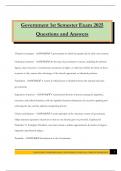
Government 1st Semester Exam 2025
Questions and Answers
Popular sovereignty - ANSWER✔✔-A government in which the people rule by their own consent.
Limited government - ANSWER✔✔-In this type of government everyone, including all authority
figures, must obey laws. Constitutions, statements of rights, or other laws define the limits of those
in power so they cannot take advantage of the elected, appointed, or inherited positions.
Federalism - ANSWER✔✔-A system in which power is divided between the national and state
governments
Separation of powers - ANSWER✔✔-Constitutional division of powers among the legislative,
executive, and judicial branches, with the legislative branch making law, the executive applying and
enforcing the law, and the judiciary interpreting the law
Checks and balances - ANSWER✔✔-A major principle of the American system of government.
Helps maintain separation of powers so that no one branch gets too powerful. Explained in
Federalist 51. Examples: President vetos laws; Senate confirms appointments & treaties; Congress
impeaches president & judges...
Preamble - ANSWER✔✔-Introduction to the Constitution
FOR STUDY PURPOSES ONLY COPYRIGHT © 2025 ALL RIGHTS RESERVED 1
, Article 1 - ANSWER✔✔-Article of the Constitution that defines the Legislative Branch, it's powers,
members, and workings.
Article 2 - ANSWER✔✔-Article of the Constitution that defines the Executive Branch, it's powers,
duties, and means of removal.
Article 3 - ANSWER✔✔-Article of the Constitution that sets up the Judicial Branch and defines
treason.
Article 4 - ANSWER✔✔-Article of the Constitution that regulates the states' powers, and their
interaction with the National government.
Article 5 - ANSWER✔✔-Article of the Constitution that sets up the amendment process.
Article 6 - ANSWER✔✔-Every state is bound to comply with treaties and federal laws. (Supremacy
Clause)
Article 7 - ANSWER✔✔-Article of the Constitution that addresses ratification and declares that the
constitution should take affect if 9 out of 13 states ratify.
Federalist - ANSWER✔✔-Supporters of ratification of the Constitution and of a strong central
government.
Anti-Federalist - ANSWER✔✔-They opposed the ratification of the Constitution because it gave
more power to the federal government and less to the states, and because it did not ensure
individual rights. Many wanted to keep the Articles of Confederation. The Antifederalists were
instrumental in obtaining passage of the Bill of Rights as a prerequisite to ratification of the
FOR STUDY PURPOSES ONLY COPYRIGHT © 2025 ALL RIGHTS RESERVED 2
Questions and Answers
Popular sovereignty - ANSWER✔✔-A government in which the people rule by their own consent.
Limited government - ANSWER✔✔-In this type of government everyone, including all authority
figures, must obey laws. Constitutions, statements of rights, or other laws define the limits of those
in power so they cannot take advantage of the elected, appointed, or inherited positions.
Federalism - ANSWER✔✔-A system in which power is divided between the national and state
governments
Separation of powers - ANSWER✔✔-Constitutional division of powers among the legislative,
executive, and judicial branches, with the legislative branch making law, the executive applying and
enforcing the law, and the judiciary interpreting the law
Checks and balances - ANSWER✔✔-A major principle of the American system of government.
Helps maintain separation of powers so that no one branch gets too powerful. Explained in
Federalist 51. Examples: President vetos laws; Senate confirms appointments & treaties; Congress
impeaches president & judges...
Preamble - ANSWER✔✔-Introduction to the Constitution
FOR STUDY PURPOSES ONLY COPYRIGHT © 2025 ALL RIGHTS RESERVED 1
, Article 1 - ANSWER✔✔-Article of the Constitution that defines the Legislative Branch, it's powers,
members, and workings.
Article 2 - ANSWER✔✔-Article of the Constitution that defines the Executive Branch, it's powers,
duties, and means of removal.
Article 3 - ANSWER✔✔-Article of the Constitution that sets up the Judicial Branch and defines
treason.
Article 4 - ANSWER✔✔-Article of the Constitution that regulates the states' powers, and their
interaction with the National government.
Article 5 - ANSWER✔✔-Article of the Constitution that sets up the amendment process.
Article 6 - ANSWER✔✔-Every state is bound to comply with treaties and federal laws. (Supremacy
Clause)
Article 7 - ANSWER✔✔-Article of the Constitution that addresses ratification and declares that the
constitution should take affect if 9 out of 13 states ratify.
Federalist - ANSWER✔✔-Supporters of ratification of the Constitution and of a strong central
government.
Anti-Federalist - ANSWER✔✔-They opposed the ratification of the Constitution because it gave
more power to the federal government and less to the states, and because it did not ensure
individual rights. Many wanted to keep the Articles of Confederation. The Antifederalists were
instrumental in obtaining passage of the Bill of Rights as a prerequisite to ratification of the
FOR STUDY PURPOSES ONLY COPYRIGHT © 2025 ALL RIGHTS RESERVED 2