1 Exampromax - Stuvia US 2025/2026
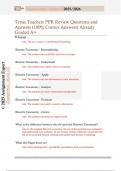
Texas Teachers PPR Review Questions and
Answers (100% Correct Answers) Already
Graded A+
Pedagogy
Ans: The art, science, or profession of teaching
Blooms Taxonomy - Remembering
Ans: The student can recall facts and basic concepts
Blooms Taxonomy - Understand
© 2025 Assignment Expert
Ans: The student can explain ideas or concepts
Exampromax - Stuvia US
Bloom's Taxonomy - Apply
Ans: The student can use information in new situations
Blooms Taxonomy - Analyze
Ans: The student can draw connections among ideas
Bloom's Taxonomy - Evaluate
Ans: The student can justify a stand or discussion
Bloom's Taxonomy - Create
Ans: The student can produce original work
What is the difference between the old and new Bloom's Taxonomy?
Ans: In the original Bloom's taxonomy, the top of the pyramid was evaluation
and underneath was synthesis. In the revised version of Bloom's taxonomy the
top of the pyramid became creating and underneath became evaluating.
What did Piaget focus on?
Ans: Brain development - specifically assimilation and accomodaition
, 2 Exampromax - Stuvia US 2025/2026
What is the order of Piaget's brain development theory?
Ans: sensorimotor, preoperational, concrete operation, formal operations
What did Erikson focus on?
Ans: The critical age for a person's social and emotional development
Trust vs. Mistrust (Stage 1)
Ans: When infants are wondering can I trust the world? Ex: Feeding and
abandonment
Autonomy vs. Shame (Stage 2)
Ans: When toddlers are learning if it is okay to be themselves. Ex: potty training
© 2025 Assignment Expert
and clothing themselves
Exampromax - Stuvia US
Initiative vs. Guilt (Stage 3)
Ans: When pre-schoolers are learning if it is okay for them to do, move, and act.
Ex: exploring, using tools, or making art
Industry vs. Inferiority - (Stage 4)
Ans: When elementary students are learning if they can make it through the
world of people and things. Ex: school and sports
Identity vs. Confusion - (Stage 5)
Ans: When adolescents are coming to know who they are and who they can be.
Ex: social interaction and relationships
Intimacy vs. Isolation - (Stage 6)
Ans: When young adults are trying to understand if they can love. Ex: romantic
relationships
Generativity vs. Stagnant - (Stage 7)
Ans: When middle adults are wondering if they can make their life count. Ex:
work and parenthood
Integrity vs. Despair - (Stage 8)
Texas Teachers PPR Review Questions and
Answers (100% Correct Answers) Already
Graded A+
Pedagogy
Ans: The art, science, or profession of teaching
Blooms Taxonomy - Remembering
Ans: The student can recall facts and basic concepts
Blooms Taxonomy - Understand
© 2025 Assignment Expert
Ans: The student can explain ideas or concepts
Exampromax - Stuvia US
Bloom's Taxonomy - Apply
Ans: The student can use information in new situations
Blooms Taxonomy - Analyze
Ans: The student can draw connections among ideas
Bloom's Taxonomy - Evaluate
Ans: The student can justify a stand or discussion
Bloom's Taxonomy - Create
Ans: The student can produce original work
What is the difference between the old and new Bloom's Taxonomy?
Ans: In the original Bloom's taxonomy, the top of the pyramid was evaluation
and underneath was synthesis. In the revised version of Bloom's taxonomy the
top of the pyramid became creating and underneath became evaluating.
What did Piaget focus on?
Ans: Brain development - specifically assimilation and accomodaition
, 2 Exampromax - Stuvia US 2025/2026
What is the order of Piaget's brain development theory?
Ans: sensorimotor, preoperational, concrete operation, formal operations
What did Erikson focus on?
Ans: The critical age for a person's social and emotional development
Trust vs. Mistrust (Stage 1)
Ans: When infants are wondering can I trust the world? Ex: Feeding and
abandonment
Autonomy vs. Shame (Stage 2)
Ans: When toddlers are learning if it is okay to be themselves. Ex: potty training
© 2025 Assignment Expert
and clothing themselves
Exampromax - Stuvia US
Initiative vs. Guilt (Stage 3)
Ans: When pre-schoolers are learning if it is okay for them to do, move, and act.
Ex: exploring, using tools, or making art
Industry vs. Inferiority - (Stage 4)
Ans: When elementary students are learning if they can make it through the
world of people and things. Ex: school and sports
Identity vs. Confusion - (Stage 5)
Ans: When adolescents are coming to know who they are and who they can be.
Ex: social interaction and relationships
Intimacy vs. Isolation - (Stage 6)
Ans: When young adults are trying to understand if they can love. Ex: romantic
relationships
Generativity vs. Stagnant - (Stage 7)
Ans: When middle adults are wondering if they can make their life count. Ex:
work and parenthood
Integrity vs. Despair - (Stage 8)