1.4 The Human Body
Problem 1: Brain and Body
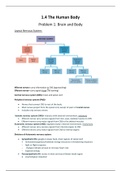
Layout Nervous System:
Afferent nerves= carry information to CNS (approaching)
Efferent nerves= carry signals from CNS (exiting)
Central nervous system (CNS)= brain and spinal cord
Peripheral nervous system (PNS)=
• Nerves that connect CNS to rest of the body
• Most nerves project from the spinal cord, except 12 pairs of cranial nerves
• Includes only sensory nerves
Somatic nervous system (SNS)= interacts with external environment, voluntary
• Afferent nerves carry sensory signals from skin, eyes, skeletal muscles to CNS
• Efferent nerves carry motor signals from CNS to the skeletal muscles
Autonomic nervous system (ANS): regulates body’s internal environment, involuntary
• Afferent nerves carry sensory signals from internal organs to CNS
• Efferent nerves carry motor signals from CNS to internal organs
Divisions of Autonomic nervous system:
• Sympathetic NS= ganglia in lower back, chest regions of spinal cord
• Stimulates/organizes/mobilizes energy resources in threatening situations
– fight or flight response
– changes indicate arousal ex increase heart rate
– Expends energy
• Parasympathetic NS: nerves in brain and sacral (lower back) region
• psychological relaxation
, • e.g. decrease heart rate
• Conserves energy
Cells of the Nervous System:
Neuron=
• Dendrite= collect information from
other neurons
• Cell body (soma)= integration of
incoming information and generation of
outgoing signal to the axon
- Cell nucleus= location of DNA
- Axon= pass signals over long distances
- Axon branches= different directions
- Presynaptic terminal (terminal buttons)=
signal is passed to dendrites of other neurons
- Myelin sheaths= fatty insulation around axon
that allows action potential (electric flow of
information)
- Nodes of Ranvier= gaps between myelin
sheaths
- Cell membrane= covers the cell body, composed of lipid bilayer (two layers of fat molecules),
selective to the
passing of molecules
Types of Neurons:
• Motor: efferent; from brain to muscles
• Sensory: afferent; from senses to brain
• Interneurons: has short or no axon, link within rather than between structures. Sends
messages between neurons
Neuroanatomical structure:
• Kinds of gross neural structures: primarily composed of cell bodies or composed of axons
• CNS
- Nucleus: clusters of cell bodies/neurons
- Tracts: group of axons
• PNS
- Ganglia: clusters of cell bodies/neurons
- Nerves: group of axons
Glial cells= other types of cells in NS, provide support to neurons (nutrition, clearing waste, physical
matrix to hold neural circuits together)
• Types of glial cells
- Oligodendrocytes
- Schwann cells
- Microglia
, - Astrocytes
Directions in the Vertebrate Nervous System:
o Superior: above another part
o Inferior: below another part
o Ipsilateral: on the same side of the body
o Contralateral: on the opposite side of the body
Meninges, Ventricles and Cerebrospinal Fluid:
The brain and spinal cord (CNS) are most protected organs, encased in bone and covered by
protective membranes:
• Meninges (Hirnhaut)= membranes surrounding brain and spinal cord
- Dura mater= outer meninx, tough membrane
- Arachnoid membrane= inside the dura mater, beneath is the subarachnoid space:
contains large blood vessels and CSF
- Pia mater= innermost meninx, adheres to the surface of CNS
• Ventricles= 4 large internal chambers/cavities of the brain that produce CSF
• Cerebrospinal fluid (CSF)= fluid made of choroid plexus
- Fills the subarachnoid space, central canal of spinal cord and cerebral ventricles of
the brain
- supports and cushions the brain, provides reservoir of hormones and nutrition for
the brain and spinal cord
Blood-Brain Barrier:
• the brain is highly sensitive to foreign chemicals
• bbb protects it against them
• efficacy of drugs dependent on how easy they can penetrate bbb
Problem 1: Brain and Body
Layout Nervous System:
Afferent nerves= carry information to CNS (approaching)
Efferent nerves= carry signals from CNS (exiting)
Central nervous system (CNS)= brain and spinal cord
Peripheral nervous system (PNS)=
• Nerves that connect CNS to rest of the body
• Most nerves project from the spinal cord, except 12 pairs of cranial nerves
• Includes only sensory nerves
Somatic nervous system (SNS)= interacts with external environment, voluntary
• Afferent nerves carry sensory signals from skin, eyes, skeletal muscles to CNS
• Efferent nerves carry motor signals from CNS to the skeletal muscles
Autonomic nervous system (ANS): regulates body’s internal environment, involuntary
• Afferent nerves carry sensory signals from internal organs to CNS
• Efferent nerves carry motor signals from CNS to internal organs
Divisions of Autonomic nervous system:
• Sympathetic NS= ganglia in lower back, chest regions of spinal cord
• Stimulates/organizes/mobilizes energy resources in threatening situations
– fight or flight response
– changes indicate arousal ex increase heart rate
– Expends energy
• Parasympathetic NS: nerves in brain and sacral (lower back) region
• psychological relaxation
, • e.g. decrease heart rate
• Conserves energy
Cells of the Nervous System:
Neuron=
• Dendrite= collect information from
other neurons
• Cell body (soma)= integration of
incoming information and generation of
outgoing signal to the axon
- Cell nucleus= location of DNA
- Axon= pass signals over long distances
- Axon branches= different directions
- Presynaptic terminal (terminal buttons)=
signal is passed to dendrites of other neurons
- Myelin sheaths= fatty insulation around axon
that allows action potential (electric flow of
information)
- Nodes of Ranvier= gaps between myelin
sheaths
- Cell membrane= covers the cell body, composed of lipid bilayer (two layers of fat molecules),
selective to the
passing of molecules
Types of Neurons:
• Motor: efferent; from brain to muscles
• Sensory: afferent; from senses to brain
• Interneurons: has short or no axon, link within rather than between structures. Sends
messages between neurons
Neuroanatomical structure:
• Kinds of gross neural structures: primarily composed of cell bodies or composed of axons
• CNS
- Nucleus: clusters of cell bodies/neurons
- Tracts: group of axons
• PNS
- Ganglia: clusters of cell bodies/neurons
- Nerves: group of axons
Glial cells= other types of cells in NS, provide support to neurons (nutrition, clearing waste, physical
matrix to hold neural circuits together)
• Types of glial cells
- Oligodendrocytes
- Schwann cells
- Microglia
, - Astrocytes
Directions in the Vertebrate Nervous System:
o Superior: above another part
o Inferior: below another part
o Ipsilateral: on the same side of the body
o Contralateral: on the opposite side of the body
Meninges, Ventricles and Cerebrospinal Fluid:
The brain and spinal cord (CNS) are most protected organs, encased in bone and covered by
protective membranes:
• Meninges (Hirnhaut)= membranes surrounding brain and spinal cord
- Dura mater= outer meninx, tough membrane
- Arachnoid membrane= inside the dura mater, beneath is the subarachnoid space:
contains large blood vessels and CSF
- Pia mater= innermost meninx, adheres to the surface of CNS
• Ventricles= 4 large internal chambers/cavities of the brain that produce CSF
• Cerebrospinal fluid (CSF)= fluid made of choroid plexus
- Fills the subarachnoid space, central canal of spinal cord and cerebral ventricles of
the brain
- supports and cushions the brain, provides reservoir of hormones and nutrition for
the brain and spinal cord
Blood-Brain Barrier:
• the brain is highly sensitive to foreign chemicals
• bbb protects it against them
• efficacy of drugs dependent on how easy they can penetrate bbb