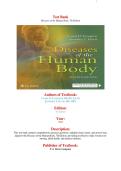
Diseases of the Human Body Seventh Ed ition by Carol D. Tamparo (Author), Jennifer T. Davis (Au thor)!!!!!!!!!!!!!!!!!!!!!!!!!!!!!!!!!!!!!!!!!!!!!!!!!!!!!!!!!!!!!!!!!!!!!!!!!!!!!!!!!!!!!!!!!!!!!!!!!!!!!!!!!!!!!!!!!!!!!!!!!!!!!!!!!4.6 4.6 out of 5 stars (50) 1
Test Bank
Diseases of the Human Body, 7th Edition
Authors of Textbook:
CAROL D. TAMPARO, MS, RN, FAAN
JENNIFER T. DAVIS, RN, MSN
Edition:
7th Edition
Year:
2026
Description:
This test bank contains comprehensive practice questions, multiple-choice items, and answer keys
aligned with Diseases of the Human Body, 7th Edition, providing an effective study resource for
nursing, allied health, and medical students.
Publisher of Textbook:
F.A. Davis Company
, Diseases of the Human Body Seventh Ed ition by Carol D. Tamparo (Author), Jennifer T. Davis (Au thor)!!!!!!!!!!!!!!!!!!!!!!!!!!!!!!!!!!!!!!!!!!!!!!!!!!!!!!!!!!!!!!!!!!!!!!!!!!!!!!!!!!!!!!!!!!!!!!!!!!!!!!!!!!!!!!!!!!!!!!!!!!!!!!!!!4.6 4.6 out of 5 stars (50) 2
Table of Contents
Chapter 01: The Disease Process
Chapter 02: Integrative Medicine and Complementary Therapies
Chapter 03: Pain and Its Management
Chapter 04: Infectious and Communicable Diseases
Chapter 05: Cancer
Chapter 06: Congenital Diseases and Disorders
Chapter 07: Mental Health Diseases and Disorders
Chapter 08: Skin Diseases and Disorders
Chapter 09: Musculoskeletal Diseases and Disorders
Chapter 10: Nervous System Diseases and Disorders
Chapter 11: Endocrine System Diseases and Disorders
Chapter 12: Cardiovascular and Lymphatic System Diseases and Disorders
Chapter 13: Respiratory System Diseases and Disorders
Chapter 14: Digestive System Diseases and Disorders
Chapter 15: Urinary System Diseases and Disorders
Chapter 16: Reproductive System Diseases and Disorders
Chapter 17: Eye and Ear Diseases and Disorders
, Diseases of the Human Body Seventh Ed ition by Carol D. Tamparo (Author), Jennifer T. Davis (Au thor)!!!!!!!!!!!!!!!!!!!!!!!!!!!!!!!!!!!!!!!!!!!!!!!!!!!!!!!!!!!!!!!!!!!!!!!!!!!!!!!!!!!!!!!!!!!!!!!!!!!!!!!!!!!!!!!!!!!!!!!!!!!!!!!!!4.6 4.6 out of 5 stars (50) 3
Chapter 1. The Disease Process
MULTIPLE CHOICE
1) Which of the following best describes an illness?
a) It is identified by the distinguishing features.
b) It can be prevented by normal body structures.
c) It is easier to treat than disease.
d) It describes the condition of the person experiencing disease.
ACTUAL ANSWER:-: D PTS: 1 DIF: Easy OBJ: 1.3
MSC: Understanding
2) What is the difference between phenotype and genotype?
a) Phenotype refers to all of the genes inherited from parents, whereas genotype refers to an X-linked
inherited disease.
b) Phenotype refers to physical appearance influenced by genetics and environment, whereas genotype
refers to all of the genes inherited from parents.
c) Phenotype refers to a defective gene contributed by both parents, whereas genotype refers to a
defective gene contributed by one parent.
d) Phenotype refers to the full set of inherited genes, whereas genotype refers to monogenic alterations
and chromosome aberrations.
ACTUAL ANSWER:-: B PTS: 1 DIF: Moderate OBJ: 1.7
MSC: Analyzing
3) Gregory is 11. He has a specific genetic disorder. He is very active but must be extremely careful to
avoid any injury that would cause bleeding. Which disorder does Gregory most likely have?
a) Sickle cell anemia
b) Rett syndrome
c) Hemophilia
d) Trisomy 21
ACTUAL ANSWER:-: C PTS: 1 DIF: Moderate OBJ: 1.9
MSC: Applying
4) The pediatrician called to say that Sheyna’s throat culture was back. The test revealed a coccus, or dot-
shaped bacterium. What does Sheyna have?
a) Strep throat
b) Whooping cough
c) Mumps
d) Tinea corporis
ACTUAL ANSWER:-: A PTS: 1 DIF: Moderate OBJ: 1.13
MSC: Applying
5) Molly is overweight and smokes a pack of cigarettes a day. She lives with her husband and five
children in a densely populated urban area. What are the factors that predispose Molly to developing a
disease?
a) Lack of an inflammatory response
b) Sex, environment, and lifestyle
c) Having a husband and five children
, Diseases of the Human Body Seventh Ed ition by Carol D. Tamparo (Author), Jennifer T. Davis (Au thor)!!!!!!!!!!!!!!!!!!!!!!!!!!!!!!!!!!!!!!!!!!!!!!!!!!!!!!!!!!!!!!!!!!!!!!!!!!!!!!!!!!!!!!!!!!!!!!!!!!!!!!!!!!!!!!!!!!!!!!!!!!!!!!!!!4.6 4.6 out of 5 stars (50) 4
d) Lack of homeostasis
ACTUAL ANSWER:-: B PTS: 1 DIF: Moderate OBJ: 1.4
MSC: Applying
6) Which of the following is a brief description of hereditary diseases?
a) Always appear at birth
b) Not influenced by environmental factors
c) Caused by a person’s genetic makeup
d) The result of mutations in gene structure
ACTUAL ANSWER:-: C PTS: 1 DIF: Easy OBJ: 1.5
MSC: Remembering
7) What is anaphylactic shock?
a) Considered by some to be an allergic reaction
b) A result of autoimmunity
c) A chronic reaction to stimuli
d) The result of impaired T-cell function
ACTUAL ANSWER:-: A PTS: 1 DIF: Easy OBJ: 1.21
MSC: Remembering
8) Malakai appears to be in good shape. During a recent physical, his BMI was measured at 15% above
his ideal body weight. Should Malakai be described as obese? Why or why not?
a) Yes, because his BMI is less than 25
b) No, because he has impressive muscle mass in his body
c) No, because he has little or no abdominal fat
d) Yes, because his BMI is 10% to 20% above his ideal body weight
ACTUAL ANSWER:-: D PTS: 1 DIF: Moderate OBJ: 1.23
MSC: Analyzing
9) The conventional method of classifying hereditary diseases is to group them into which of the
following categories?
a) Congenital, mutational, and infectious
b) Chromosomal, multaifactorial, and monogenic
c) Monogenic, chromosomal, and congenital
d) Chromosomal, mutational, and autoimmune
ACTUAL ANSWER:-: B PTS: 1 DIF: Easy OBJ: 1.7
MSC: Remembering
10) Alice’s annual mammogram showed three suspicious neoplasms. Needle biopsies revealed that two
were benign. What is the likely disease demonstrated by the third neoplasm?
a) Cancer
b) Leukemia
c) Cysts
d) Inflammation
ACTUAL ANSWER:-: A PTS: 1 DIF: Moderate OBJ: 1.4
, Diseases of the Human Body Seventh Ed ition by Carol D. Tamparo (Author), Jennifer T. Davis (Au thor)!!!!!!!!!!!!!!!!!!!!!!!!!!!!!!!!!!!!!!!!!!!!!!!!!!!!!!!!!!!!!!!!!!!!!!!!!!!!!!!!!!!!!!!!!!!!!!!!!!!!!!!!!!!!!!!!!!!!!!!!!!!!!!!!!4.6 4.6 out of 5 stars (50) 5
MSC: Applying
11) Sheryl was prescribed sulfa drugs for a urinary infection. After a couple of days, she felt like she had
the flu, and she developed a rash and erythema. Which of the following likely describes her condition?
a) Cardiac irregularities
b) Influenza
c) Allergic reaction
d) Phenylketonuria
ACTUAL ANSWER:-: C
MSC: Applying PTS: 1 DIF: Moderate OBJ: 1.1
12) What are the symptoms of acute inflammation?
a) Redness, heat, pain, swelling, and possibly loss of function
b) Heat, swelling, and loss of function
c) Redness, pain, swelling, and loss of function
d) Redness, pain, and loss of function
ACTUAL ANSWER:-: A PTS: 1 DIF: Easy OBJ: 1.11
MSC: Remembering
13) George is in the emergency room with a penetrating chest wound from being stabbed in a street fight.
He has so much blood loss that his body cannot meet its metabolic needs. What is this condition called?
a) Syncope
b) Asphyxiation
c) Hypovolemic shock
d) Lack of metastasis
ACTUAL ANSWER:-: C PTS: 1 DIF: Moderate OBJ: 1.14
MSC: Applying
14) Which of the following is a chromosomal disorder?
A. Huntington disease
B. Diabetes mellitus
C. Rett syndrome
D. Klinefelter syndrome
ACTUAL ANSWER:-: D
PTS: 1 DIF: Easy OBJ: 1.9
MSC: Remembering
15) After performing a thorough medical examination and doing extensive blood work, the primary care
provider describes Damien’s disease as idiopathic. What does that mean?
a) It is transmitted genetically.
b) It has no known cause.
, Diseases of the Human Body Seventh Ed ition by Carol D. Tamparo (Author), Jennifer T. Davis (Au thor)!!!!!!!!!!!!!!!!!!!!!!!!!!!!!!!!!!!!!!!!!!!!!!!!!!!!!!!!!!!!!!!!!!!!!!!!!!!!!!!!!!!!!!!!!!!!!!!!!!!!!!!!!!!!!!!!!!!!!!!!!!!!!!!!!4.6 4.6 out of 5 stars (50) 6
c) It is caused by medical treatment.
d) It is caused by trauma.
ACTUAL ANSWER:-: B PTS: 1 DIF: Moderate OBJ: 1.24
MSC: Applying
16) Which describes an iatrogenic disease?
a) One that is transmitted genetically
b) One that has no known cause
c) One caused by medical treatment
d) One resulting from trauma
ACTUAL ANSWER:-: C PTS: 1 DIF: Easy OBJ: 1.24
MSC: Remembering
17) What do the ―rule of nines‖ and Lund and Browder charts assess?
a) Hereditary diseases
b) Malnourishment
c) Burns
d) Infections
ACTUAL ANSWER:-: C
MSC: Remembering PTS: 1 DIF: Easy OBJ: 1.17
18) Which of the following microorganisms include yeasts and molds and can cause mycoses?
a) Fungi
b) Bacteria
c) Protozoa
d) Viruses
ACTUAL ANSWER:-: A PTS: 1 DIF: Easy OBJ: 1.13
MSC: Remembering
19) What is the large division of wormlike internal parasites known as?
A. Trypanosoma
B. Aspergillus
C. Helminths
D. Plasmodium ACTUAL
ANSWER:-: C
PTS: 1 DIF: Easy OBJ: 1.13
MSC: Remembering
20) What microorganisms can only be seen by an electron microscope?
a) Bacilli
Test Bank
Diseases of the Human Body, 7th Edition
Authors of Textbook:
CAROL D. TAMPARO, MS, RN, FAAN
JENNIFER T. DAVIS, RN, MSN
Edition:
7th Edition
Year:
2026
Description:
This test bank contains comprehensive practice questions, multiple-choice items, and answer keys
aligned with Diseases of the Human Body, 7th Edition, providing an effective study resource for
nursing, allied health, and medical students.
Publisher of Textbook:
F.A. Davis Company
, Diseases of the Human Body Seventh Ed ition by Carol D. Tamparo (Author), Jennifer T. Davis (Au thor)!!!!!!!!!!!!!!!!!!!!!!!!!!!!!!!!!!!!!!!!!!!!!!!!!!!!!!!!!!!!!!!!!!!!!!!!!!!!!!!!!!!!!!!!!!!!!!!!!!!!!!!!!!!!!!!!!!!!!!!!!!!!!!!!!4.6 4.6 out of 5 stars (50) 2
Table of Contents
Chapter 01: The Disease Process
Chapter 02: Integrative Medicine and Complementary Therapies
Chapter 03: Pain and Its Management
Chapter 04: Infectious and Communicable Diseases
Chapter 05: Cancer
Chapter 06: Congenital Diseases and Disorders
Chapter 07: Mental Health Diseases and Disorders
Chapter 08: Skin Diseases and Disorders
Chapter 09: Musculoskeletal Diseases and Disorders
Chapter 10: Nervous System Diseases and Disorders
Chapter 11: Endocrine System Diseases and Disorders
Chapter 12: Cardiovascular and Lymphatic System Diseases and Disorders
Chapter 13: Respiratory System Diseases and Disorders
Chapter 14: Digestive System Diseases and Disorders
Chapter 15: Urinary System Diseases and Disorders
Chapter 16: Reproductive System Diseases and Disorders
Chapter 17: Eye and Ear Diseases and Disorders
, Diseases of the Human Body Seventh Ed ition by Carol D. Tamparo (Author), Jennifer T. Davis (Au thor)!!!!!!!!!!!!!!!!!!!!!!!!!!!!!!!!!!!!!!!!!!!!!!!!!!!!!!!!!!!!!!!!!!!!!!!!!!!!!!!!!!!!!!!!!!!!!!!!!!!!!!!!!!!!!!!!!!!!!!!!!!!!!!!!!4.6 4.6 out of 5 stars (50) 3
Chapter 1. The Disease Process
MULTIPLE CHOICE
1) Which of the following best describes an illness?
a) It is identified by the distinguishing features.
b) It can be prevented by normal body structures.
c) It is easier to treat than disease.
d) It describes the condition of the person experiencing disease.
ACTUAL ANSWER:-: D PTS: 1 DIF: Easy OBJ: 1.3
MSC: Understanding
2) What is the difference between phenotype and genotype?
a) Phenotype refers to all of the genes inherited from parents, whereas genotype refers to an X-linked
inherited disease.
b) Phenotype refers to physical appearance influenced by genetics and environment, whereas genotype
refers to all of the genes inherited from parents.
c) Phenotype refers to a defective gene contributed by both parents, whereas genotype refers to a
defective gene contributed by one parent.
d) Phenotype refers to the full set of inherited genes, whereas genotype refers to monogenic alterations
and chromosome aberrations.
ACTUAL ANSWER:-: B PTS: 1 DIF: Moderate OBJ: 1.7
MSC: Analyzing
3) Gregory is 11. He has a specific genetic disorder. He is very active but must be extremely careful to
avoid any injury that would cause bleeding. Which disorder does Gregory most likely have?
a) Sickle cell anemia
b) Rett syndrome
c) Hemophilia
d) Trisomy 21
ACTUAL ANSWER:-: C PTS: 1 DIF: Moderate OBJ: 1.9
MSC: Applying
4) The pediatrician called to say that Sheyna’s throat culture was back. The test revealed a coccus, or dot-
shaped bacterium. What does Sheyna have?
a) Strep throat
b) Whooping cough
c) Mumps
d) Tinea corporis
ACTUAL ANSWER:-: A PTS: 1 DIF: Moderate OBJ: 1.13
MSC: Applying
5) Molly is overweight and smokes a pack of cigarettes a day. She lives with her husband and five
children in a densely populated urban area. What are the factors that predispose Molly to developing a
disease?
a) Lack of an inflammatory response
b) Sex, environment, and lifestyle
c) Having a husband and five children
, Diseases of the Human Body Seventh Ed ition by Carol D. Tamparo (Author), Jennifer T. Davis (Au thor)!!!!!!!!!!!!!!!!!!!!!!!!!!!!!!!!!!!!!!!!!!!!!!!!!!!!!!!!!!!!!!!!!!!!!!!!!!!!!!!!!!!!!!!!!!!!!!!!!!!!!!!!!!!!!!!!!!!!!!!!!!!!!!!!!4.6 4.6 out of 5 stars (50) 4
d) Lack of homeostasis
ACTUAL ANSWER:-: B PTS: 1 DIF: Moderate OBJ: 1.4
MSC: Applying
6) Which of the following is a brief description of hereditary diseases?
a) Always appear at birth
b) Not influenced by environmental factors
c) Caused by a person’s genetic makeup
d) The result of mutations in gene structure
ACTUAL ANSWER:-: C PTS: 1 DIF: Easy OBJ: 1.5
MSC: Remembering
7) What is anaphylactic shock?
a) Considered by some to be an allergic reaction
b) A result of autoimmunity
c) A chronic reaction to stimuli
d) The result of impaired T-cell function
ACTUAL ANSWER:-: A PTS: 1 DIF: Easy OBJ: 1.21
MSC: Remembering
8) Malakai appears to be in good shape. During a recent physical, his BMI was measured at 15% above
his ideal body weight. Should Malakai be described as obese? Why or why not?
a) Yes, because his BMI is less than 25
b) No, because he has impressive muscle mass in his body
c) No, because he has little or no abdominal fat
d) Yes, because his BMI is 10% to 20% above his ideal body weight
ACTUAL ANSWER:-: D PTS: 1 DIF: Moderate OBJ: 1.23
MSC: Analyzing
9) The conventional method of classifying hereditary diseases is to group them into which of the
following categories?
a) Congenital, mutational, and infectious
b) Chromosomal, multaifactorial, and monogenic
c) Monogenic, chromosomal, and congenital
d) Chromosomal, mutational, and autoimmune
ACTUAL ANSWER:-: B PTS: 1 DIF: Easy OBJ: 1.7
MSC: Remembering
10) Alice’s annual mammogram showed three suspicious neoplasms. Needle biopsies revealed that two
were benign. What is the likely disease demonstrated by the third neoplasm?
a) Cancer
b) Leukemia
c) Cysts
d) Inflammation
ACTUAL ANSWER:-: A PTS: 1 DIF: Moderate OBJ: 1.4
, Diseases of the Human Body Seventh Ed ition by Carol D. Tamparo (Author), Jennifer T. Davis (Au thor)!!!!!!!!!!!!!!!!!!!!!!!!!!!!!!!!!!!!!!!!!!!!!!!!!!!!!!!!!!!!!!!!!!!!!!!!!!!!!!!!!!!!!!!!!!!!!!!!!!!!!!!!!!!!!!!!!!!!!!!!!!!!!!!!!4.6 4.6 out of 5 stars (50) 5
MSC: Applying
11) Sheryl was prescribed sulfa drugs for a urinary infection. After a couple of days, she felt like she had
the flu, and she developed a rash and erythema. Which of the following likely describes her condition?
a) Cardiac irregularities
b) Influenza
c) Allergic reaction
d) Phenylketonuria
ACTUAL ANSWER:-: C
MSC: Applying PTS: 1 DIF: Moderate OBJ: 1.1
12) What are the symptoms of acute inflammation?
a) Redness, heat, pain, swelling, and possibly loss of function
b) Heat, swelling, and loss of function
c) Redness, pain, swelling, and loss of function
d) Redness, pain, and loss of function
ACTUAL ANSWER:-: A PTS: 1 DIF: Easy OBJ: 1.11
MSC: Remembering
13) George is in the emergency room with a penetrating chest wound from being stabbed in a street fight.
He has so much blood loss that his body cannot meet its metabolic needs. What is this condition called?
a) Syncope
b) Asphyxiation
c) Hypovolemic shock
d) Lack of metastasis
ACTUAL ANSWER:-: C PTS: 1 DIF: Moderate OBJ: 1.14
MSC: Applying
14) Which of the following is a chromosomal disorder?
A. Huntington disease
B. Diabetes mellitus
C. Rett syndrome
D. Klinefelter syndrome
ACTUAL ANSWER:-: D
PTS: 1 DIF: Easy OBJ: 1.9
MSC: Remembering
15) After performing a thorough medical examination and doing extensive blood work, the primary care
provider describes Damien’s disease as idiopathic. What does that mean?
a) It is transmitted genetically.
b) It has no known cause.
, Diseases of the Human Body Seventh Ed ition by Carol D. Tamparo (Author), Jennifer T. Davis (Au thor)!!!!!!!!!!!!!!!!!!!!!!!!!!!!!!!!!!!!!!!!!!!!!!!!!!!!!!!!!!!!!!!!!!!!!!!!!!!!!!!!!!!!!!!!!!!!!!!!!!!!!!!!!!!!!!!!!!!!!!!!!!!!!!!!!4.6 4.6 out of 5 stars (50) 6
c) It is caused by medical treatment.
d) It is caused by trauma.
ACTUAL ANSWER:-: B PTS: 1 DIF: Moderate OBJ: 1.24
MSC: Applying
16) Which describes an iatrogenic disease?
a) One that is transmitted genetically
b) One that has no known cause
c) One caused by medical treatment
d) One resulting from trauma
ACTUAL ANSWER:-: C PTS: 1 DIF: Easy OBJ: 1.24
MSC: Remembering
17) What do the ―rule of nines‖ and Lund and Browder charts assess?
a) Hereditary diseases
b) Malnourishment
c) Burns
d) Infections
ACTUAL ANSWER:-: C
MSC: Remembering PTS: 1 DIF: Easy OBJ: 1.17
18) Which of the following microorganisms include yeasts and molds and can cause mycoses?
a) Fungi
b) Bacteria
c) Protozoa
d) Viruses
ACTUAL ANSWER:-: A PTS: 1 DIF: Easy OBJ: 1.13
MSC: Remembering
19) What is the large division of wormlike internal parasites known as?
A. Trypanosoma
B. Aspergillus
C. Helminths
D. Plasmodium ACTUAL
ANSWER:-: C
PTS: 1 DIF: Easy OBJ: 1.13
MSC: Remembering
20) What microorganisms can only be seen by an electron microscope?
a) Bacilli