Health Assessment Exam 1: Foundational Concepts and Clinical Application in Nursing Practice
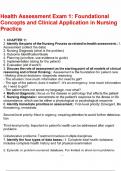
Health Assessment Exam 1: Foundational Concepts and Clinical Application in Nursing PracticeHealth Assessment Exam 1: Foundational Concepts and Clinical Application in Nursing PracticeHealth Assessment Exam 1: Foundational Concepts and Clinical Application in Nursing Practice Health Assessment Exam 1: Foundational Concepts and Clinical Application in Nursing Practice 1. CHAPTER 1:: 2. Identify the parts of the Nursing Process as related to health assessment.: 1. Assessment (collect the data) 2. Nursing Diagnosis (what is the problem) 3. Outcome Identification/Goals 4. Planning (prioritize, use evidence to guide) 5. Implementation (doing for the patient) 6. Evaluation (did it work?) 3. Discuss the role of assessment as the starting point of all models of clinical reasoning and critical thinking.: Assessment is the foundation for patient care: - Making clinical decisions: diagnostic reasoning - The situation: how much information do I need to get? - The age of the patient, does it matter? - It's an emergency, how much information do I need to get? - The patient does not speak my language, now what? 4. Medical diagnosis:: focus on the disease or pathology that affects the patient 5. Nursing diagnosis:: concentrate on the patient's response to the illness or life circumstance, which can be either a physiological or psychological response 6. Identify Immediate priorities in assessment.: First-level priority: Emergent, life threatening, immediate Second-level priority: Next in urgency, requiring attention to avoid further deteriora- tion Third-level priority: Important to patient's health can be addressed after urgent problems Collaborative problems: Treatment involves multiple disciplines 7. Identify the four types of data bases.: 1. Complete total health database: Includes complete health history and full physical examination 2. Episodic or problem-centered database: For limited or short-term problems- Collect "mini" database, smaller scope and more focused than complete database 3. Follow-up database: Status of all identified problems should be evaluated at regular and appropriate intervals 4. Emergency database: Rapid collection of data, often compiled concurrently with lifesaving meas
Written for
- Institution
- Health assessment
- Course
- Health assessment
Document information
- Uploaded on
- May 19, 2025
- Number of pages
- 32
- Written in
- 2024/2025
- Type
- Exam (elaborations)
- Contains
- Questions & answers
Subjects
-
health assessment exam 1 foundational concepts an

Also available in package deal