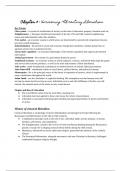
Chapter 3 - Uncovering 19th-century Liberalism
Key Terms:
Class system - A system of stratification of society on the basis of education, property, business/work etc.
Enlightenment - a European intellectual movement of the late 17th and 18th centuries emphasizing
reason and individualism rather than tradition.
Free market - an economic system in which prices are determined by unrestricted competition between
privately owned businesses.
Industrialization - the period of social and economic change that transforms a human group from an
agrarian society into an industrial society.
Laissez-faire capitalism - an economic philosophy of free-market capitalism that opposes government
intervention
Limited government - the concept of a government limited in power.
Traditional economy - an economic system in which traditions, customs, and beliefs help shape the goods
and services the economy produces, as well as the rules and manners of their distribution.
John Locke - made foundational contributions to modern theories of limited, liberal government.
John Stuart Mill - contributed widely to social theory, political theory, and political economy.
Montesquieu - He is the principal source of the theory of separation of powers, which is implemented in
many constitutions throughout the world.
Adam Smith - was the 'forefather' of capitalist thinking. His assumption was that humans were self
serving by nature but that as long as every individual were to seek the fulfillment of her/his own self
interest, the material needs of the whole society would be met.
Origins and Rise of Liberalism
● The word liberal comes from the Latin liber, meaning free.
● Liberalism has been applied to those who favour the reform of government.
● Liberalism is associated with being open-minded and supporting freedom of speech and freedom
of action.
History of classical liberalism
Classical liberalism is an ideology rooted in individualism and emerged in Europe following the
Renaissance and Reformation in the 14th to 16th centuries.
● It emphasizes principles such as the rule of law, individual rights, private property, economic
freedom, self-interest, and competition.
● The Enlightenment, rooted in the revival of Greek and Roman thinking during the Renaissance,
played a crucial role in shaping classical liberal beliefs during the 18th century.
● Humanists, influenced by reason rather than religion, questioned the authority of the Catholic
Church.
● The Protestant Reformation, alongside encounters with non-Christian civilizations, challenged
established European religious thought.
,By the 17th century, Europe experienced turmoil marked by religious wars and contests for imperial
expansion.
● Enlightenment thinkers believed in the potential for freer and more tolerant societies, but these
ideas faced resistance as they challenged existing social foundations.
● The 17th century also witnessed the breakdown of the feudal economic order, leading to the
growth of cities, the emergence of a wealthy middle class, and changes in the economic
landscape.
● Amidst political struggles, demands for economic opportunities, and social movements
challenging the status quo, classical liberalism emerged as a political and economic philosophy
advocating individual rights and limited government intervention. It focused on granting citizens
freedom in their economic, political, and social lives, although in practice, these rights often
applied more to the entrepreneurial class.
Classical liberalism, characterized by principles such as individual rights and freedoms, rational decision-
making, economic freedom, protection of civil liberties, and constitutional limitations on government,
was shaped by influential thinkers including Thomas Hobbes, John Locke, Montesquieu, Adam Smith,
and John Stuart Mill.
Origins of Laissez-Faire economics
Around 1750, the Industrial Revolution marked a significant shift in Great Britain's economy,
transitioning from subsistence farming to industrialization. Three key factors contributed to this
transformation:
● As an island nation, Great Britain heavily relied on sea trade, resulting in a powerful navy, a large
commercial fleet, and a vast empire.
● A parliamentary government and constitutional monarchy, established since the 17th century,
facilitated political stability and shared power between the king and Parliament.
● Enclosure Acts forced low-income farmers into towns, creating a large pool of cheap labor for
industrialization.
Influence of Enlightenment Ideas:
● Enlightenment thinkers promoted human reason, initiative, and individual worth.
● New ideas about human potential, individual worth, and progress converged with a government
friendly to business and innovation, facilitating the development of the factory system.
Laissez-Faire Capitalism:
● The French term "laissez-faire" characterized capitalism during this period, advocating for
reduced government involvement in the economy.
● Physiocrats, Enlightenment philosophers in France, promoted laissez-faire and argued that the
government should leave business entrepreneurs alone to pursue their self-interest.
● Adam Smith, influenced by physiocrats, published "The Wealth of Nations" in 1776, challenging
the prevailing mercantilist system. He proposed a free-market system where individuals working
for their self-interest would benefit society as a whole.
, ● Smith's idea of the "invisible hand" suggested that individual self-interest, when left to operate
freely in a market, unintentionally benefits society by providing jobs and cheaper products.
● Smith advocated for a limited government role, focusing on maintaining the rule of law, ensuring
contract enforcement, and providing some public works.
The convergence of new ideas, political stability, and economic factors in Great Britain around 1750 led
to the Industrial Revolution. This period saw the rise of laissez-faire capitalism, with its emphasis on
individual self-interest, free markets, and limited government intervention, laying the foundation for
classical liberalism.
Evolution of classical liberalist thought
Classical liberalism, shaped by thinkers like Locke, Montesquieu, Smith, and Mill, was concerned with
protecting the rights and freedoms of citizens. This section explores how classical liberal thought evolved
into the principles of liberalism through the lens of the American and French revolutions.
The French Revolution (1789–1799):
● The French Revolution was an attempt to transform society using liberal principles. France faced
economic challenges, a bankrupt government, and inefficient taxation, contributing to widespread
frustration.
● The Estates General, representing three classes, was recalled in 1788. The Third Estate,
representing common people, revolted against the king's authority in 1789.
● Leaders of the Revolution, believing in liberal principles, faced challenges as the movement
developed a mob mentality.
● The Reign of Terror led to thousands losing lives and property.
● Despite the chaos, the Revolution produced important documents reflecting the influence of
liberal thought on French society.
● The recognition of these rights would significantly alter the existing social structure in France.
● Implementation of these principles could challenge the positions and privileges of the clergy,
nobles, middle class, and peasants, promoting equality and individual liberties
Declaration of the Rights of Man and of the Citizen (1789):
● Approved by the National Assembly on August 26, 1789, this document became foundational for
individual freedoms, although it initially applied specifically to men.
● Key excerpts from the Declaration emphasized equality, liberty, and natural rights.
○ Men are born free and equal in rights; social distinctions should be based on the general
good.
○ Political association aims to preserve natural and imprescriptible rights, including liberty,
property, security, and resistance to oppression.
○ Liberty consists in freedom that does not harm others; limits are determined by law.
○ Law is the expression of the general will; citizens have the right to participate.
○ Equality in the eyes of the law, eligibility to public positions based on abilities, and free
communication of ideas are emphasized.
Key Terms:
Class system - A system of stratification of society on the basis of education, property, business/work etc.
Enlightenment - a European intellectual movement of the late 17th and 18th centuries emphasizing
reason and individualism rather than tradition.
Free market - an economic system in which prices are determined by unrestricted competition between
privately owned businesses.
Industrialization - the period of social and economic change that transforms a human group from an
agrarian society into an industrial society.
Laissez-faire capitalism - an economic philosophy of free-market capitalism that opposes government
intervention
Limited government - the concept of a government limited in power.
Traditional economy - an economic system in which traditions, customs, and beliefs help shape the goods
and services the economy produces, as well as the rules and manners of their distribution.
John Locke - made foundational contributions to modern theories of limited, liberal government.
John Stuart Mill - contributed widely to social theory, political theory, and political economy.
Montesquieu - He is the principal source of the theory of separation of powers, which is implemented in
many constitutions throughout the world.
Adam Smith - was the 'forefather' of capitalist thinking. His assumption was that humans were self
serving by nature but that as long as every individual were to seek the fulfillment of her/his own self
interest, the material needs of the whole society would be met.
Origins and Rise of Liberalism
● The word liberal comes from the Latin liber, meaning free.
● Liberalism has been applied to those who favour the reform of government.
● Liberalism is associated with being open-minded and supporting freedom of speech and freedom
of action.
History of classical liberalism
Classical liberalism is an ideology rooted in individualism and emerged in Europe following the
Renaissance and Reformation in the 14th to 16th centuries.
● It emphasizes principles such as the rule of law, individual rights, private property, economic
freedom, self-interest, and competition.
● The Enlightenment, rooted in the revival of Greek and Roman thinking during the Renaissance,
played a crucial role in shaping classical liberal beliefs during the 18th century.
● Humanists, influenced by reason rather than religion, questioned the authority of the Catholic
Church.
● The Protestant Reformation, alongside encounters with non-Christian civilizations, challenged
established European religious thought.
,By the 17th century, Europe experienced turmoil marked by religious wars and contests for imperial
expansion.
● Enlightenment thinkers believed in the potential for freer and more tolerant societies, but these
ideas faced resistance as they challenged existing social foundations.
● The 17th century also witnessed the breakdown of the feudal economic order, leading to the
growth of cities, the emergence of a wealthy middle class, and changes in the economic
landscape.
● Amidst political struggles, demands for economic opportunities, and social movements
challenging the status quo, classical liberalism emerged as a political and economic philosophy
advocating individual rights and limited government intervention. It focused on granting citizens
freedom in their economic, political, and social lives, although in practice, these rights often
applied more to the entrepreneurial class.
Classical liberalism, characterized by principles such as individual rights and freedoms, rational decision-
making, economic freedom, protection of civil liberties, and constitutional limitations on government,
was shaped by influential thinkers including Thomas Hobbes, John Locke, Montesquieu, Adam Smith,
and John Stuart Mill.
Origins of Laissez-Faire economics
Around 1750, the Industrial Revolution marked a significant shift in Great Britain's economy,
transitioning from subsistence farming to industrialization. Three key factors contributed to this
transformation:
● As an island nation, Great Britain heavily relied on sea trade, resulting in a powerful navy, a large
commercial fleet, and a vast empire.
● A parliamentary government and constitutional monarchy, established since the 17th century,
facilitated political stability and shared power between the king and Parliament.
● Enclosure Acts forced low-income farmers into towns, creating a large pool of cheap labor for
industrialization.
Influence of Enlightenment Ideas:
● Enlightenment thinkers promoted human reason, initiative, and individual worth.
● New ideas about human potential, individual worth, and progress converged with a government
friendly to business and innovation, facilitating the development of the factory system.
Laissez-Faire Capitalism:
● The French term "laissez-faire" characterized capitalism during this period, advocating for
reduced government involvement in the economy.
● Physiocrats, Enlightenment philosophers in France, promoted laissez-faire and argued that the
government should leave business entrepreneurs alone to pursue their self-interest.
● Adam Smith, influenced by physiocrats, published "The Wealth of Nations" in 1776, challenging
the prevailing mercantilist system. He proposed a free-market system where individuals working
for their self-interest would benefit society as a whole.
, ● Smith's idea of the "invisible hand" suggested that individual self-interest, when left to operate
freely in a market, unintentionally benefits society by providing jobs and cheaper products.
● Smith advocated for a limited government role, focusing on maintaining the rule of law, ensuring
contract enforcement, and providing some public works.
The convergence of new ideas, political stability, and economic factors in Great Britain around 1750 led
to the Industrial Revolution. This period saw the rise of laissez-faire capitalism, with its emphasis on
individual self-interest, free markets, and limited government intervention, laying the foundation for
classical liberalism.
Evolution of classical liberalist thought
Classical liberalism, shaped by thinkers like Locke, Montesquieu, Smith, and Mill, was concerned with
protecting the rights and freedoms of citizens. This section explores how classical liberal thought evolved
into the principles of liberalism through the lens of the American and French revolutions.
The French Revolution (1789–1799):
● The French Revolution was an attempt to transform society using liberal principles. France faced
economic challenges, a bankrupt government, and inefficient taxation, contributing to widespread
frustration.
● The Estates General, representing three classes, was recalled in 1788. The Third Estate,
representing common people, revolted against the king's authority in 1789.
● Leaders of the Revolution, believing in liberal principles, faced challenges as the movement
developed a mob mentality.
● The Reign of Terror led to thousands losing lives and property.
● Despite the chaos, the Revolution produced important documents reflecting the influence of
liberal thought on French society.
● The recognition of these rights would significantly alter the existing social structure in France.
● Implementation of these principles could challenge the positions and privileges of the clergy,
nobles, middle class, and peasants, promoting equality and individual liberties
Declaration of the Rights of Man and of the Citizen (1789):
● Approved by the National Assembly on August 26, 1789, this document became foundational for
individual freedoms, although it initially applied specifically to men.
● Key excerpts from the Declaration emphasized equality, liberty, and natural rights.
○ Men are born free and equal in rights; social distinctions should be based on the general
good.
○ Political association aims to preserve natural and imprescriptible rights, including liberty,
property, security, and resistance to oppression.
○ Liberty consists in freedom that does not harm others; limits are determined by law.
○ Law is the expression of the general will; citizens have the right to participate.
○ Equality in the eyes of the law, eligibility to public positions based on abilities, and free
communication of ideas are emphasized.