PRO4801
ASSIGNMENT 2 2025
UNIQUE NO.
DUE DATE: MAY 2025
, PRO4801 Assignment 2 (2025)
Question 2.1 – Organic Project Organisations
(i) What does “organic” mean? (10 marks)
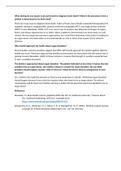
An organic organisational structure refers to a flexible and evolving system of
management that adapts easily to change. Unlike rigid, bureaucratic structures, an
organic model is marked by low levels of formalisation and hierarchy. Authority is often
decentralised, allowing for faster decision-making and greater autonomy among team
members. This type of structure is particularly well-suited to project environments where
innovation, unpredictability, and responsiveness are critical.
In organic project organisations, communication tends to flow freely across
departments, encouraging collaboration and knowledge sharing. Rather than being
confined by strict roles or job titles, individuals often perform diverse tasks based on the
project’s needs. This enables teams to rapidly adjust to new challenges and
opportunities as they arise.
Key characteristics of organic structures include:
Minimal rules and procedures (low formalisation).
Decentralised authority, promoting local decision-making.
Strong emphasis on direct and informal communication.
Roles are flexible and task-based rather than fixed.
Cross-functional collaboration is common.
High adaptability to change and project-specific demands.
Such a structure is ideal for dynamic settings, such as technology development or
creative industries, where teams must be innovative and responsive.
(ii) Integrators’ Role in Coordination and Adjustment (15 marks)
ASSIGNMENT 2 2025
UNIQUE NO.
DUE DATE: MAY 2025
, PRO4801 Assignment 2 (2025)
Question 2.1 – Organic Project Organisations
(i) What does “organic” mean? (10 marks)
An organic organisational structure refers to a flexible and evolving system of
management that adapts easily to change. Unlike rigid, bureaucratic structures, an
organic model is marked by low levels of formalisation and hierarchy. Authority is often
decentralised, allowing for faster decision-making and greater autonomy among team
members. This type of structure is particularly well-suited to project environments where
innovation, unpredictability, and responsiveness are critical.
In organic project organisations, communication tends to flow freely across
departments, encouraging collaboration and knowledge sharing. Rather than being
confined by strict roles or job titles, individuals often perform diverse tasks based on the
project’s needs. This enables teams to rapidly adjust to new challenges and
opportunities as they arise.
Key characteristics of organic structures include:
Minimal rules and procedures (low formalisation).
Decentralised authority, promoting local decision-making.
Strong emphasis on direct and informal communication.
Roles are flexible and task-based rather than fixed.
Cross-functional collaboration is common.
High adaptability to change and project-specific demands.
Such a structure is ideal for dynamic settings, such as technology development or
creative industries, where teams must be innovative and responsive.
(ii) Integrators’ Role in Coordination and Adjustment (15 marks)