Biopsychology notes
The nervous system
1. Central: receives info from the senses and controls the body’s responses
2. Peripheral: messages to and from CNS (sensory neurones)
a) Autonomic nervous system: involuntary
i) Sympathetic: fight or flight
ii) Parasympathetic: rest and relax (after emergency)
b) Somatic: voluntary (receives info from CNS to control muscles and glands)
The endocrine system
Where hormones are secreted from different glands into the blood and transported to
target cells Its regulated by a feedback loop to maintain stable concentrations of hormones.
Pituitary gland
i) Anterior ACTH (stimulates adrenal gland to produce cortisol)
ii) Posterior Oxytocin (uterine contractions and mother infant bonding)
Adrenal glands
i) Adrenal cortex Cortisol (stress, quick burst of energy lower pain sensitivity,
lowered immunity impaired cognitive)
ii) Adrenal medulla Noradrenaline/Adrenaline fight or flight, increasing blood flow
to the brain, muscles and heart rate)
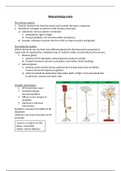
Synaptic transmission
AP travels down axon
Terminal releases
neurotransmitters
Diffuse across synapse to
receptors
chemical to electrical
transmission
Excitatory: increases formation of AP
dopamine
Inhibitory: decreases formation of AP
serotonin
Sensory: receptors to CNS
Relay: connection
Motor: CNS to effectors
, Fight or flight
When an individual is faced with a threat amygdala is immobilised associates sensory with
emotional sends stressing signal to hypothalamus
Response to acute stress: sympathetic nervous system prepares for fight or flight
sends signal to adrenal medulla to secrete adrenaline (increase BP and breathing)
parasympathetic dampens after fight or flight is over.
Response to Chronic ongoing stress: hypothalamus releases CRH, which causes
pituitary to secrete ACTH stimulates adrenal glands to stimulate cortisol
P cannot be generalised to both genders
E Shelley Taylor 2000 females also befriend
E beta bias towards women and low population validity
L decreases effectiveness of theory as can’t be applied to everyone idiographic approach
P fight or flight is useful in defending against a stressor that requires energetic behavioural
response not modern day
E increased BP due to prolonged stress lead to damage blood vessels then heart disease
E no longer an adaptive advantage modern human
L so fight or flight in modern life can have more implications then positives
Localisation of function
The localisation theory suggests that different parts of the brain are responsible for different
actions, behaviours and processes.
Motor cortex: movement
Central sulcus: separates motor
and sensory
Somatosensory cortex: processes
sensory info such as touch
Parietal lobe: comprehension of
language
Broca’s lobe: speech damage to
this area results in Broca’s
aphasia difficulty forming
sentences and understanding
sentences (broca research)
Temporal lobe: hearing
Occipital lobe: primary vision
Wernicke’s area: comprehension of speech damage leads to Wernicke’s aphasia use
of nonsensical words (research by Wernicke)
Cerebellum: coordination
Brainstem: swallowing, breathing involuntary function
Temporal lobe: intellectual and emotional function
Frontal lobe: judgement foresight and voluntary insight
The nervous system
1. Central: receives info from the senses and controls the body’s responses
2. Peripheral: messages to and from CNS (sensory neurones)
a) Autonomic nervous system: involuntary
i) Sympathetic: fight or flight
ii) Parasympathetic: rest and relax (after emergency)
b) Somatic: voluntary (receives info from CNS to control muscles and glands)
The endocrine system
Where hormones are secreted from different glands into the blood and transported to
target cells Its regulated by a feedback loop to maintain stable concentrations of hormones.
Pituitary gland
i) Anterior ACTH (stimulates adrenal gland to produce cortisol)
ii) Posterior Oxytocin (uterine contractions and mother infant bonding)
Adrenal glands
i) Adrenal cortex Cortisol (stress, quick burst of energy lower pain sensitivity,
lowered immunity impaired cognitive)
ii) Adrenal medulla Noradrenaline/Adrenaline fight or flight, increasing blood flow
to the brain, muscles and heart rate)
Synaptic transmission
AP travels down axon
Terminal releases
neurotransmitters
Diffuse across synapse to
receptors
chemical to electrical
transmission
Excitatory: increases formation of AP
dopamine
Inhibitory: decreases formation of AP
serotonin
Sensory: receptors to CNS
Relay: connection
Motor: CNS to effectors
, Fight or flight
When an individual is faced with a threat amygdala is immobilised associates sensory with
emotional sends stressing signal to hypothalamus
Response to acute stress: sympathetic nervous system prepares for fight or flight
sends signal to adrenal medulla to secrete adrenaline (increase BP and breathing)
parasympathetic dampens after fight or flight is over.
Response to Chronic ongoing stress: hypothalamus releases CRH, which causes
pituitary to secrete ACTH stimulates adrenal glands to stimulate cortisol
P cannot be generalised to both genders
E Shelley Taylor 2000 females also befriend
E beta bias towards women and low population validity
L decreases effectiveness of theory as can’t be applied to everyone idiographic approach
P fight or flight is useful in defending against a stressor that requires energetic behavioural
response not modern day
E increased BP due to prolonged stress lead to damage blood vessels then heart disease
E no longer an adaptive advantage modern human
L so fight or flight in modern life can have more implications then positives
Localisation of function
The localisation theory suggests that different parts of the brain are responsible for different
actions, behaviours and processes.
Motor cortex: movement
Central sulcus: separates motor
and sensory
Somatosensory cortex: processes
sensory info such as touch
Parietal lobe: comprehension of
language
Broca’s lobe: speech damage to
this area results in Broca’s
aphasia difficulty forming
sentences and understanding
sentences (broca research)
Temporal lobe: hearing
Occipital lobe: primary vision
Wernicke’s area: comprehension of speech damage leads to Wernicke’s aphasia use
of nonsensical words (research by Wernicke)
Cerebellum: coordination
Brainstem: swallowing, breathing involuntary function
Temporal lobe: intellectual and emotional function
Frontal lobe: judgement foresight and voluntary insight