[DATE]
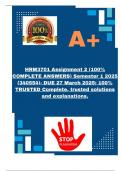
COM3705
ASSIGNMENT 3
(PORTFOLIO)
SEMESTER 1 MEMO |
DUE 23 MAY 2025
USER
NO PLAGIARISM
, Exam (elaborations)
COM3705 Assignment 3 (Portfolio) Semester
1 Memo | Due 23 May 2025
Course
International Communication (COM3705)
Institution
University Of South Africa (Unisa)
Book
Media Imperialism
COM3705 Assignment 3 (Portfolio) Semester 1 Memo | Due 23 May 2025. All
questions fully answered.
QUESTION 1: INTERNATIONAL RELATIONS (Dzuni Mtimbani) (45) READ THE
BELOW ARTICLE BEFORE YOU ANSWER THE QUESTIONS South Africa
committed to US ties after ‗regrettable‘ expulsion of envoy South Africa has
said the decision of the United States to expel Ambassador Ebrahim Rasool is
―regrettable‖, but the country ―remains committed to building a mutually
beneficial relationship‖ with Washington. South Africa‘s presidency urged
―all relevant and impacted stakeholders to maintain the established
diplomatic decorum in their engagement with the matter‖ in a statement
issued on Saturday morning, just hours after US State Secretary Marco Rubio
called Rasool a ―race-baiting politician‖ who hates the US and President
Donald Trump. Rubio wrote on X that Rasool was ―no longer welcome in our
great country‖, adding: ―We have nothing to discuss with him and so he is
considered PERSONA NON GRATA.‖ Rubio linked his remarks to an article by
the right-wing media outlet Breitbart, wherein Rasool is quoted as saying
Trump mobilised a ―supremacist instinct‖ and ―white victimhood‖ as a
―dog whistle‖ during the 2024 elections. But South African political analyst
Sandile Swana told Al Jazeera that the ―core of the dispute‖ was Pretoria‘s
decision to form a genocide case at the International Court of Justice against
Israel, a close US ally, over its war on Gaza. In February, Rasool, an
antiapartheid campaigner, told the Zeteo news site that what South Africans
experienced during apartheid rule ―is on steroids in Palestine‖. Moreover,
Swana explained that in the fight against apartheid, the US ―supported the
apartheid regime‖.―[So] Rasool continues to point out the behaviour of the
United States, even now is to support apartheid and genocide,‖ he added.
Land policy Still, the decision by Washington to expel the South African
ambassador comes at a time of heightened tensions between the two
countries, since Trump cut financial aid to South Africa after citing his
disapproval of its land policy that he alleged allows land to be seized from
white farmers. Last week, Trump pushed this further and said South Africa‘s
, farmers were welcome to settle in the US, repeating that the South African
government was ―confiscating‖ land from white people. South African-born
tech billionaire Elon Musk, a close Trump ally, has also accused the country
of having ―openly racist ownership laws‖. However, South African President
Cyril Ramaphosa has defended the policy, saying the government was not
confiscating land but aiming to level racial disparities in land ownership in
the Black-majority nation. Instructions In light of the above article, and the
prescribed readings (including your Study Guide), write an essay and it must
include the following points: 1.1 Introduction (it must introduce all the key
points of the essay) (3)
1.1 Introduction (3 marks)
The expulsion of South African Ambassador Ebrahim Rasool by the United States has sparked
significant diplomatic tensions between the two nations. The United States, citing Rasool's
controversial comments about US politics and his strong stance on the Israel-Palestine conflict,
declared him persona non grata. This move comes amid a broader disagreement over South
Africa's foreign policy, particularly its position on Palestine and its internal land reform policy.
The expulsion is also set against the backdrop of historical and ongoing tensions, with the US
criticizing South Africa's land reform and racial policies. Despite the diplomatic rift, South
Africa remains committed to nurturing a constructive and mutually beneficial relationship with
the US. This essay will explore the key aspects of this dispute, analyzing the core issues of US-
South African relations, land policy, and foreign policy vis-à-vis Israel and Palestine.
1.1 Introduction
The diplomatic tensions between South Africa and the United States, as highlighted by the recent
expulsion of South African Ambassador Ebrahim Rasool, reflect deep-seated political and
ideological differences between the two nations. This incident, which has been described by
South Africa as “regrettable,” underscores growing friction stemming from Pretoria's
international stance on human rights issues—most notably its genocide case against Israel at the
International Court of Justice (ICJ). The comments made by US Secretary of State Marco Rubio
and other political figures such as Donald Trump and Elon Musk further complicate the
situation, revealing how race, foreign policy, and land reform have become flashpoints in the
bilateral relationship. This essay explores the core reasons behind Rasool’s expulsion, the
broader international and historical context of US–South Africa relations, and the implications of
South Africa's land reform policy for its global diplomatic standing. Additionally, it discusses
how these developments reflect power dynamics in international relations, the legacy of
COM3705
ASSIGNMENT 3
(PORTFOLIO)
SEMESTER 1 MEMO |
DUE 23 MAY 2025
USER
NO PLAGIARISM
, Exam (elaborations)
COM3705 Assignment 3 (Portfolio) Semester
1 Memo | Due 23 May 2025
Course
International Communication (COM3705)
Institution
University Of South Africa (Unisa)
Book
Media Imperialism
COM3705 Assignment 3 (Portfolio) Semester 1 Memo | Due 23 May 2025. All
questions fully answered.
QUESTION 1: INTERNATIONAL RELATIONS (Dzuni Mtimbani) (45) READ THE
BELOW ARTICLE BEFORE YOU ANSWER THE QUESTIONS South Africa
committed to US ties after ‗regrettable‘ expulsion of envoy South Africa has
said the decision of the United States to expel Ambassador Ebrahim Rasool is
―regrettable‖, but the country ―remains committed to building a mutually
beneficial relationship‖ with Washington. South Africa‘s presidency urged
―all relevant and impacted stakeholders to maintain the established
diplomatic decorum in their engagement with the matter‖ in a statement
issued on Saturday morning, just hours after US State Secretary Marco Rubio
called Rasool a ―race-baiting politician‖ who hates the US and President
Donald Trump. Rubio wrote on X that Rasool was ―no longer welcome in our
great country‖, adding: ―We have nothing to discuss with him and so he is
considered PERSONA NON GRATA.‖ Rubio linked his remarks to an article by
the right-wing media outlet Breitbart, wherein Rasool is quoted as saying
Trump mobilised a ―supremacist instinct‖ and ―white victimhood‖ as a
―dog whistle‖ during the 2024 elections. But South African political analyst
Sandile Swana told Al Jazeera that the ―core of the dispute‖ was Pretoria‘s
decision to form a genocide case at the International Court of Justice against
Israel, a close US ally, over its war on Gaza. In February, Rasool, an
antiapartheid campaigner, told the Zeteo news site that what South Africans
experienced during apartheid rule ―is on steroids in Palestine‖. Moreover,
Swana explained that in the fight against apartheid, the US ―supported the
apartheid regime‖.―[So] Rasool continues to point out the behaviour of the
United States, even now is to support apartheid and genocide,‖ he added.
Land policy Still, the decision by Washington to expel the South African
ambassador comes at a time of heightened tensions between the two
countries, since Trump cut financial aid to South Africa after citing his
disapproval of its land policy that he alleged allows land to be seized from
white farmers. Last week, Trump pushed this further and said South Africa‘s
, farmers were welcome to settle in the US, repeating that the South African
government was ―confiscating‖ land from white people. South African-born
tech billionaire Elon Musk, a close Trump ally, has also accused the country
of having ―openly racist ownership laws‖. However, South African President
Cyril Ramaphosa has defended the policy, saying the government was not
confiscating land but aiming to level racial disparities in land ownership in
the Black-majority nation. Instructions In light of the above article, and the
prescribed readings (including your Study Guide), write an essay and it must
include the following points: 1.1 Introduction (it must introduce all the key
points of the essay) (3)
1.1 Introduction (3 marks)
The expulsion of South African Ambassador Ebrahim Rasool by the United States has sparked
significant diplomatic tensions between the two nations. The United States, citing Rasool's
controversial comments about US politics and his strong stance on the Israel-Palestine conflict,
declared him persona non grata. This move comes amid a broader disagreement over South
Africa's foreign policy, particularly its position on Palestine and its internal land reform policy.
The expulsion is also set against the backdrop of historical and ongoing tensions, with the US
criticizing South Africa's land reform and racial policies. Despite the diplomatic rift, South
Africa remains committed to nurturing a constructive and mutually beneficial relationship with
the US. This essay will explore the key aspects of this dispute, analyzing the core issues of US-
South African relations, land policy, and foreign policy vis-à-vis Israel and Palestine.
1.1 Introduction
The diplomatic tensions between South Africa and the United States, as highlighted by the recent
expulsion of South African Ambassador Ebrahim Rasool, reflect deep-seated political and
ideological differences between the two nations. This incident, which has been described by
South Africa as “regrettable,” underscores growing friction stemming from Pretoria's
international stance on human rights issues—most notably its genocide case against Israel at the
International Court of Justice (ICJ). The comments made by US Secretary of State Marco Rubio
and other political figures such as Donald Trump and Elon Musk further complicate the
situation, revealing how race, foreign policy, and land reform have become flashpoints in the
bilateral relationship. This essay explores the core reasons behind Rasool’s expulsion, the
broader international and historical context of US–South Africa relations, and the implications of
South Africa's land reform policy for its global diplomatic standing. Additionally, it discusses
how these developments reflect power dynamics in international relations, the legacy of