Becker CPA FAR
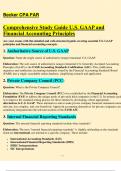
Comprehensive Study Guide U.S. GAAP and
Financial Accounting Principles
Ace your exams with this detailed and well-structured guide covering essential U.S. GAAP
principles and financial accounting concepts.
1. Authoritative Source of U.S. GAAP
Question: Name the single source of authoritative nongovernmental U.S. GAAP.
Elaboration: The sole source of authoritative nongovernmental U.S. Generally Accepted Accounting
Principles (GAAP) is the FASB Accounting Standards Codification (ASC). This codification
organizes and synthesizes accounting standards issued by the Financial Accounting Standards Board
(FASB) into a single, searchable online database, simplifying research and application.
2. Private Company Council (PCC)
Question: What is the Private Company Council?
Elaboration: The Private Company Council (PCC) was established by the Financial Accounting
Foundation (FAF) to address the unique needs of privately held companies in the U.S. Its primary goal
is to improve the standard-setting process for these entities by developing, where appropriate,
alternatives to U.S. GAAP. These alternatives aim to make private company financial statements more
relevant, less complex, and cost-beneficial. Approved accounting alternatives for private companies are
seamlessly integrated into the relevant sections of the FASB ASC.
3. Internal Financial Reporting Standards
Question: The internal financial reporting standards include what standards?
Elaboration: The term "internal financial reporting standards" is slightly misleading as the standards
listed are international, not internal to a specific company. These include:
International Accounting Standards (IAS)
International Financial Reporting Standards (IFRS)
IFRIC Interpretations
SIC Interpretations
,These standards are developed and issued by the International Accounting Standards Board (IASB) and
are used by many countries around the world.
4. Primary Users of General Purpose Financial Reports
Question: Who are the primary users of general purpose financial reports?
Elaboration: The primary users of general purpose financial reports are existing and potential
investors, lenders, and other creditors. These users rely on financial reports to make decisions about
providing resources to the entity. Their information needs include assessing the entity's:
Ability to generate cash flows
Management's stewardship of the entity's resources
Financial position and performance
5. Fundamental Qualitative Characteristics of Useful Financial
Information
Question: Name the fundamental qualitative characteristics of useful financial information.
Elaboration: The two fundamental qualitative characteristics that make financial information useful
are:
Relevance: Information is relevant if it is capable of making a difference in the decisions made
by users.
Faithful Representation: Information faithfully represents the economic phenomena that it
purports to represent.
Both characteristics are essential for financial information to be considered useful.
6. Elements of Relevance
Question: Name the three elements of relevance.
Elaboration: Relevance is composed of three key elements:
Predictive Value: Information has predictive value if it can be used as an input to processes
employed by users to form their own expectations about the future.
Confirming Value: Information has confirming value if it provides feedback about (confirms or
changes) users' earlier expectations.
, Materiality: Information is material if omitting it or misstating it could reasonably be expected
to influence decisions that the primary users of general purpose financial reports make on the
basis of those reports. Materiality is entity-specific.
7. Elements of Faithful Representation
Question: Name the three elements of faithful representation.
Elaboration: Faithful representation comprises three characteristics:
Completeness: All the information that is necessary for a user to understand the phenomenon
being depicted, including all necessary descriptions and explanations, is provided.
Neutrality: The information is without bias in the selection or presentation of financial
information. It is not slanted, weighted, emphasized, deemphasized, or otherwise manipulated to
increase the probability that financial information will be received favorably or unfavorably by
users.
Freedom from Error: There are no errors or omissions in the description of the phenomenon,
and the process used to produce the reported information has been selected and applied with no
errors in the process.
8. Enhancing Qualitative Characteristics of Financial Information
Question: Name the enhancing qualitative characteristics of financial information.
Elaboration: The enhancing qualitative characteristics improve the usefulness of financial information
that is relevant and faithfully represented. These include:
Comparability: Information is comparable if it enables users to identify and understand
similarities in, and differences among, items. Consistency, which refers to the use of the same
methods for the same items, period after period, enhances comparability.
Verifiability: Verifiable information means that knowledgeable and independent observers could
reach consensus, although not necessarily complete agreement, that a particular depiction is a
faithful representation.
Timeliness: Timeliness means having information available to decision-makers in time to be
capable of influencing their decisions.
Understandability: Classifying, characterizing, and presenting information clearly and concisely
makes it understandable.
9. Pervasive Constraint on Financial Reporting Information
Question: Name the pervasive constraint on the information provided in financial reporting.
, Elaboration: The pervasive constraint on the information provided in financial reporting is the cost
constraint. This principle states that the benefits of reporting financial information must outweigh the
costs of obtaining and presenting that information. Assessing whether the benefits justify the costs is a
judgment made by preparers, auditors, and users.
10. Full Set of Financial Statements (SFAC No. 5)
Question: According to SFAC No. 5, what should a full set of financial statements include?
Elaboration: According to Statement of Financial Accounting Concepts (SFAC) No. 5, a full set of
financial statements should include:
Statement of Financial Position (the Balance Sheet)
Statement of Earnings (the Income Statement)
Statement of Comprehensive Income
Statement of Cash Flows
Statement of Changes in Owners' Equity
These statements, along with related notes, provide a comprehensive view of an entity's financial
performance and position.
11. Elements of Financial Statements (SFAC No. 6)
Question: List the 10 elements of financial statements according to SFAC #6.
Elaboration: According to SFAC No. 6, the 10 elements of financial statements are often remembered
by the acronym CREG A LIDE:
Comprehensive Income
Revenues
Expenses
Gains
Losses
Assets
Liabilities
Equity (or Net Assets)
Investment by Owners
Distributions to Owners
12. Elements of Present Value Measurement (SFAC #7)
Question: Name the five elements of present value measurement per SFAC #7.
Comprehensive Study Guide U.S. GAAP and
Financial Accounting Principles
Ace your exams with this detailed and well-structured guide covering essential U.S. GAAP
principles and financial accounting concepts.
1. Authoritative Source of U.S. GAAP
Question: Name the single source of authoritative nongovernmental U.S. GAAP.
Elaboration: The sole source of authoritative nongovernmental U.S. Generally Accepted Accounting
Principles (GAAP) is the FASB Accounting Standards Codification (ASC). This codification
organizes and synthesizes accounting standards issued by the Financial Accounting Standards Board
(FASB) into a single, searchable online database, simplifying research and application.
2. Private Company Council (PCC)
Question: What is the Private Company Council?
Elaboration: The Private Company Council (PCC) was established by the Financial Accounting
Foundation (FAF) to address the unique needs of privately held companies in the U.S. Its primary goal
is to improve the standard-setting process for these entities by developing, where appropriate,
alternatives to U.S. GAAP. These alternatives aim to make private company financial statements more
relevant, less complex, and cost-beneficial. Approved accounting alternatives for private companies are
seamlessly integrated into the relevant sections of the FASB ASC.
3. Internal Financial Reporting Standards
Question: The internal financial reporting standards include what standards?
Elaboration: The term "internal financial reporting standards" is slightly misleading as the standards
listed are international, not internal to a specific company. These include:
International Accounting Standards (IAS)
International Financial Reporting Standards (IFRS)
IFRIC Interpretations
SIC Interpretations
,These standards are developed and issued by the International Accounting Standards Board (IASB) and
are used by many countries around the world.
4. Primary Users of General Purpose Financial Reports
Question: Who are the primary users of general purpose financial reports?
Elaboration: The primary users of general purpose financial reports are existing and potential
investors, lenders, and other creditors. These users rely on financial reports to make decisions about
providing resources to the entity. Their information needs include assessing the entity's:
Ability to generate cash flows
Management's stewardship of the entity's resources
Financial position and performance
5. Fundamental Qualitative Characteristics of Useful Financial
Information
Question: Name the fundamental qualitative characteristics of useful financial information.
Elaboration: The two fundamental qualitative characteristics that make financial information useful
are:
Relevance: Information is relevant if it is capable of making a difference in the decisions made
by users.
Faithful Representation: Information faithfully represents the economic phenomena that it
purports to represent.
Both characteristics are essential for financial information to be considered useful.
6. Elements of Relevance
Question: Name the three elements of relevance.
Elaboration: Relevance is composed of three key elements:
Predictive Value: Information has predictive value if it can be used as an input to processes
employed by users to form their own expectations about the future.
Confirming Value: Information has confirming value if it provides feedback about (confirms or
changes) users' earlier expectations.
, Materiality: Information is material if omitting it or misstating it could reasonably be expected
to influence decisions that the primary users of general purpose financial reports make on the
basis of those reports. Materiality is entity-specific.
7. Elements of Faithful Representation
Question: Name the three elements of faithful representation.
Elaboration: Faithful representation comprises three characteristics:
Completeness: All the information that is necessary for a user to understand the phenomenon
being depicted, including all necessary descriptions and explanations, is provided.
Neutrality: The information is without bias in the selection or presentation of financial
information. It is not slanted, weighted, emphasized, deemphasized, or otherwise manipulated to
increase the probability that financial information will be received favorably or unfavorably by
users.
Freedom from Error: There are no errors or omissions in the description of the phenomenon,
and the process used to produce the reported information has been selected and applied with no
errors in the process.
8. Enhancing Qualitative Characteristics of Financial Information
Question: Name the enhancing qualitative characteristics of financial information.
Elaboration: The enhancing qualitative characteristics improve the usefulness of financial information
that is relevant and faithfully represented. These include:
Comparability: Information is comparable if it enables users to identify and understand
similarities in, and differences among, items. Consistency, which refers to the use of the same
methods for the same items, period after period, enhances comparability.
Verifiability: Verifiable information means that knowledgeable and independent observers could
reach consensus, although not necessarily complete agreement, that a particular depiction is a
faithful representation.
Timeliness: Timeliness means having information available to decision-makers in time to be
capable of influencing their decisions.
Understandability: Classifying, characterizing, and presenting information clearly and concisely
makes it understandable.
9. Pervasive Constraint on Financial Reporting Information
Question: Name the pervasive constraint on the information provided in financial reporting.
, Elaboration: The pervasive constraint on the information provided in financial reporting is the cost
constraint. This principle states that the benefits of reporting financial information must outweigh the
costs of obtaining and presenting that information. Assessing whether the benefits justify the costs is a
judgment made by preparers, auditors, and users.
10. Full Set of Financial Statements (SFAC No. 5)
Question: According to SFAC No. 5, what should a full set of financial statements include?
Elaboration: According to Statement of Financial Accounting Concepts (SFAC) No. 5, a full set of
financial statements should include:
Statement of Financial Position (the Balance Sheet)
Statement of Earnings (the Income Statement)
Statement of Comprehensive Income
Statement of Cash Flows
Statement of Changes in Owners' Equity
These statements, along with related notes, provide a comprehensive view of an entity's financial
performance and position.
11. Elements of Financial Statements (SFAC No. 6)
Question: List the 10 elements of financial statements according to SFAC #6.
Elaboration: According to SFAC No. 6, the 10 elements of financial statements are often remembered
by the acronym CREG A LIDE:
Comprehensive Income
Revenues
Expenses
Gains
Losses
Assets
Liabilities
Equity (or Net Assets)
Investment by Owners
Distributions to Owners
12. Elements of Present Value Measurement (SFAC #7)
Question: Name the five elements of present value measurement per SFAC #7.