
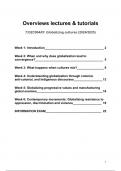
Overviews lectures & tutorials
7332C004AY: Globalizing cultures (2024/2025)
Week 1: Introduction___________________________________ 2
Week 2: When and why does globalization lead to
convergence?________________________________________ 5
Week 3: What happens when cultures mix?________________ 9
Week 4: Understanding globalization through colonial,
anti-colonial, and Indigenous discourses_________________ 13
Week 5: Globalizing progressive values and manufacturing
global enemies_______________________________________16
Week 6: Contemporary movements: Globalizing resistance to
oppression, discrimination and violence_________________ 19
INFORMATION EXAM_________________________________ 22
1
,Week 1: Introduction
1.1 Learning goals:
● Understand multiple definitions of globalization.
● Critically assess historical timelines for globalization.
● Recognize globalization as a relational process (Mintz).
● Comprehend globalization through liquid flows (Ritzer).
● Examine how culture is shaped by and shapes globalization.
1.2 What is globalization?
There is no single definition of globalization. Different thinkers use different meanings.
Every definition/theory highlights different elements and sees globalization starting in a
different time period, from Homo sapiens to modern capitalism:
● George Ritzer (2009): Increasing liquidity and multidirectional flows (goods,
money, people, technology etc). Startpoint was in the industrial revolution.
● Jan Nederveen Pieterse (1995): Long-term worldwide interconnectedness.
Startpoint was prehistoric when humans began migrating.
● Roland Robertson (1992): Consciousness of the world as a whole. Startpoint was
when humans gained this consciousness (prehistoric).
● Immanuel Wallerstein (1974): World systems theory (capitalism spreads globally
from colonial centers). Startpoint was in the 15th century when colonialism started.
● Lechner & Boli (2005): Neo-institutional theory (world consists of a global society
composed of nation-states and international organizations that share a common
world culture. Startpoint was the 19th century according to them.
● Arjun Appadurai (1990): Deterritorialization (cultures detach from specific
geographies due to migration, media and commodification). Startpoint is 20th
century.
1.3 Why Study globalization through culture?
Studying globalization through the lens of culture allows us to see how deeply it is woven
into the fabric of everyday life. Culture is not just something affected by globalization, it is
one of the engines driving it. Cultural practices, identities, and norms travel and transform
across borders. In a globalized world, culture can both unite and divide. It connects people
across continents while also provoking local resistance, such as the rise of nationalist
populism. In this context, understanding culture is essential to understanding how
globalization functions and why it often provokes political and emotional responses.
The desire for safety and a stable sense of identity often increases in reaction to
globalization’s fluidity. This can help explain the resurgence of radical right-wing populist
movements, which seek to reassert the power of the nation-state and preserve cultural
homogeneity in an increasingly diverse and interconnected world.
2
, 1.4 Ritzer’s flows and liquidity
Ritzer sees globalization as the transformation of the solid into liquid: structures dissolve,
things become mobile. Liquidity refers to the ease and speed at which things (people, goods
and ideas) move. Solids (such as national borders, fixed institutions, and localized cultures)
are being reshaped by global flows. As these flows increase in volume and speed, the world
becomes more flexible and interconnected. However, this transformation is not evenly
distributed. Not all people, ideas, or products move freely. Structures such as borders, class
divisions, technological access, and political power continue to shape who and what can
move, and who or what is left behind.
Ritzer identities four types of flows:
1. Interconnected: One flow causes or intersects with another.
2. Multidirectional: Many directions at once, interdependent.
3. Conflicting: Aim to block others (eg terrorism blocks travel).
4. Reverse: Flows that bounce back (eg outsourcing leads to unemployment at home).
Different structures that can affect flows are nation states, capitalism, regulations, networks,
technology, language, geography and colonial histories. These global flows are not free; they
are shaped by power, infrastructure, and historical inequalities.
1.5 Appadurai’s deterritorialization
Appadurai’s concept of deterritorialization highlights the disconnection between culture and
location in the global era. In earlier historical periods, cultures were often tightly tied to
geographic places. Today, cultural practices are mobile: they are carried by migrants,
transmitted through media, and commodified into global products. You can now find
elements of a culture (such as cuisine, language, music, or religious rituals) far from their
places of origin. This means that culture and place are no longer inherently linked. The
global flows of people and information have made it possible to maintain or even reinvent a
cultural identity away from its traditional homeland. Culture has become portable.
1.6 Mintz on sugar
Sidney Mintz’s analysis of sugar provides a powerful example of how to understand
globalization as a relational and historical process. Sugar, which is now cheap and
ubiquitous, was once an expensive luxury item available only to the wealthy. Its transition
into a common ingredient used by working-class families in Europe is inseparable from the
history of colonialism and industrial capitalism.
Mintz argues that colonialism played a crucial role in this transformation. The establishment
of sugar plantations in the Caribbean and the use of enslaved labor allowed for mass
production at low cost. At the same time, industrialization in Europe created a new working
class with little time or resources to cook elaborate meals. Women, in particular, turned to
sugar as a quick and affordable source of calories. This shift in consumption patterns made
sugar a daily necessity and integrated it into the capitalist system.
What makes Mintz’s argument so powerful is his relational approach: he connects the lives
of European workers with those of enslaved laborers thousands of miles away. The global
3
7332C004AY: Globalizing cultures (2024/2025)
Week 1: Introduction___________________________________ 2
Week 2: When and why does globalization lead to
convergence?________________________________________ 5
Week 3: What happens when cultures mix?________________ 9
Week 4: Understanding globalization through colonial,
anti-colonial, and Indigenous discourses_________________ 13
Week 5: Globalizing progressive values and manufacturing
global enemies_______________________________________16
Week 6: Contemporary movements: Globalizing resistance to
oppression, discrimination and violence_________________ 19
INFORMATION EXAM_________________________________ 22
1
,Week 1: Introduction
1.1 Learning goals:
● Understand multiple definitions of globalization.
● Critically assess historical timelines for globalization.
● Recognize globalization as a relational process (Mintz).
● Comprehend globalization through liquid flows (Ritzer).
● Examine how culture is shaped by and shapes globalization.
1.2 What is globalization?
There is no single definition of globalization. Different thinkers use different meanings.
Every definition/theory highlights different elements and sees globalization starting in a
different time period, from Homo sapiens to modern capitalism:
● George Ritzer (2009): Increasing liquidity and multidirectional flows (goods,
money, people, technology etc). Startpoint was in the industrial revolution.
● Jan Nederveen Pieterse (1995): Long-term worldwide interconnectedness.
Startpoint was prehistoric when humans began migrating.
● Roland Robertson (1992): Consciousness of the world as a whole. Startpoint was
when humans gained this consciousness (prehistoric).
● Immanuel Wallerstein (1974): World systems theory (capitalism spreads globally
from colonial centers). Startpoint was in the 15th century when colonialism started.
● Lechner & Boli (2005): Neo-institutional theory (world consists of a global society
composed of nation-states and international organizations that share a common
world culture. Startpoint was the 19th century according to them.
● Arjun Appadurai (1990): Deterritorialization (cultures detach from specific
geographies due to migration, media and commodification). Startpoint is 20th
century.
1.3 Why Study globalization through culture?
Studying globalization through the lens of culture allows us to see how deeply it is woven
into the fabric of everyday life. Culture is not just something affected by globalization, it is
one of the engines driving it. Cultural practices, identities, and norms travel and transform
across borders. In a globalized world, culture can both unite and divide. It connects people
across continents while also provoking local resistance, such as the rise of nationalist
populism. In this context, understanding culture is essential to understanding how
globalization functions and why it often provokes political and emotional responses.
The desire for safety and a stable sense of identity often increases in reaction to
globalization’s fluidity. This can help explain the resurgence of radical right-wing populist
movements, which seek to reassert the power of the nation-state and preserve cultural
homogeneity in an increasingly diverse and interconnected world.
2
, 1.4 Ritzer’s flows and liquidity
Ritzer sees globalization as the transformation of the solid into liquid: structures dissolve,
things become mobile. Liquidity refers to the ease and speed at which things (people, goods
and ideas) move. Solids (such as national borders, fixed institutions, and localized cultures)
are being reshaped by global flows. As these flows increase in volume and speed, the world
becomes more flexible and interconnected. However, this transformation is not evenly
distributed. Not all people, ideas, or products move freely. Structures such as borders, class
divisions, technological access, and political power continue to shape who and what can
move, and who or what is left behind.
Ritzer identities four types of flows:
1. Interconnected: One flow causes or intersects with another.
2. Multidirectional: Many directions at once, interdependent.
3. Conflicting: Aim to block others (eg terrorism blocks travel).
4. Reverse: Flows that bounce back (eg outsourcing leads to unemployment at home).
Different structures that can affect flows are nation states, capitalism, regulations, networks,
technology, language, geography and colonial histories. These global flows are not free; they
are shaped by power, infrastructure, and historical inequalities.
1.5 Appadurai’s deterritorialization
Appadurai’s concept of deterritorialization highlights the disconnection between culture and
location in the global era. In earlier historical periods, cultures were often tightly tied to
geographic places. Today, cultural practices are mobile: they are carried by migrants,
transmitted through media, and commodified into global products. You can now find
elements of a culture (such as cuisine, language, music, or religious rituals) far from their
places of origin. This means that culture and place are no longer inherently linked. The
global flows of people and information have made it possible to maintain or even reinvent a
cultural identity away from its traditional homeland. Culture has become portable.
1.6 Mintz on sugar
Sidney Mintz’s analysis of sugar provides a powerful example of how to understand
globalization as a relational and historical process. Sugar, which is now cheap and
ubiquitous, was once an expensive luxury item available only to the wealthy. Its transition
into a common ingredient used by working-class families in Europe is inseparable from the
history of colonialism and industrial capitalism.
Mintz argues that colonialism played a crucial role in this transformation. The establishment
of sugar plantations in the Caribbean and the use of enslaved labor allowed for mass
production at low cost. At the same time, industrialization in Europe created a new working
class with little time or resources to cook elaborate meals. Women, in particular, turned to
sugar as a quick and affordable source of calories. This shift in consumption patterns made
sugar a daily necessity and integrated it into the capitalist system.
What makes Mintz’s argument so powerful is his relational approach: he connects the lives
of European workers with those of enslaved laborers thousands of miles away. The global
3


