LEARNING UNIT 1 – THEME 1
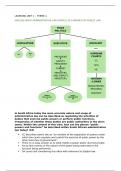
DISCUSS WHAT ADMINISTRATIVE LAW ENTAILS AS A BRANCH OF PUBLIC LAW
TRIAS
POLITICA
LEGISLATURE EXECUTIVE JUDICIARY
NA
NCO SUPREME
P
PRESIDENT COURTS
DEPUTY CC
PRESIDENT
SCA
CABINET
HC
MINISTERS
AND DEPUTY
MINISTERS INTERIM
/LOWER
MAGISTRATES:
REGIONAL
DISTRICT
DRAFTS PUBLIC
POLICIES/BILL ADMINISTRATI
S ON
In South Africa today the more accurate nature and scope of
administrative law can be described as regulating the activities of
bodies that exercise public powers or perform public functions,
irrespective of whether these bodies are public authorities in the strict
sense. Within the context of this view, how can the phrase “public
powers and functions” be described within South African administrative
law today? (10)
CC describes admin law as “an incident of the separation of powers under
which the courts regulate and control the exercise of public power by the
other branches of government”.
There is no easy answer as to what makes a power public and not private.
Focus falls mainly on the nature of the power being exercised or the
function being performed.
SA courts still considering this often with reference to English law.
, CC case of AAA Investments (Pty)Ltd v Micro Finance Regulatory Council
and SCA case of Calibre Clinical Consultants (Pty) v National Bargaining
Council....
Whereas in US and Canada courts have regarded “public” powers and
functions with conduct and activities that is “governmental”, judge in AAA
Investments case said “governmental” enquiry not necessary.
However, in the Calibre case, SCA did conduct governmental enquiry and
judge said when considering whether conduct is reviewable, courts
“almost always sought out features that are governmental in kind”.
Some factors that have found acceptance in our courts:
- The extent of state involvement and control over the power or function.
- Public funding.
- Source of power.
- Whether power exercised consensually or coercively.
- Effect of power on the public
Must not apply “governmental test” too literally as “public” seems to have
a broader meaning than “governmental”.
- Public power has often and rightly been associated with duty to act in the
public interest.
- In this sense, public interest and public duty may go beyond strictly
governmental.
Must avoid relying on any one of the criteria and a broad and flexible
approach must be used.
As judge in Calibre case said – “there is no single test or universal
application to determine whether a power or function is of a public
nature”.
DEFINE “PUBLIC ADMINISTRATION”
PUBLIC ADMINISTRATION AND ADMINISTRATIVE ACTION
With regards to the focus of administrative law, administrative law
differs from constitutional law in its emphasis on one particular branch
of the state system, the public administrations, and on a particular
activity of the state: administrative action. Describe in detail these two
constituting factors (public administration and administrative action) of
administrative law. (10)
SCA has described AA as “the conduct of bureaucracy… in carrying
out the daily functions of the state which necessarily involves the
application of policy, usually after its translation into law, with
direct and immediate consequences for individuals or groups of
individuals”.
Public administration is a more technical term generally understood to
mean the organs and functionaries of the executive branch of the state
concerned with the day-to-day business of implementing law and
administering policy.
- Does not cover high policy-making organs such as cabinet, president,
premiers, executive council.
- Does cover all government departments.
, Constitution makes it clear that public administration
encompasses the [public service] or the employees of government
departments.
Also covers the local government administrations, security forces and
“fringe organisations” such as cultural bodies, boards etc, controlled by
government e.g. Telkom, Eskom, Transnet, SABC etc.
In past “administrative action” was loosely used to describe the conduct of
public administration.
In democratic era though it has a specific and technical meaning as
constitutional rights to administrative justice are attached and confined to
this type of action.
AA is not only performed by members of the public administration –
actions by private bodies also qualify as AA provided they have a public
character.
PARTICULAR AND GENERAL ADMINISTRATIVE LAW
DESCRIBE THE DIFFERENCE BETWEEN PARTICULAR AND GENERAL
ADMINISTRATIVE LAW [5]
PARTICULAR OR “SECTORAL” ADMINISTRATIVE LAW
Deals with rules and principles that have developed in specific and
specialised areas of administration such as social welfare, liquor licencing,
immigration and road transport.
GENERAL ADMINISTRATIVE LAW
Expounds the rules and principles common to all or most kinds of AA.
Could be described as “the regulation of regulation”.
Baxter says it consists of “ general principles of law which regulate
the organisation of administrative institutions and the fairness
and efficacy of the administrative process, govern the validity of
and liability for AA and inaction and govern the administrative
and judicial remedies relating to such action or inaction”.
General admin law is concerned with a variety of admin fields and
institutions and agencies.
Most important legal machinery of general admin law is constitutional
rights to admin justice and PAJA.
There are several different avenues for one to pursue should you want to
challenge admin action or lack thereof e.g. Courts, Public Protector.
ORGANS OF THE GOVERNMENT THAT FORM PART OF THE PUBLIC
ADMINISTRATION & DEVELOPMENT OF ADMINISTRATIVE LAW IN SOUTH AFRICA
BY FOCUSING ON THE IMPACT WITH WHICH THE CONSTITUTION HAS HAD FROM
THE PRE-DEMOCRATIC ERA TO MODERN DAY
DESCRIBE IN DETAIL THE DOMAIN OF ADMINISTRATIVE LAW [10]
, Admin law covers a vast area because relevant whenever any action
involving use of public powers or performance of public functions.
Baxter explains that it is a branch of law that “permeates virtually every
facet of the legal system”
- Public procurement
- All forms of licencing
- Town planning
- Provision of education and health
- Arrest and prosecution of suspects
- Protection of environment etc
In all cases, admin bodies are subject to a mass of rules and principles.
There are differences in the degree that the various functions are under
control of courts of law.
Reasons for spread of admin law is because of tremendous growth in
power, influence and activities of state.
20th century saw the emergence of social welfare or benefactor state –
- state is expected to play positive and interventionist role in socio-eco
regeneration and welfare of citizens.
- State public power is exercised, not just to achieve internal order and
defence against external threats but also to engage in measures to
achieve distributive justice.
S.A. is not a typical social welfare state and certainly not during apartheid
although there was substantial state intervention during apartheid which
regulated e.g. movement of people, access to housing, education and
jobs.
Demise of apartheid has not diminished the states intervention as there is
now great commitment to social and economic transformation.
NEW AREAS ARE ALSO EMERGING:
- Land reform
- BEE
- Labour law, which is a state’s attempt to intervene to provide fairness and
efficiency in industrial relations.
GROWTH OF ADMINISTRATIVE STATE IN SA COMES WITH COSTS
- Public administration has become overburdened and unwieldy.
- This has led to the privatisation of many functions – does not mean an
escape from public law as disciplinary tribunals and non-statutory bodies
exercising public power are still subject to judicial review by courts under
the common law.
TODAY THE REACH OF ADMIN LAW IS LONGER – CONSTITUTION AND PAJA
- Constitutional recognition of fundamental rights means rather less work
for administrative law review to do than in the past.
- Many cases that would have been considered under admin law are now
considered under fundamental rights and therefore under the constitution.
DEVELOPMENT OF “GLOBAL ADMINISTRATIVE LAW”
DESCRIBE THE DEVELOPMENT ENTITLED “GLOBAL ADMINISTRATIVE
LAW” [5]
Known as “GAL”.
DISCUSS WHAT ADMINISTRATIVE LAW ENTAILS AS A BRANCH OF PUBLIC LAW
TRIAS
POLITICA
LEGISLATURE EXECUTIVE JUDICIARY
NA
NCO SUPREME
P
PRESIDENT COURTS
DEPUTY CC
PRESIDENT
SCA
CABINET
HC
MINISTERS
AND DEPUTY
MINISTERS INTERIM
/LOWER
MAGISTRATES:
REGIONAL
DISTRICT
DRAFTS PUBLIC
POLICIES/BILL ADMINISTRATI
S ON
In South Africa today the more accurate nature and scope of
administrative law can be described as regulating the activities of
bodies that exercise public powers or perform public functions,
irrespective of whether these bodies are public authorities in the strict
sense. Within the context of this view, how can the phrase “public
powers and functions” be described within South African administrative
law today? (10)
CC describes admin law as “an incident of the separation of powers under
which the courts regulate and control the exercise of public power by the
other branches of government”.
There is no easy answer as to what makes a power public and not private.
Focus falls mainly on the nature of the power being exercised or the
function being performed.
SA courts still considering this often with reference to English law.
, CC case of AAA Investments (Pty)Ltd v Micro Finance Regulatory Council
and SCA case of Calibre Clinical Consultants (Pty) v National Bargaining
Council....
Whereas in US and Canada courts have regarded “public” powers and
functions with conduct and activities that is “governmental”, judge in AAA
Investments case said “governmental” enquiry not necessary.
However, in the Calibre case, SCA did conduct governmental enquiry and
judge said when considering whether conduct is reviewable, courts
“almost always sought out features that are governmental in kind”.
Some factors that have found acceptance in our courts:
- The extent of state involvement and control over the power or function.
- Public funding.
- Source of power.
- Whether power exercised consensually or coercively.
- Effect of power on the public
Must not apply “governmental test” too literally as “public” seems to have
a broader meaning than “governmental”.
- Public power has often and rightly been associated with duty to act in the
public interest.
- In this sense, public interest and public duty may go beyond strictly
governmental.
Must avoid relying on any one of the criteria and a broad and flexible
approach must be used.
As judge in Calibre case said – “there is no single test or universal
application to determine whether a power or function is of a public
nature”.
DEFINE “PUBLIC ADMINISTRATION”
PUBLIC ADMINISTRATION AND ADMINISTRATIVE ACTION
With regards to the focus of administrative law, administrative law
differs from constitutional law in its emphasis on one particular branch
of the state system, the public administrations, and on a particular
activity of the state: administrative action. Describe in detail these two
constituting factors (public administration and administrative action) of
administrative law. (10)
SCA has described AA as “the conduct of bureaucracy… in carrying
out the daily functions of the state which necessarily involves the
application of policy, usually after its translation into law, with
direct and immediate consequences for individuals or groups of
individuals”.
Public administration is a more technical term generally understood to
mean the organs and functionaries of the executive branch of the state
concerned with the day-to-day business of implementing law and
administering policy.
- Does not cover high policy-making organs such as cabinet, president,
premiers, executive council.
- Does cover all government departments.
, Constitution makes it clear that public administration
encompasses the [public service] or the employees of government
departments.
Also covers the local government administrations, security forces and
“fringe organisations” such as cultural bodies, boards etc, controlled by
government e.g. Telkom, Eskom, Transnet, SABC etc.
In past “administrative action” was loosely used to describe the conduct of
public administration.
In democratic era though it has a specific and technical meaning as
constitutional rights to administrative justice are attached and confined to
this type of action.
AA is not only performed by members of the public administration –
actions by private bodies also qualify as AA provided they have a public
character.
PARTICULAR AND GENERAL ADMINISTRATIVE LAW
DESCRIBE THE DIFFERENCE BETWEEN PARTICULAR AND GENERAL
ADMINISTRATIVE LAW [5]
PARTICULAR OR “SECTORAL” ADMINISTRATIVE LAW
Deals with rules and principles that have developed in specific and
specialised areas of administration such as social welfare, liquor licencing,
immigration and road transport.
GENERAL ADMINISTRATIVE LAW
Expounds the rules and principles common to all or most kinds of AA.
Could be described as “the regulation of regulation”.
Baxter says it consists of “ general principles of law which regulate
the organisation of administrative institutions and the fairness
and efficacy of the administrative process, govern the validity of
and liability for AA and inaction and govern the administrative
and judicial remedies relating to such action or inaction”.
General admin law is concerned with a variety of admin fields and
institutions and agencies.
Most important legal machinery of general admin law is constitutional
rights to admin justice and PAJA.
There are several different avenues for one to pursue should you want to
challenge admin action or lack thereof e.g. Courts, Public Protector.
ORGANS OF THE GOVERNMENT THAT FORM PART OF THE PUBLIC
ADMINISTRATION & DEVELOPMENT OF ADMINISTRATIVE LAW IN SOUTH AFRICA
BY FOCUSING ON THE IMPACT WITH WHICH THE CONSTITUTION HAS HAD FROM
THE PRE-DEMOCRATIC ERA TO MODERN DAY
DESCRIBE IN DETAIL THE DOMAIN OF ADMINISTRATIVE LAW [10]
, Admin law covers a vast area because relevant whenever any action
involving use of public powers or performance of public functions.
Baxter explains that it is a branch of law that “permeates virtually every
facet of the legal system”
- Public procurement
- All forms of licencing
- Town planning
- Provision of education and health
- Arrest and prosecution of suspects
- Protection of environment etc
In all cases, admin bodies are subject to a mass of rules and principles.
There are differences in the degree that the various functions are under
control of courts of law.
Reasons for spread of admin law is because of tremendous growth in
power, influence and activities of state.
20th century saw the emergence of social welfare or benefactor state –
- state is expected to play positive and interventionist role in socio-eco
regeneration and welfare of citizens.
- State public power is exercised, not just to achieve internal order and
defence against external threats but also to engage in measures to
achieve distributive justice.
S.A. is not a typical social welfare state and certainly not during apartheid
although there was substantial state intervention during apartheid which
regulated e.g. movement of people, access to housing, education and
jobs.
Demise of apartheid has not diminished the states intervention as there is
now great commitment to social and economic transformation.
NEW AREAS ARE ALSO EMERGING:
- Land reform
- BEE
- Labour law, which is a state’s attempt to intervene to provide fairness and
efficiency in industrial relations.
GROWTH OF ADMINISTRATIVE STATE IN SA COMES WITH COSTS
- Public administration has become overburdened and unwieldy.
- This has led to the privatisation of many functions – does not mean an
escape from public law as disciplinary tribunals and non-statutory bodies
exercising public power are still subject to judicial review by courts under
the common law.
TODAY THE REACH OF ADMIN LAW IS LONGER – CONSTITUTION AND PAJA
- Constitutional recognition of fundamental rights means rather less work
for administrative law review to do than in the past.
- Many cases that would have been considered under admin law are now
considered under fundamental rights and therefore under the constitution.
DEVELOPMENT OF “GLOBAL ADMINISTRATIVE LAW”
DESCRIBE THE DEVELOPMENT ENTITLED “GLOBAL ADMINISTRATIVE
LAW” [5]
Known as “GAL”.