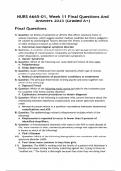
NURS 6665-01, Week 11 Final Exam Questions And Answers 2025 (Graded A+)
Final Questions 1) Question: An illness of symptoms or deficits that affect voluntary motor or sensory functions, which suggest another medical condition but that is judged to be caused by psychological factors because the illness is preceded by conflicts or other stressors in known as which of the following? A. functional neurological symptom disorder 2) Question: A condition characterized by the person giving approximate answers, with clouding of consciousness, frequently accompanied by hallucinations or other dissociative, somatoform or conversion symptoms is A. Ganser Syndrome 3) Question: Which of the following can cause delirium? Check all that apply. A. Polypharmacy B. Sleep deprivation 4) Question: Acute withdrawal from alcohol represents which type of clinical problem in psychosomatic medicine? A. Medical complications of psychiatric conditions or treatments 5) Question: The principal theoretician to bring psyche and soma together was which of the following? A. Sigmund Freud 6) Question: Which of the following would not be included in the treatment plan for a patient with illness anxiety disorder? A. Exploratory invasive procedures to obtain diagnosis 7) Question: Which of the following is consistent with current literature about the relationship between obstetrical complications and autism spectrum disorders (ASD)? A. Research proves there is a positive correlation between obstetrical complications and ASD 8) Question: The epidemiology related to kleptomania includes which of the following? A. Kleptomania is reported to occur in fewer than 5 percent of identified shoplifters. 9) Question: A frontotemporal dementia with onset in the fifth to sixth decade of life, more common in men, marked by personality change and cognitive decline, is known as which of the following? A. Pick’s Disease 10) Question: Which of the following demographics are consistent with autism spectrum disorder (ASD) A. Four times more common in boys than girls. 11) Question: The ARNP is working with the family of a patient with Alzheimer’s Disease who keeps stating the family is plotting against her, trying to have her “snuffed out.” The family is distraught because they state they are doing their lOMoAR cPSD| best to make sure their family member is safe. The ARNP explains which of the following in educating the patient about the patient’s A. The patient is delusional. An estimated 30 to 40 percent of patients with dementia have delusions 12) Question: Which of the following persons hypothesized that the symptoms of conversion disorder reflect unconscious conflict? A. Sigmund Freud 13) Question: Which of the following is consistent within normal range developmental milestones in adaptive skills for a 4-year-old? A. Toilets self alone; uses fork 14) Question: A temporary marked alteration in the state of consciousness or by the customary sense of personal identity without the replacement by an alternate sense of identity is known as which of the following? A. Dissociative trance disorder 15) Question: Differential diagnoses to be considered when diagnosing Ganser syndrome include which of the following? A. All the above (organic dementia, depressive pseudodementia, Korsakoff’s syndrome) 16) Question: A patient who has been raped, presents with the inability to recall important personal information and any information about the rape, does recall events prior and since. There does not appear to be any physiological reason for this. This presentation is consistent with which of the following diagnoses? A. Dissociative amnesia 17) Question: Depersonalization can result from which of the following conditions? Check all that apply. A. Seizure disorders 18) Question: A child who demonstrates repetitive significant violations of social rules and the rights of others over the course of a year would likely be diagnosed with which of the following diagnoses? A. Conduct Disorder 19) Question: A sudden unexpected purposeful travel away from home with inability to recall all of one’s past accompanied by confusion about personal identity not due to direct effects of a substance or a general medical condition which causes clinically significant distress or impairment in social, occupational, or other important areas of functioning is most specifically known as which of the following? A. Dissociative fugue 20) Question: Which of the following is NOT considered a nonpathological form of amnesia? A. Generalized Amnesia 21) Question: The diagnosis formerly known as multiple personality disorder is now known as which of the following? A. Dissociative Identity Disorder lOMoAR cPSD| 22) Question: A patient presents reporting acute amnesia and fugue episodes in addition to recurrent blackouts, unexplained possessions, and fluctuations in skills, habits, and knowledge. The ARNP recognizes this is consistent with which of the following? A. Dissociative Identity Disorders 23) Question: Deficits in language including naming, repetition, reading and comprehension, and writing is NOT associated with impairment in which of the following regions of the brain? A. Right parietal 24) Question: A major neurocognitive disorder with severe impairment in memory, judgment, orientation, and cognition is known as which of the following? A. Dementia 25) Question: The patient with an illness anxiety disorder is requesting medication only from the ARNP. The ARNPs response about pharmacotherapy in illness anxiety disorder would include which of the following? A. Pharmacotherapy helps alleviating symptoms but cannot provide lasting relief 26) Question: Which of the following is consistent with what is known about kleptomania? A. The goal for the person with kleptomania is the act of stealing 27) Question: A type of delirium characterized by cycling through psychomotor agitation and retardation, from apathy to hypervigilance is known as which of the following? A. Mixed delirium 28) Question: Under hypnosis or during psychotherapy, a patient may recover a memory of a painful experience that is etiologically significant. This is known as which of the following? A. Recalled Memory Syndrome 29) Question: Which of the following conversion disorder symptoms are associated with a good prognosis? A. Paralysis and blindness 30) Question: According to the DSM-5 which of the following symptoms differentiates illness anxiety disorder from somatic symptom disorder? A. In somatic symptom disorder, persons are primarily concerned with the idea they are ill, with few or no somatic symptoms. 31) Question: A recurrent failure to resist impulses to steal objects not needed for personal use or monetary value is an essential feature of which of the following disorders? A. KLEPTOMANIA 32) Question: Which of the following would be a cause of concern for the ARNP working with parents of a 0–3-month-old? A. The parent becomes upset whenever the baby cries. lOMoAR cPSD| 33) Question: Identifying developmental milestones is an important skill set for ARNPs for which of the following reasons? A. Often developmental milestones go unrecognized until a child is much older. B. Knowing when a significant variation in development has occurred improves diagnostic accuracy. C. The sooner a significant developmental impairment is identified and addressed, the better the long-term outcomes could be for patients. D. All of the above 34) Question: Which of the following is true about compulsions? A. The person feels compelled to act out their pathological behavior. B. Compulsions are usually ego dystonic. C. A and B only 35) Question: The ARNP recognizes which of the following when the 2-month-old opens her mouth when she sees a bottle. A. The 2-month-old is demonstrating a normal developmental visual motor skill. 36) Question: The ARNP notices the 6-month-old does not have a spontaneous smile response and realizes which of the following? A. This is a social/emotional developmental red-flag delay and triggers further assessment. 37) Question: Data supports which of the following demographics of persons with conversions disorder? A. Conversion disorder is most common among rural people 38) Question: Which of the following is consistent with what is known about electroconvulsive therapy (ECT) use in patients with dissociative identity disorder (DID)? A. ECT is helpful in ameliorating refractory mood disorders and does not worsen dissociative memory problems 39) Question: Which of the following conditions associated with childhood are part of the five conditions which comprise disruptive, impulse-control, and conduct disorders? A. ODD 40) Question: A category of disorders characterized by the inability to resist an intense impulse, drive, or temptation to perform a particular act that is obviously harmful to self or others, or both is known as which of the following? A. Disruptive, impulse-control disorders 41) Question: A person reveals to the ARNP that they steal to get the things they want and cannot afford. The person says they just can’t help themselves because they have kleptomania. The ARNP realizes the following: A. The person likely does not have kleptomania because a person with kleptomania is more concerned with the act of stealing rather than the obtaining the object which has been stolen. 42) Question: Which of the following would demonstrate the normal achievement of gross motor developmental milestone for a 6-month-old? lOMoAR cPSD| A. BRIEFLY SITS ALONE: PIVOTS IN PRONE 43) Question: According to a psychodynamic perspective, depersonalization and derealization are understood as which of the following? A. Traumatic stress response 44) Question: Which of the following is consistent with brain-imaging findings related to autism spectrum disorder (ASD)? A. Increased head size and brain volume 45) Question: Which of the following biological factors have been associated with kleptomania? Check all that apply. A. Cortical atrophy, brain diseases, mental retardation and enlarged lateral ventricles 46) Question: The symptom of giving approximate answers is known as which of the following? A. Paralogia
Written for
- Institution
-
Walden University
- Course
-
NURS 6665 (NURS666501)
Document information
- Uploaded on
- May 14, 2025
- Number of pages
- 15
- Written in
- 2024/2025
- Type
- Exam (elaborations)
- Contains
- Questions & answers
Subjects
- nurs
- nurs 6665
- nurs 6665 01
-
nurs 6665 01 week 11 final exam

Also available in package deal