
Explore how the process of cell division in eukaryotic cells contributed to genetic
variation:
Humans are known as eukaryotic organisms and most of our DNA is packaged into
chromosomes which are found within a nucleus. Each human body cell, except red blood
cells have 46 chromosomes. Each chromosome will have one molecule of DNA and then
within this are specific lengths of DNA, each which codes for a specific amino acid
sequence, this is called a gene. When the cell is not in active cell division, known as
interphase, the DNA encased within the nucleus is spread out, diffused and spread out
along the cell, called chromatin. Chromatin is a long strand of DNA coiled around
structures called histones, proteins. The chromatin coils tightly and the dense chromatin
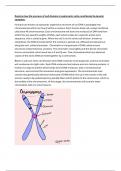
forms a chromatid, which each has a P and Q arm. Two chromatids which are identical
copies of the same DNA are held together by a centromere.
Before a cell can enter cell division each DNA molecule must duplicate, and the chromatin
will condense into tight coils. Each DNA molecule has histone and non-histone proteins. A
histone is a type of protein which binds to the DNA molecule, aids in chromosomal
structure, and controls the movement and gene expression. The chromosomes now
contain two genetically identical molecules of DNA which line up in the center of the cell
and are ready to be pulled apart by spindle fibers which attach to the centromere, which is
the middle of the chromosome. At this stage, the chromosomes still contain sister
chromatids, half of a chromosome.
,In the human body there are 23 pairs of chromosomes, so 46 individual chromosomes,
each pair has a chromosome from the female gamete and from the male gamete. In
animals, each chromosome pair has its own function, in human cells there are 23
chromosome pairs and they each contain genes for functions. One example of this is
chromosome 7, the function of this is that it contains genes which are very important in the
development in vitro, it contains genes which affects the legs, face and other body parts.
Each chromosome has its unique functions that allow organisms to carry out metabolic
and physical functions and any errors or changes to chromosomes can lead to genetic
diseases and abnormalities. There are two distinct types of chromosomes, homologous
and non-homologous. A homologous chromosome pairs up at meiosis, meaning they are
the same size, position, same gene loci, this is a specific place on a chromosome where a
gene is found. They may have different alleles which are different versions of a gene. In
humans, the homologous chromosomes pair up after fertilization, so one is from the
female, and one is from the male. An example of a homologous chromosome is an
autosomal one which determines physical presenting characteristics like our eye color.
When the DNA is exchanged between these chromosomes, it is known as recombination,
meaning the genetic material from one pair is recombined with another to make a similar
pair. A non-homologous chromosome does not pair up at meiosis and they are completely
different from each other. A good example of this is our sex chromosomes which decide
the sex that we will be at birth, these are XX which determine females and XY which
determine you to be male. These are known as sex chromosomes because they decide the
sex. When DNA is exchanged between non homologous chromosomes it happens in a
process called translocation, it results in a pair that is not similar and can help lead to
genetic variation.
The function of a chromosome is to carry genetic information, they contain DNA and
nucleic proteins which are histones as mentioned previously. Chromosomes contain
genes and our genes determine the entire genetic makeup of us and of other organisms.
Chromosomes are essential in the process of growth and repair in organisms. This is
because chromosomes are vital in the processes of the cell cycle and cell division, in
these processes they undergo replication to pass on genetic information to new cells. The
chromosomes make sure that during cell division, each daughter cell receives a full copy
of the genetic information. Chromosomes contain the genes to produce proteins that
express the genetic code for which it contains. They aid in the growth and repair of body
tissues and cells so that metabolic processes can continuously occur. For example, cells
in the skin constantly require regeneration and chromosomes help with this because they
contain the code that codes for proteins which help in skin cell regeneration.
Chromosomes are also vital in inheritance. This is because during fertilization, each
, parent's gamete contains one set of chromosomes that combine to make a new unique set
that is completely individual to each organism.
A centromere is a region on the chromosome, which is a compressed region. The main
function of a centromere is to attach to the sister chromatids. It is also the site where
spindle fibers attach. Another important function of the centromere is to ensure the
chromosomes are properly aligned to ensure a smooth metaphase in cell division. The
centromeres play a significant role in cell division as without them, the spindle fibers
would not have a site of attachment, so the chromatids would not be pulled to either side
of the cell in anaphase. This could result in an incorrect number of chromatids being in
each cell following cell division. A chromatid is one singular copy of a chromosome that
has been recently replicated, it is still joined to the chromosome which it originated from
by the centromere. The centromere is a vital component because it ensures that sister
chromatids are pulled to opposite poles of the cell so that when the cell undergoes
cytokinesis, each cell has the same number of chromatids, so each daughter cell has the
same genetic information.
Mitosis root tip practical:
This practical aim is to see plant cells in active cell division; we use onion root tips because
these cells are in active cell division, particularly in a place called the meristem in the root
tips. This means we can clearly see the stages of mitosis, which produces identical
daughter cells, especially because the cells only have eight chromosomes, so we can see
them condensed. Also, by completing this practical it improves our scientific ability to
prepare a slide to see under an optical microscope.
In industry this practical would allow us to complete a method which is known as
karyotyping which involves finding out the size, shape and the number which corresponds
to the chromosomes, which in this case are from a root tip of garlic. This is done because
we will be able to create a photomicrograph of the eight chromosomes in the garlic cell.
The chromosome number is important because it provides the information which code for
a particular protein which in turn is a function, for example, in humans the X and Y
chromosomes determine the sex that we are. In the classroom, we can only look for
different mitosis stages due to our microscopes' limitations. We can only use light
microscopes so the resolution (the ability to distinguish between two different points in the
field of view) is lower which means that we can only see the largest organelle, being the
nucleus.
variation:
Humans are known as eukaryotic organisms and most of our DNA is packaged into
chromosomes which are found within a nucleus. Each human body cell, except red blood
cells have 46 chromosomes. Each chromosome will have one molecule of DNA and then
within this are specific lengths of DNA, each which codes for a specific amino acid
sequence, this is called a gene. When the cell is not in active cell division, known as
interphase, the DNA encased within the nucleus is spread out, diffused and spread out
along the cell, called chromatin. Chromatin is a long strand of DNA coiled around
structures called histones, proteins. The chromatin coils tightly and the dense chromatin
forms a chromatid, which each has a P and Q arm. Two chromatids which are identical
copies of the same DNA are held together by a centromere.
Before a cell can enter cell division each DNA molecule must duplicate, and the chromatin
will condense into tight coils. Each DNA molecule has histone and non-histone proteins. A
histone is a type of protein which binds to the DNA molecule, aids in chromosomal
structure, and controls the movement and gene expression. The chromosomes now
contain two genetically identical molecules of DNA which line up in the center of the cell
and are ready to be pulled apart by spindle fibers which attach to the centromere, which is
the middle of the chromosome. At this stage, the chromosomes still contain sister
chromatids, half of a chromosome.
,In the human body there are 23 pairs of chromosomes, so 46 individual chromosomes,
each pair has a chromosome from the female gamete and from the male gamete. In
animals, each chromosome pair has its own function, in human cells there are 23
chromosome pairs and they each contain genes for functions. One example of this is
chromosome 7, the function of this is that it contains genes which are very important in the
development in vitro, it contains genes which affects the legs, face and other body parts.
Each chromosome has its unique functions that allow organisms to carry out metabolic
and physical functions and any errors or changes to chromosomes can lead to genetic
diseases and abnormalities. There are two distinct types of chromosomes, homologous
and non-homologous. A homologous chromosome pairs up at meiosis, meaning they are
the same size, position, same gene loci, this is a specific place on a chromosome where a
gene is found. They may have different alleles which are different versions of a gene. In
humans, the homologous chromosomes pair up after fertilization, so one is from the
female, and one is from the male. An example of a homologous chromosome is an
autosomal one which determines physical presenting characteristics like our eye color.
When the DNA is exchanged between these chromosomes, it is known as recombination,
meaning the genetic material from one pair is recombined with another to make a similar
pair. A non-homologous chromosome does not pair up at meiosis and they are completely
different from each other. A good example of this is our sex chromosomes which decide
the sex that we will be at birth, these are XX which determine females and XY which
determine you to be male. These are known as sex chromosomes because they decide the
sex. When DNA is exchanged between non homologous chromosomes it happens in a
process called translocation, it results in a pair that is not similar and can help lead to
genetic variation.
The function of a chromosome is to carry genetic information, they contain DNA and
nucleic proteins which are histones as mentioned previously. Chromosomes contain
genes and our genes determine the entire genetic makeup of us and of other organisms.
Chromosomes are essential in the process of growth and repair in organisms. This is
because chromosomes are vital in the processes of the cell cycle and cell division, in
these processes they undergo replication to pass on genetic information to new cells. The
chromosomes make sure that during cell division, each daughter cell receives a full copy
of the genetic information. Chromosomes contain the genes to produce proteins that
express the genetic code for which it contains. They aid in the growth and repair of body
tissues and cells so that metabolic processes can continuously occur. For example, cells
in the skin constantly require regeneration and chromosomes help with this because they
contain the code that codes for proteins which help in skin cell regeneration.
Chromosomes are also vital in inheritance. This is because during fertilization, each
, parent's gamete contains one set of chromosomes that combine to make a new unique set
that is completely individual to each organism.
A centromere is a region on the chromosome, which is a compressed region. The main
function of a centromere is to attach to the sister chromatids. It is also the site where
spindle fibers attach. Another important function of the centromere is to ensure the
chromosomes are properly aligned to ensure a smooth metaphase in cell division. The
centromeres play a significant role in cell division as without them, the spindle fibers
would not have a site of attachment, so the chromatids would not be pulled to either side
of the cell in anaphase. This could result in an incorrect number of chromatids being in
each cell following cell division. A chromatid is one singular copy of a chromosome that
has been recently replicated, it is still joined to the chromosome which it originated from
by the centromere. The centromere is a vital component because it ensures that sister
chromatids are pulled to opposite poles of the cell so that when the cell undergoes
cytokinesis, each cell has the same number of chromatids, so each daughter cell has the
same genetic information.
Mitosis root tip practical:
This practical aim is to see plant cells in active cell division; we use onion root tips because
these cells are in active cell division, particularly in a place called the meristem in the root
tips. This means we can clearly see the stages of mitosis, which produces identical
daughter cells, especially because the cells only have eight chromosomes, so we can see
them condensed. Also, by completing this practical it improves our scientific ability to
prepare a slide to see under an optical microscope.
In industry this practical would allow us to complete a method which is known as
karyotyping which involves finding out the size, shape and the number which corresponds
to the chromosomes, which in this case are from a root tip of garlic. This is done because
we will be able to create a photomicrograph of the eight chromosomes in the garlic cell.
The chromosome number is important because it provides the information which code for
a particular protein which in turn is a function, for example, in humans the X and Y
chromosomes determine the sex that we are. In the classroom, we can only look for
different mitosis stages due to our microscopes' limitations. We can only use light
microscopes so the resolution (the ability to distinguish between two different points in the
field of view) is lower which means that we can only see the largest organelle, being the
nucleus.


