

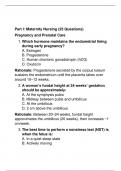
Part I: Maternity Nursing (25 Questions)
Pregnancy and Prenatal Care
1. Which hormone maintains the endometrial lining
during early pregnancy?
A. Estrogen
B. Progesterone
C. Human chorionic gonadotropin (hCG)
D. Oxytocin
Rationale: Progesterone secreted by the corpus luteum
sustains the endometrium until the placenta takes over
around 10–12 weeks.
2. A woman’s fundal height at 24 weeks’ gestation
should be approximately:
A. At the symphysis pubis
B. Midway between pubis and umbilicus
C. At the umbilicus
D. 2 cm above the umbilicus
Rationale: Between 20–24 weeks, fundal height
approximates the umbilicus (20 weeks), then increases ~1
cm/week.
3. The best time to perform a nonstress test (NST) is
when the fetus is:
A. In a quiet sleep state
B. Actively moving
, C. During a maternal contraction
D. Immediately after a meal
Rationale: Fetal movements stimulate heart rate
accelerations; testing during active periods yields reliable
results.
4. Which prenatal lab result indicates iron deficiency
anemia?
A. Hgb 13 g/dL
B. Hct 39%
C. Hgb 10 g/dL
D. Hct 42%
Rationale: Hemoglobin below 11 g/dL in pregnancy
signals anemia; often due to increased iron demands.
5. Maternal risks associated with oligohydramnios
include all EXCEPT:
A. Cord compression
B. Pulmonary hypoplasia
C. Postmaturity syndrome
D. Placental abruption
Rationale: Oligohydramnios increases cord compression
and lung issues; postmaturity and abruption aren’t direct
outcomes.
Labor and Intrapartum Care
6. The “latent phase” of labor is characterized by:
A. Rapid cervical dilation
B. Contractions every 2 minutes
, C. Cervix dilated 0–3 cm, mild contractions
D. Strong urge to push
Rationale: Early (latent) labor is slow, with mild, irregular
contractions and cervical dilation up to 3 cm.
7. A reassuring fetal heart tracing shows:
A. Late decelerations
B. Early decelerations
C. Variable decelerations
D. Accelerations ≥15 bpm for 15 seconds
Rationale: Accelerations indicate good oxygenation and
fetal well-being.
8. The most effective nonpharmacologic pain relief
method in first-stage labor is:
A. Epidural anesthesia
B. Breathing techniques and relaxation
C. IV opioid analgesia
D. Pudendal block
Rationale: Breathing and relaxation support coping with
contractions without pharmacologic risks.
9. Immediately after birth, if the newborn’s heart rate
is 105 bpm and respirations are shallow, the
nurse should:
A. Dry and stimulate the newborn
B. Begin positive-pressure ventilation
C. Perform chest compressions
D. Administer oxygen by blow-by
Pregnancy and Prenatal Care
1. Which hormone maintains the endometrial lining
during early pregnancy?
A. Estrogen
B. Progesterone
C. Human chorionic gonadotropin (hCG)
D. Oxytocin
Rationale: Progesterone secreted by the corpus luteum
sustains the endometrium until the placenta takes over
around 10–12 weeks.
2. A woman’s fundal height at 24 weeks’ gestation
should be approximately:
A. At the symphysis pubis
B. Midway between pubis and umbilicus
C. At the umbilicus
D. 2 cm above the umbilicus
Rationale: Between 20–24 weeks, fundal height
approximates the umbilicus (20 weeks), then increases ~1
cm/week.
3. The best time to perform a nonstress test (NST) is
when the fetus is:
A. In a quiet sleep state
B. Actively moving
, C. During a maternal contraction
D. Immediately after a meal
Rationale: Fetal movements stimulate heart rate
accelerations; testing during active periods yields reliable
results.
4. Which prenatal lab result indicates iron deficiency
anemia?
A. Hgb 13 g/dL
B. Hct 39%
C. Hgb 10 g/dL
D. Hct 42%
Rationale: Hemoglobin below 11 g/dL in pregnancy
signals anemia; often due to increased iron demands.
5. Maternal risks associated with oligohydramnios
include all EXCEPT:
A. Cord compression
B. Pulmonary hypoplasia
C. Postmaturity syndrome
D. Placental abruption
Rationale: Oligohydramnios increases cord compression
and lung issues; postmaturity and abruption aren’t direct
outcomes.
Labor and Intrapartum Care
6. The “latent phase” of labor is characterized by:
A. Rapid cervical dilation
B. Contractions every 2 minutes
, C. Cervix dilated 0–3 cm, mild contractions
D. Strong urge to push
Rationale: Early (latent) labor is slow, with mild, irregular
contractions and cervical dilation up to 3 cm.
7. A reassuring fetal heart tracing shows:
A. Late decelerations
B. Early decelerations
C. Variable decelerations
D. Accelerations ≥15 bpm for 15 seconds
Rationale: Accelerations indicate good oxygenation and
fetal well-being.
8. The most effective nonpharmacologic pain relief
method in first-stage labor is:
A. Epidural anesthesia
B. Breathing techniques and relaxation
C. IV opioid analgesia
D. Pudendal block
Rationale: Breathing and relaxation support coping with
contractions without pharmacologic risks.
9. Immediately after birth, if the newborn’s heart rate
is 105 bpm and respirations are shallow, the
nurse should:
A. Dry and stimulate the newborn
B. Begin positive-pressure ventilation
C. Perform chest compressions
D. Administer oxygen by blow-by


