RDF2601
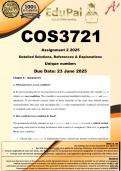
ASSIGNMENT 2
MEMO | DUE 13
MAY 2025
NO PLAGIARISM
Abstract
[Draw your reader in with an engaging abstract. It is typically a short summary of the document.
When you’re ready to add your content, just click here and start typing.]
user
[Email address]
, Exam (elaborations)
RDF2601 Assignment 2 Memo | Due 13 May
2025
Course
Resource Development in Foundation Phase (RDF2601)
Institution
University Of South Africa (Unisa)
RDF2601 Assignment 2 Memo | Due 13 May 2025. All questions fully
answered.
QUESTION 1 1. Read the background information provided in the box below,
then respond to the questions that follow. Resource development is a critical
process in education that focuses on creating, curating, and optimising
instructional materials and tools to enhance teaching and learning
experiences. This involves the identification of educational needs, the design
of relevant resources, and the integration of these materials into classroom
practices to address diverse learner profiles. Effective resource development
not only ensures alignment with curriculum standards but also promotes
engagement, inclusivity, and adaptability to meet varying teaching contexts.
1.1. Define the term “resource development”.
.1 Definition of Resource Development:
Resource development in education refers to the process of designing, creating, selecting, and
refining instructional materials and tools that support effective teaching and learning. It involves
identifying learners' needs, aligning materials with curriculum standards, and ensuring that the
resources are engaging, inclusive, and adaptable to diverse educational contexts and learner
profiles.
1.1. Definition of “Resource Development”
Resource development in education refers to the systematic process of creating, selecting,
adapting, and refining teaching and learning materials to support effective instruction and
address learners' diverse needs. It involves identifying specific educational goals, designing or
sourcing appropriate resources, and ensuring these materials align with curriculum standards
while enhancing learner engagement, inclusivity, and adaptability across different teaching
environments.
, 1.2. List THREE (3) examples of natural materials used in resource
development.
.2. Three (3) Examples of Natural Materials Used in Resource Development:
1. Wood – Used for crafting teaching tools like models, props, and educational toys.
2. Clay – Often used in creating sculptures, models, or art projects that engage students in
hands-on learning.
3. Plants (e.g., leaves, flowers, seeds) – Utilized for science lessons, especially in biology,
to demonstrate concepts like plant growth, ecosystems, and classification.
1.2 Three examples of natural materials used in resource development are:
1. Clay – used for modeling or creating tactile learning aids.
2. Wood – used to make educational tools like counting sticks, puzzles, or blocks.
3. Stones – used for counting, sorting activities, or creating textured learning resources.
1.3. Distinguish between open-ended and closed-ended materials in resource
development. Your feedback should be differentiated according to the
aspects provided and be tabulated as illustrated below:
Aspect Open-ended Materials Closed-ended Materials
Materials that can be used in multiple Materials designed for a specific
Definition
ways with no single outcome purpose with a fixed outcome
Learning Encourage creativity, exploration, and Focus on specific skills or knowledge
Outcome problem-solving with correct answers
Worksheets, flashcards, multiple-
Examples Blocks, clay, paint, loose parts
choice quizzes
ASSIGNMENT 2
MEMO | DUE 13
MAY 2025
NO PLAGIARISM
Abstract
[Draw your reader in with an engaging abstract. It is typically a short summary of the document.
When you’re ready to add your content, just click here and start typing.]
user
[Email address]
, Exam (elaborations)
RDF2601 Assignment 2 Memo | Due 13 May
2025
Course
Resource Development in Foundation Phase (RDF2601)
Institution
University Of South Africa (Unisa)
RDF2601 Assignment 2 Memo | Due 13 May 2025. All questions fully
answered.
QUESTION 1 1. Read the background information provided in the box below,
then respond to the questions that follow. Resource development is a critical
process in education that focuses on creating, curating, and optimising
instructional materials and tools to enhance teaching and learning
experiences. This involves the identification of educational needs, the design
of relevant resources, and the integration of these materials into classroom
practices to address diverse learner profiles. Effective resource development
not only ensures alignment with curriculum standards but also promotes
engagement, inclusivity, and adaptability to meet varying teaching contexts.
1.1. Define the term “resource development”.
.1 Definition of Resource Development:
Resource development in education refers to the process of designing, creating, selecting, and
refining instructional materials and tools that support effective teaching and learning. It involves
identifying learners' needs, aligning materials with curriculum standards, and ensuring that the
resources are engaging, inclusive, and adaptable to diverse educational contexts and learner
profiles.
1.1. Definition of “Resource Development”
Resource development in education refers to the systematic process of creating, selecting,
adapting, and refining teaching and learning materials to support effective instruction and
address learners' diverse needs. It involves identifying specific educational goals, designing or
sourcing appropriate resources, and ensuring these materials align with curriculum standards
while enhancing learner engagement, inclusivity, and adaptability across different teaching
environments.
, 1.2. List THREE (3) examples of natural materials used in resource
development.
.2. Three (3) Examples of Natural Materials Used in Resource Development:
1. Wood – Used for crafting teaching tools like models, props, and educational toys.
2. Clay – Often used in creating sculptures, models, or art projects that engage students in
hands-on learning.
3. Plants (e.g., leaves, flowers, seeds) – Utilized for science lessons, especially in biology,
to demonstrate concepts like plant growth, ecosystems, and classification.
1.2 Three examples of natural materials used in resource development are:
1. Clay – used for modeling or creating tactile learning aids.
2. Wood – used to make educational tools like counting sticks, puzzles, or blocks.
3. Stones – used for counting, sorting activities, or creating textured learning resources.
1.3. Distinguish between open-ended and closed-ended materials in resource
development. Your feedback should be differentiated according to the
aspects provided and be tabulated as illustrated below:
Aspect Open-ended Materials Closed-ended Materials
Materials that can be used in multiple Materials designed for a specific
Definition
ways with no single outcome purpose with a fixed outcome
Learning Encourage creativity, exploration, and Focus on specific skills or knowledge
Outcome problem-solving with correct answers
Worksheets, flashcards, multiple-
Examples Blocks, clay, paint, loose parts
choice quizzes