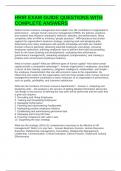
HRIR EXAM GUIDE QUESTIONS WITH
COMPLETE ANSWERS
Define human resource management and explain how HR contributes to organization's
performance. - Answer-human resource management (HRM), the policies, practices,
and systems that influence employees' behavior, attitudes, and performance. Many
companies refer to HRM as involving "people practices." HRM practices that should
support the organization's business strategy: analyzing work and designing jobs,
determining how many employees with specific knowledge and skills are needed
(human resource planning), attracting potential employees (recruiting), choosing
employees (selection), teaching employees how to perform their jobs and preparing
them for the future (training and development), evaluating their performance
(performance management), rewarding employees (compensation), and creating a
positive work environment (employee relations).
What is human capital? What are different types of human capital? How does human
capital provide a competitive advantage? - Answer-organization's employees, described
in terms of their training, experience, judgment, intelligence, relationships, and insight—
the employee characteristics that can add economic value to the organization. By
influencing who works for the organization and how those people work, human resource
management therefore contributes to basic measures of an organization's performance,
such as quality, profitability, and customer satisfaction
What are the functions of human resource departments? - Answer-1. Analyzing and
Designing Jobs - Job analysis is the process of getting detailed information about jobs.
Job design is the process of defining the way work will be performed and the tasks that
a given job requires.
2. Recruiting and Hiring Employees
3. Training and Developing Employees
4. Managing Performance
5. Planning and Administering Pay/Benefits
6. Maintaining positive employee relations
7. Establishing and administering personnel data
8. Managing and Using HR Data
9. Ensuring compliance with Labor Laws
10. Supporting the org's strategy
What are the strategic (SKILLS) competencies necessary to be effective in HR
management? Refer to in your text. - Answer-Business Acumen, Human Resource
Expertise, Relationship management, Consolation, Relationship Management,
Leadership, Communication, Critical Evaluation, Ethical Practice, Global and Cultural
Effectiveness
, Explain the human resource responsibilities of Managers vs HR - Answer-Organizations
depend on supervisors to help them determine what kinds of work need to be done (job
analysis and design) and how many employees are needed (HR planning). Supervisors
typically interview job candidates and participate in the decisions about which
candidates to hire. Many organizations expect supervisors to train employees in some
or all aspects of the employees' jobs. Supervisors conduct performance appraisals and
may recommend pay increases. And, of course, supervisors play a key role in employee
relations
What are ethical issues in human resource management? - Answer-For human
resource practices to be considered ethical, they must satisfy the three basic standards
summarized in First, HRM practices must result in the greatest good for the largest
number of people. Second, employment practices must respect basic human rights of
privacy, due process, consent, and free speech. Third, managers must treat employees
and customers equitably and fairly.
What are major changes occurring within organizations and the external environment
and identify the challenges they pose for human capital management? - Answer-Right
of free consent—People have the right to be treated only as they knowingly and willingly
consent to be treated. An example that applies to employees would be that employees
should know the nature of the job they are being hired to do; the employer should not
deceive them.
Right of privacy—People have the right to do as they wish in their private lives, and they
have the right to control what they reveal about private activities. One way an employer
respects this right is by keeping employees' personal records confidential.
Right of freedom of conscience—People have the right to refuse to do what violates
their moral beliefs, as long as these beliefs reflect commonly accepted norms. A
supervisor who demands that an employee do something that is unsafe or
environmentally damaging may be violating this right if the task conflicts with the
employee's values. (Such behavior could be illegal as well as unethical.)
Right of freedom of speech—People have the right to criticize an organization's ethics if
they do so in good conscience and their criticism does not violate the rights of
individuals in the organization. Many organizations address this right by offering hot
lines or policies and procedures designed to handle complaints from employees.
Right to due process—If people believe their rights are being violated, they have the
right to a fair and impartial hearing.
Understand the basic trends in labor forces. - Answer-With a growing share of the
workforce nearing retirement age, human resource professionals will need to spend
much of their time on concerns related to planning retirement, retraining older workers,
and motivating workers whose careers have plateaued. Organizations will struggle with
ways to control the rising costs of health care and other benefits, and many of
COMPLETE ANSWERS
Define human resource management and explain how HR contributes to organization's
performance. - Answer-human resource management (HRM), the policies, practices,
and systems that influence employees' behavior, attitudes, and performance. Many
companies refer to HRM as involving "people practices." HRM practices that should
support the organization's business strategy: analyzing work and designing jobs,
determining how many employees with specific knowledge and skills are needed
(human resource planning), attracting potential employees (recruiting), choosing
employees (selection), teaching employees how to perform their jobs and preparing
them for the future (training and development), evaluating their performance
(performance management), rewarding employees (compensation), and creating a
positive work environment (employee relations).
What is human capital? What are different types of human capital? How does human
capital provide a competitive advantage? - Answer-organization's employees, described
in terms of their training, experience, judgment, intelligence, relationships, and insight—
the employee characteristics that can add economic value to the organization. By
influencing who works for the organization and how those people work, human resource
management therefore contributes to basic measures of an organization's performance,
such as quality, profitability, and customer satisfaction
What are the functions of human resource departments? - Answer-1. Analyzing and
Designing Jobs - Job analysis is the process of getting detailed information about jobs.
Job design is the process of defining the way work will be performed and the tasks that
a given job requires.
2. Recruiting and Hiring Employees
3. Training and Developing Employees
4. Managing Performance
5. Planning and Administering Pay/Benefits
6. Maintaining positive employee relations
7. Establishing and administering personnel data
8. Managing and Using HR Data
9. Ensuring compliance with Labor Laws
10. Supporting the org's strategy
What are the strategic (SKILLS) competencies necessary to be effective in HR
management? Refer to in your text. - Answer-Business Acumen, Human Resource
Expertise, Relationship management, Consolation, Relationship Management,
Leadership, Communication, Critical Evaluation, Ethical Practice, Global and Cultural
Effectiveness
, Explain the human resource responsibilities of Managers vs HR - Answer-Organizations
depend on supervisors to help them determine what kinds of work need to be done (job
analysis and design) and how many employees are needed (HR planning). Supervisors
typically interview job candidates and participate in the decisions about which
candidates to hire. Many organizations expect supervisors to train employees in some
or all aspects of the employees' jobs. Supervisors conduct performance appraisals and
may recommend pay increases. And, of course, supervisors play a key role in employee
relations
What are ethical issues in human resource management? - Answer-For human
resource practices to be considered ethical, they must satisfy the three basic standards
summarized in First, HRM practices must result in the greatest good for the largest
number of people. Second, employment practices must respect basic human rights of
privacy, due process, consent, and free speech. Third, managers must treat employees
and customers equitably and fairly.
What are major changes occurring within organizations and the external environment
and identify the challenges they pose for human capital management? - Answer-Right
of free consent—People have the right to be treated only as they knowingly and willingly
consent to be treated. An example that applies to employees would be that employees
should know the nature of the job they are being hired to do; the employer should not
deceive them.
Right of privacy—People have the right to do as they wish in their private lives, and they
have the right to control what they reveal about private activities. One way an employer
respects this right is by keeping employees' personal records confidential.
Right of freedom of conscience—People have the right to refuse to do what violates
their moral beliefs, as long as these beliefs reflect commonly accepted norms. A
supervisor who demands that an employee do something that is unsafe or
environmentally damaging may be violating this right if the task conflicts with the
employee's values. (Such behavior could be illegal as well as unethical.)
Right of freedom of speech—People have the right to criticize an organization's ethics if
they do so in good conscience and their criticism does not violate the rights of
individuals in the organization. Many organizations address this right by offering hot
lines or policies and procedures designed to handle complaints from employees.
Right to due process—If people believe their rights are being violated, they have the
right to a fair and impartial hearing.
Understand the basic trends in labor forces. - Answer-With a growing share of the
workforce nearing retirement age, human resource professionals will need to spend
much of their time on concerns related to planning retirement, retraining older workers,
and motivating workers whose careers have plateaued. Organizations will struggle with
ways to control the rising costs of health care and other benefits, and many of