100% satisfaction guarantee Immediately available after payment Both online and in PDF No strings attached 4.2 TrustPilot
logo-home
Exam (elaborations)

Washington Real Estate Fundamentals Chapter Two Questions and Answers

Rating
-
Sold
-
Pages
3
Grade
A+
Uploaded on
11-05-2025
Written in
2024/2025

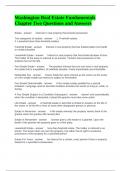
Washington Real Estate Fundamentals Chapter Two Questions and Answers Estate interests in real property that include possession Two categories of estates 1. Freehold estates 2. Leasehold (less-than-freehold) estates Freehold Estate Interest in real property that has indeterinable (not fixedd or certain) duration Leasehold Estate Interest in real property that has limited duration of time. The holder of the lease is referred to as tennant. Tenantn has possession of the property but not the title. Fee Simple Estate The greatest interest that one can have in real property. An estate that is unqualified, of indefinite duration, freely transferable and inheritable. Defeasible Fee Owner holds the same interest as the owner as the owner of a fee simple estate but interest is subject to termination Fee Simple Determinable A fee simple estate qualified by a special limitation. Language used to describe limitation includes the words so long as, while, or during. A Fee Simple Subject to a Condition Subsequent doesn't end automatically when the condition is breached, instead the grantor must take some action Life Estate A freehold estate in land that is limited in duration to the life of the owner or to the life or lives of some other designated person or persons. Estate In Reversion A life estate whereby the property reverts back to the grantor when the grantee (life tenant) dies Estate In Remainder Grantor gives a life estate to a grantee. Upon the death of the grantee the property goes to a third party. Leasehold Estate less-than-freehold estate. The holder is referred to as tenant. The tenant does not own the property, but rather has ta right to exclusive possession of the property for a specified period Estate For Years An interest for a certain, exact period of time in property leased for a specified consideration. Periodic Estate Non-ownership Estate; Has a defined start date, but no defined end date (typically has an automatic renewal clause) Tenancy At Sufferance Lowest type of estate. Technically not an estate. A tenant who came into possession of the property lawfully, under a valid lease, holds over after the lease has expired. Concurrent Ownership Two or more persons own a piece of real property Under Washington law, three forms of concurrent ownership are recognized: 1. Tenancy in Common 2. Joint Tenancy 3. Community Property Tenancy In Common Co-ownership of property in which each party owns an undivided interest that passes to his or her heirs at death. Termination of Tenancy In Common A legal action that divides the interest in the property and deseparate parcels. AKA Partiotion Suit Joint Tenancy The joint ownership of property by two or more co-owners in which each co-owner owns an undivided portion of the property. On the death of one of the joint tenants, his or her interest automatically passes to the surviving joint tenants. Advantage of joint tenancy: Avoiding the delay and cost of probate proceedings Disadvantage of joint tenancy: Gives up the right to dispose of owner interest in the property by will. Community Property property acquired during marriage and owned equally by both spouses limited partnership A partnership with one or more general partners and one or more limited partners. Limited Liability Companies combines the most favorable attributes of both partnerships and corporations Members (like shareholders) are not personally liable for LLC obligations. LLC's are taxed like a partnership. To form an LLC - Articles of Organization must be filed with the Secretary of State Joint Ventures when two or more companies join forces - sharing resources, risks, and profits, but not actually merging companies - to pursue specific opportunities Trust One or more trustess manage property for the benefit of one or more beneficiaries. Real Estate Investment Trust (REIT) Finance large real estate projects Cooperative Ownership of the property is vested in a single entity - usually a corporation. Residents own shares in the corporation rather than owning the property themselves.

Show more Read less
Institution
WASHINGTON REAL ESTATE
Course
WASHINGTON REAL ESTATE


Whoops! We can’t load your doc right now. Try again or contact support.

Written for

Institution
WASHINGTON REAL ESTATE
Course
WASHINGTON REAL ESTATE

Document information

Uploaded on
May 11, 2025
Number of pages
3
Written in
2024/2025
Type
Exam (elaborations)
Contains
Questions & answers

Subjects

Content preview

Washington Real Estate Fundamentals
Chapter Two Questions and Answers
Estate - answer interests in real property that include possession

Two categories of estates - answer 1. Freehold estates
2. Leasehold (less-than-freehold) estates

Freehold Estate - answer Interest in real property that has indeterinable (not fixedd
or certain) duration

Leasehold Estate - answer Interest in real property that has limited duration of time.
The holder of the lease is referred to as tennant. Tenantn has possession of the
property but not the title.

Fee Simple Estate - answer The greatest interest that one can have in real property.
An estate that is unqualified, of indefinite duration, freely transferable and inheritable.

Defeasible Fee - answer Owner holds the same interest as the owner as the owner
of a fee simple estate but interest is subject to termination

Fee Simple Determinable - answer A fee simple estate qualified by a special
limitation. Language used to describe limitation includes the words so long as, while, or
during.

A Fee Simple Subject to a Condition Subsequent - answer doesn't end automatically
when the condition is breached, instead the grantor must take some action

Life Estate - answer A freehold estate in land that is limited in duration to the life of
the owner or to the life or lives of some other designated person or persons.

Estate In Reversion - answer A life estate whereby the property reverts back to the
grantor when the grantee (life tenant) dies

Estate In Remainder - answer Grantor gives a life estate to a grantee. Upon the
death of the grantee the property goes to a third party.

Leasehold Estate - answer less-than-freehold estate. The holder is referred to as
tenant. The tenant does not own the property, but rather has ta right to exclusive
possession of the property for a specified period

Estate For Years - answer An interest for a certain, exact period of time in property
leased for a specified consideration.

Get to know the seller

Seller avatar
Reputation scores are based on the amount of documents a seller has sold for a fee and the reviews they have received for those documents. There are three levels: Bronze, Silver and Gold. The better the reputation, the more your can rely on the quality of the sellers work.
Pogba119 Harvard University
View profile
Follow You need to be logged in order to follow users or courses
Sold
48
Member since
1 year
Number of followers
2
Documents
4870
Last sold
1 month ago
NURSING TEST

BEST EDUCATIONAL RESOURCES FOR STUDENTS

3.9

9 reviews

5
4
4
2
3
2
2
0
1
1

Recently viewed by you

Why students choose Stuvia

Created by fellow students, verified by reviews

Quality you can trust: written by students who passed their exams and reviewed by others who've used these notes.

Didn't get what you expected? Choose another document

No worries! You can immediately select a different document that better matches what you need.

Pay how you prefer, start learning right away

No subscription, no commitments. Pay the way you're used to via credit card or EFT and download your PDF document instantly.

Student with book image

“Bought, downloaded, and aced it. It really can be that simple.”

Alisha Student

Frequently asked questions