

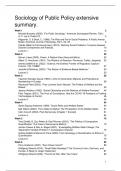
Sociology of Public Policy extensive
summary.
Week 1 2
Michael Burawoy (2005). “For Public Sociology.” American Sociological Review, 70(1):
4–11 (up to Thesis IV) 2
Hilgartner, S. & Bosk, C. (1988). The Rise and Fall of Social Problems: A Public Arenas
Model. American Journal of Sociology, 94(1), 53–78. 6
Claude Gilbert & Emmanuel Henry (2012). Defining Social Problems: Tensions between
Discreet Compromise and Publicity. 10
Lecture 1: 14
Week 2 20
Steven Lukes (2005). Power: A Radical View (Second Edition) 20
Albert O. Hirschman (1991). The Rhetoric of Reaction: Perversity, Futility, Jeopardy 23
Andrea Saltelli et al. (2022). “Science, the Endless Frontier of Regulatory Capture.”
Futures, 135, 102860 27
Jureidini & McHenry (2022). “The Illusion of Evidence-Based Medicine.” 30
Lecture 2: 33
Week 3 38
Yasemin Nuhoglu Soysal (1994). Limits of Citizenship: Migrants and Postnational
Membership in Europe 38
Raymond Plant (2003). “Free Lunches Don’t Nourish: The Politics of Welfare and the
Market.” 40
Jeremy Waldron (1992). “Social Citizenship and the Defense of Welfare Provision” 43
Félix Tréguer (2021). The Virus of Surveillance: How the COVID-19 Pandemic is Fuelling
Technologies of Control 46
Lecture 3: 49
Week 4 54
Gøsta Esping-Andersen (1999). “Social Risks and Welfare States.” 54
Neil Gilbert (2002). “From State to Market: The Privatization of the Welfare State.” 57
Colin Crouch (2004). Post-Democracy (Chapter 1 Excerpt) 61
Lecture 4: 64
Week 5 70
Tero Erkkilä, B. Guy Peters & Ossi Piironen (2016). “The Politics of Comparative
Quantification: The Case of Governance Metrics.” 70
Jochen Clasen & Nico A. Siegel (2007). “Investigating Welfare State Change: The
‘Dependent Variable Problem’ in Comparative Analysis” 73
Andrea Saltelli & Monica Di Fiore (2020). From Sociology of Quantification to Ethics of
Quantification 76
Lecture 5: 79
Week 6 85
Perry Anderson (2021). “Ever Closer Union?” 85
Wolfgang Streeck (2014). “Small-State Nostalgia? The Currency Union, Germany, and
Europe: A Reply to Jürgen Habermas” 87
Wolfgang Streeck (2024). “The EU at War: After Two Years” 90
1
, Francesco Nicoli et al. (2024).“Closer During Crises? European Identity During the
COVID-19 Pandemic and the Russian Invasion of Ukraine” 94
Week 1
Michael Burawoy (2005). “For Public Sociology.”
American Sociological Review, 70(1): 4–11 (up to
Thesis IV)
Aim of the Article
Burawoy argues for a reinvigoration of sociology’s public role. He analyzes the possibilities
and contradictions of public sociology, critiques its marginalization, and outlines its place
within a broader typology of sociological practice. He seeks to legitimize public sociology
as part of an organic disciplinary division of labor.
Context and Framing
Using Walter Benjamin’s “angel of history” metaphor, Burawoy paints sociology as caught
between:
● A discipline that has become more critical, and
● A world that has become more hostile to critical thought and social equality (i.e.,
neoliberalism, marketization, university defunding, anti-intellectualism).
This growing disjuncture has created both a demand for public sociology and a hostile
context in which it must operate.
Thesis I: The Scissors Movement
● Sociology has become more critical, progressive, and focused on inequality and
domination.
● Meanwhile, society has moved in the opposite direction—toward increased
inequality, privatization, and repression.
● The gap between sociology’s ethos and the world’s direction has widened.
2
, ● Universities, under pressure from neoliberal forces (e.g., competition,
corporatization), have embraced market logic—abandoning their role as public
institutions.
● Public sociology arises as a response to the privatization of public life, seeking
to resuscitate the very idea of “the public.”
● Paradox: While the gap justifies public sociology, it also makes it harder to realize.
"We are governed by a regime that is deeply anti-sociological in its ethos,
hostile to the very idea of society."
Typology of Four Sociologies
Type Audience Knowledge Role & Traits Pathology
Type
Profession Academic Instrumental Theory-driven, methodical, Insularity
al peers foundational; generates tools and
legitimacy.
Policy Clients Instrumental Applies knowledge to social Servility
(state) problems for clients (e.g. WRR,
SCP in NL).
Public General Reflexive Dialogical, moral, civic; turns Populism
public private troubles into public
issues.
Critical Sociology Reflexive Interrogates values and Sectarianis
itself assumptions of the discipline and m
of society.
●
All are ideal types, interdependent, and part of an “organic division of labour”.
● A healthy sociology maintains balance and integration, avoiding “anomic
fragmentation.”
Thesis II: The Multiplicity of Public Sociologies
3
, ● Not one but many public sociologies exist, corresponding to different publics and
styles of engagement.
Two Key Forms:
1. Traditional Public Sociology
○ Addressed to mainstream, invisible, passive publics via books, media, op-
eds.
○ Example: Du Bois’ The Souls of Black Folk.
○ Focuses on raising awareness and debate, but often one-directional.
2. Organic Public Sociology
○ Involves active, visible, thick, local counterpublics (e.g., unions, immigrant
groups, faith communities).
○ Dialogical and mutually educational.
○ Builds publics by co-constructing categories: e.g., “women,” “people with
AIDS.”
“Publics are not fixed but in flux; sociologists can participate in their creation
and transformation.”
Students as Publics
● Students are a key public: captive, teachable, and already in dialogue.
● Education is framed as a series of dialogues that extend from classroom to broader
publics.
Professional Associations
● Following Durkheim, sociological associations should play an active role in political
life, not just defend their turf.
Thesis III: The Division of Sociological Labor
● Distinction between public and policy sociology:
4
summary.
Week 1 2
Michael Burawoy (2005). “For Public Sociology.” American Sociological Review, 70(1):
4–11 (up to Thesis IV) 2
Hilgartner, S. & Bosk, C. (1988). The Rise and Fall of Social Problems: A Public Arenas
Model. American Journal of Sociology, 94(1), 53–78. 6
Claude Gilbert & Emmanuel Henry (2012). Defining Social Problems: Tensions between
Discreet Compromise and Publicity. 10
Lecture 1: 14
Week 2 20
Steven Lukes (2005). Power: A Radical View (Second Edition) 20
Albert O. Hirschman (1991). The Rhetoric of Reaction: Perversity, Futility, Jeopardy 23
Andrea Saltelli et al. (2022). “Science, the Endless Frontier of Regulatory Capture.”
Futures, 135, 102860 27
Jureidini & McHenry (2022). “The Illusion of Evidence-Based Medicine.” 30
Lecture 2: 33
Week 3 38
Yasemin Nuhoglu Soysal (1994). Limits of Citizenship: Migrants and Postnational
Membership in Europe 38
Raymond Plant (2003). “Free Lunches Don’t Nourish: The Politics of Welfare and the
Market.” 40
Jeremy Waldron (1992). “Social Citizenship and the Defense of Welfare Provision” 43
Félix Tréguer (2021). The Virus of Surveillance: How the COVID-19 Pandemic is Fuelling
Technologies of Control 46
Lecture 3: 49
Week 4 54
Gøsta Esping-Andersen (1999). “Social Risks and Welfare States.” 54
Neil Gilbert (2002). “From State to Market: The Privatization of the Welfare State.” 57
Colin Crouch (2004). Post-Democracy (Chapter 1 Excerpt) 61
Lecture 4: 64
Week 5 70
Tero Erkkilä, B. Guy Peters & Ossi Piironen (2016). “The Politics of Comparative
Quantification: The Case of Governance Metrics.” 70
Jochen Clasen & Nico A. Siegel (2007). “Investigating Welfare State Change: The
‘Dependent Variable Problem’ in Comparative Analysis” 73
Andrea Saltelli & Monica Di Fiore (2020). From Sociology of Quantification to Ethics of
Quantification 76
Lecture 5: 79
Week 6 85
Perry Anderson (2021). “Ever Closer Union?” 85
Wolfgang Streeck (2014). “Small-State Nostalgia? The Currency Union, Germany, and
Europe: A Reply to Jürgen Habermas” 87
Wolfgang Streeck (2024). “The EU at War: After Two Years” 90
1
, Francesco Nicoli et al. (2024).“Closer During Crises? European Identity During the
COVID-19 Pandemic and the Russian Invasion of Ukraine” 94
Week 1
Michael Burawoy (2005). “For Public Sociology.”
American Sociological Review, 70(1): 4–11 (up to
Thesis IV)
Aim of the Article
Burawoy argues for a reinvigoration of sociology’s public role. He analyzes the possibilities
and contradictions of public sociology, critiques its marginalization, and outlines its place
within a broader typology of sociological practice. He seeks to legitimize public sociology
as part of an organic disciplinary division of labor.
Context and Framing
Using Walter Benjamin’s “angel of history” metaphor, Burawoy paints sociology as caught
between:
● A discipline that has become more critical, and
● A world that has become more hostile to critical thought and social equality (i.e.,
neoliberalism, marketization, university defunding, anti-intellectualism).
This growing disjuncture has created both a demand for public sociology and a hostile
context in which it must operate.
Thesis I: The Scissors Movement
● Sociology has become more critical, progressive, and focused on inequality and
domination.
● Meanwhile, society has moved in the opposite direction—toward increased
inequality, privatization, and repression.
● The gap between sociology’s ethos and the world’s direction has widened.
2
, ● Universities, under pressure from neoliberal forces (e.g., competition,
corporatization), have embraced market logic—abandoning their role as public
institutions.
● Public sociology arises as a response to the privatization of public life, seeking
to resuscitate the very idea of “the public.”
● Paradox: While the gap justifies public sociology, it also makes it harder to realize.
"We are governed by a regime that is deeply anti-sociological in its ethos,
hostile to the very idea of society."
Typology of Four Sociologies
Type Audience Knowledge Role & Traits Pathology
Type
Profession Academic Instrumental Theory-driven, methodical, Insularity
al peers foundational; generates tools and
legitimacy.
Policy Clients Instrumental Applies knowledge to social Servility
(state) problems for clients (e.g. WRR,
SCP in NL).
Public General Reflexive Dialogical, moral, civic; turns Populism
public private troubles into public
issues.
Critical Sociology Reflexive Interrogates values and Sectarianis
itself assumptions of the discipline and m
of society.
●
All are ideal types, interdependent, and part of an “organic division of labour”.
● A healthy sociology maintains balance and integration, avoiding “anomic
fragmentation.”
Thesis II: The Multiplicity of Public Sociologies
3
, ● Not one but many public sociologies exist, corresponding to different publics and
styles of engagement.
Two Key Forms:
1. Traditional Public Sociology
○ Addressed to mainstream, invisible, passive publics via books, media, op-
eds.
○ Example: Du Bois’ The Souls of Black Folk.
○ Focuses on raising awareness and debate, but often one-directional.
2. Organic Public Sociology
○ Involves active, visible, thick, local counterpublics (e.g., unions, immigrant
groups, faith communities).
○ Dialogical and mutually educational.
○ Builds publics by co-constructing categories: e.g., “women,” “people with
AIDS.”
“Publics are not fixed but in flux; sociologists can participate in their creation
and transformation.”
Students as Publics
● Students are a key public: captive, teachable, and already in dialogue.
● Education is framed as a series of dialogues that extend from classroom to broader
publics.
Professional Associations
● Following Durkheim, sociological associations should play an active role in political
life, not just defend their turf.
Thesis III: The Division of Sociological Labor
● Distinction between public and policy sociology:
4

