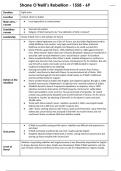
Shane O’Neill’s Rebellion - 1558 - 69
Duration Eight years
Location Ireland, Ulster to Dublin
Main aims / ● Local opposition to central power
causes
Subsidiary ● Internal Irish politics
causes ● Religion- O’Neill claimed to be “true defender of faith in Ireland”
Leadership Shane O’Neill, heir to the Earldom of Tyrone
● Shane= oldest legitimate son of Earl of Tyrone, but had older illegitimate brother
called Matthew. Irish custom- only legit could inherit but father preferred
Matthew so did a deal with English Lord Deputy so he could succeed him.
● Many O’Neills supported Shane. 1558, Matthew killed in a fight against Shane’s
men. When Shane’s father died, Earl of Sussex (Elizabeth’s deputy in Ireland) felt it
would be safer to back Matthew’s sons- would favour London- for Earldom.
● Shane accepted Earldom after father’s death, implied willingness to conform to
English law, decision that may have serious consequences for his children. But also
saw himself as Gaelic clan leader and at end of 1588 decided to reassert
traditional independence by rebelling.
● Uprising coincided to when Elizabeth faced threat of invasion from France,
couldn’t send forces to deal with Shane- he secured almost all of Ulster. 1561-
Sussex marched against him but English relied heavily on O’Neill’s traditional
enemies (O’Donnells) for support.
Detail on the ● Shane avoided head on battle with English, but targeted supplies. Brough in 1,000
rebellion Scottish mercenaries (“Redshanks”) to fight for him- reached outskirts of Dublin.
● Elizabeth forced to launch 3 expensive expeditions in response, only in 1563-
attention turned to destruction of O’Neill property- farms burnt, cattle killed-
Shane persuaded to come to terms. He was promised a full pardon, he visited
London was pardoned by Elizabeth and reconfirmed Earl of Tyrone. On his return
showed his ‘loyalty’ by attacking O’Donnell’s in the Queen’s name and stole
30,000 cattle.
● Treaty with Shane lasted 2 years- rebellion resulted in 1565, new English leader
Sidney had only 1,000 men and couldn’t capture him.
● 1567- Shane seeking alliances with France, Spain and O’Donnell’s, many think that
Sidney was concerned by this and paid O’Donnell’s to murder Shane; but not
confirmed. Shane murdered 1569 and rebellion ended.
● O’Neill successfully used guerrilla tactics- rebellion too difficult and expensive to
put down
Outcomes ● O’Neill eventually murdered by rival Irish, maybe paid by English
● Elizabeth attaints (lands) O’Neill lands in Ulster, seizing extensive possessions but
storing up future trouble with Tyrone Earls
Medium- long lasting rebellion but largely because it was financially impossible for English
to bring a decisive force to bear, Dublin was threatened. While O’Neill wanted to rule hie
Level of part of Ulster without interference there was no calls for independence/ regime change.
threat
, Northern Rebellion - 1569-70
Duration 3 months
Location North of England
● Defence of catholic faith- stronger force of Protestantism
Main aims / ● Dynastic and factional- Mary QOS, available as an alternative
causes leader, her faction supported this rebellion
Subsidiary ● Resistance to the centre- the resentment of the northern earls by
causes the centre increased interference from London
Leadership Earls of Northumberland and Westmorland
● First plot to attempt to destabilize protestantism, first of many.
Reasons why they all started at the end of 1560s: Mary QOS-
arrived in North of England, protestantism not fully established,
deterioration of relations with Spain, Elizabeth unmarried and
lacked heir, William Cecil- most influential councillor was hated.
● Earl of Northumberland and Westmorland conceived vague idea
for the rebellion with a help of southern nobles to put Mary on the
throne, but Duke of Norfolk backed down- notherners had no hope
of success.
Detail on ● While they wavered, Elizabethan intelligence heard of the plot. Earl
the of Sussex, head of Council of the North, tried to raise forces to
rebellion combat a rebellion, few responded to his calls for men. Only had
400 badly equipped cavalry and Northern earls went to Durham-
tore down Protestant symbols in the cathedral and celebrated
mass. Then they headed slowly south with 5,000 men.
● Northerners lack of determination. They heard false rumours that
a large royal army was marching north, knowing that Mary was
under house arrest they realised that neither the south nor
Scotland was going to join the rebellion so they dispersed.
● May have been more serious if it had been better organised but
only 5 men killed.
● Lack of organisation and clear aims causes the rebellion to collapse
quickly and Northumberland was beheaded
Outcomes ● Earl of Huntingdon (Puritan) made president of the council of the
north- his 23 years in charge ends catholic threat from this region
Low. Far from London and plot betrayed before it started. Neither Earl
Level of showed determination. Bad timing- midwinter.
threat
Duration Eight years
Location Ireland, Ulster to Dublin
Main aims / ● Local opposition to central power
causes
Subsidiary ● Internal Irish politics
causes ● Religion- O’Neill claimed to be “true defender of faith in Ireland”
Leadership Shane O’Neill, heir to the Earldom of Tyrone
● Shane= oldest legitimate son of Earl of Tyrone, but had older illegitimate brother
called Matthew. Irish custom- only legit could inherit but father preferred
Matthew so did a deal with English Lord Deputy so he could succeed him.
● Many O’Neills supported Shane. 1558, Matthew killed in a fight against Shane’s
men. When Shane’s father died, Earl of Sussex (Elizabeth’s deputy in Ireland) felt it
would be safer to back Matthew’s sons- would favour London- for Earldom.
● Shane accepted Earldom after father’s death, implied willingness to conform to
English law, decision that may have serious consequences for his children. But also
saw himself as Gaelic clan leader and at end of 1588 decided to reassert
traditional independence by rebelling.
● Uprising coincided to when Elizabeth faced threat of invasion from France,
couldn’t send forces to deal with Shane- he secured almost all of Ulster. 1561-
Sussex marched against him but English relied heavily on O’Neill’s traditional
enemies (O’Donnells) for support.
Detail on the ● Shane avoided head on battle with English, but targeted supplies. Brough in 1,000
rebellion Scottish mercenaries (“Redshanks”) to fight for him- reached outskirts of Dublin.
● Elizabeth forced to launch 3 expensive expeditions in response, only in 1563-
attention turned to destruction of O’Neill property- farms burnt, cattle killed-
Shane persuaded to come to terms. He was promised a full pardon, he visited
London was pardoned by Elizabeth and reconfirmed Earl of Tyrone. On his return
showed his ‘loyalty’ by attacking O’Donnell’s in the Queen’s name and stole
30,000 cattle.
● Treaty with Shane lasted 2 years- rebellion resulted in 1565, new English leader
Sidney had only 1,000 men and couldn’t capture him.
● 1567- Shane seeking alliances with France, Spain and O’Donnell’s, many think that
Sidney was concerned by this and paid O’Donnell’s to murder Shane; but not
confirmed. Shane murdered 1569 and rebellion ended.
● O’Neill successfully used guerrilla tactics- rebellion too difficult and expensive to
put down
Outcomes ● O’Neill eventually murdered by rival Irish, maybe paid by English
● Elizabeth attaints (lands) O’Neill lands in Ulster, seizing extensive possessions but
storing up future trouble with Tyrone Earls
Medium- long lasting rebellion but largely because it was financially impossible for English
to bring a decisive force to bear, Dublin was threatened. While O’Neill wanted to rule hie
Level of part of Ulster without interference there was no calls for independence/ regime change.
threat
, Northern Rebellion - 1569-70
Duration 3 months
Location North of England
● Defence of catholic faith- stronger force of Protestantism
Main aims / ● Dynastic and factional- Mary QOS, available as an alternative
causes leader, her faction supported this rebellion
Subsidiary ● Resistance to the centre- the resentment of the northern earls by
causes the centre increased interference from London
Leadership Earls of Northumberland and Westmorland
● First plot to attempt to destabilize protestantism, first of many.
Reasons why they all started at the end of 1560s: Mary QOS-
arrived in North of England, protestantism not fully established,
deterioration of relations with Spain, Elizabeth unmarried and
lacked heir, William Cecil- most influential councillor was hated.
● Earl of Northumberland and Westmorland conceived vague idea
for the rebellion with a help of southern nobles to put Mary on the
throne, but Duke of Norfolk backed down- notherners had no hope
of success.
Detail on ● While they wavered, Elizabethan intelligence heard of the plot. Earl
the of Sussex, head of Council of the North, tried to raise forces to
rebellion combat a rebellion, few responded to his calls for men. Only had
400 badly equipped cavalry and Northern earls went to Durham-
tore down Protestant symbols in the cathedral and celebrated
mass. Then they headed slowly south with 5,000 men.
● Northerners lack of determination. They heard false rumours that
a large royal army was marching north, knowing that Mary was
under house arrest they realised that neither the south nor
Scotland was going to join the rebellion so they dispersed.
● May have been more serious if it had been better organised but
only 5 men killed.
● Lack of organisation and clear aims causes the rebellion to collapse
quickly and Northumberland was beheaded
Outcomes ● Earl of Huntingdon (Puritan) made president of the council of the
north- his 23 years in charge ends catholic threat from this region
Low. Far from London and plot betrayed before it started. Neither Earl
Level of showed determination. Bad timing- midwinter.
threat