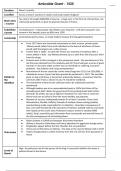
Amicable Grant - 1525
Duration About 3 months
Location Across at least 5 counties in eastern and south-eastern England
Tax- Henry VIII sought £800,000 of new tax - a huge sum, in the form of a forced loan, not
Main aims ordered by parliament, to back his planned invasion of France
/ causes
Subsidiary Unemployment - rising sharply and inflation was rising fast - 12% fall in peasant’s real
causes income in this decade, prices up 60% since 1500
Locals below gentry status, no major leaders because the King agreed pardons
Leadership
● From 1515 there was increased assessments on land, income, private assets
-Wolsey would collect from each individual on the basis of whichever of these
would yield the largest sum; unfair process
● Further hike in 1520s - to catch the French at a moment of weakness after a
severe defeat in Italy - saw Wolsey demand up to a sixth from the laity and a third
from the clergy
● Protests were at their strongest in the prosperous south - this was because of the
tax that was collected from the relatively well off. There had been a series of good
harvests in the early 1520s so there was no real death or suffering. Economic
problems - fast inflation and rising unemployment.
● Resentment of the tax caused by: earlier taxes (huge loan 1522-3 of £250,000), 4
subsidiaries across 4 years had been granted by parliament in 1523. The amicable
Detail on grant on top of all these, a forced loan ordered by Wolsey - resentment that the
the commons didn’t have a chance to say if it should be voted/not.
rebellion ● The resentment meant the tax collection had to be scaled back and then
abandoned.
● Although taxation was at an unprecedented peak in 1520s the failure of the
amicable grant didn’t deter the government from pushing ahead with further
demands. By 1540s, tax was at highest it had been for more than 2 centuries-
Henry took care to collect it from the more wealthy, not peasants.
● Reasons for success: widespread protests (in at least 5 counties- Essex, Kent,
Warwickshire, Norfolk, Suffolk), Example of multiple classes uniting (nobility
resented being made responsible for its collection - faced dire consequences if
fails, Lord Lisle threatened with execution), Protestors avoided violence and made
their loyalty to the crown clear, Protestors ready to march to London (4000
rebels), King’s councillors got information from countryside and warned Henry of
the dire consequences of not backing down.
● Major protests in Suffolk and taxpayer discontent elsewhere
● Wolsey is forced to climb down and Henry abandons his aggressive foreign policy
● Ringleaders appear before the Star Chamber but are pardoned
● Henry puts all the blame on Wolsey - first step on the road to Wolsey’s fall in 1529
Outcomes ● Tudors change policy to collect more tax from the rich and less from peasantry in
future
High - for policy but not for the person of the King. A successful rebellion but never a
Level of political threat to the throne
threat
Duration About 3 months
Location Across at least 5 counties in eastern and south-eastern England
Tax- Henry VIII sought £800,000 of new tax - a huge sum, in the form of a forced loan, not
Main aims ordered by parliament, to back his planned invasion of France
/ causes
Subsidiary Unemployment - rising sharply and inflation was rising fast - 12% fall in peasant’s real
causes income in this decade, prices up 60% since 1500
Locals below gentry status, no major leaders because the King agreed pardons
Leadership
● From 1515 there was increased assessments on land, income, private assets
-Wolsey would collect from each individual on the basis of whichever of these
would yield the largest sum; unfair process
● Further hike in 1520s - to catch the French at a moment of weakness after a
severe defeat in Italy - saw Wolsey demand up to a sixth from the laity and a third
from the clergy
● Protests were at their strongest in the prosperous south - this was because of the
tax that was collected from the relatively well off. There had been a series of good
harvests in the early 1520s so there was no real death or suffering. Economic
problems - fast inflation and rising unemployment.
● Resentment of the tax caused by: earlier taxes (huge loan 1522-3 of £250,000), 4
subsidiaries across 4 years had been granted by parliament in 1523. The amicable
Detail on grant on top of all these, a forced loan ordered by Wolsey - resentment that the
the commons didn’t have a chance to say if it should be voted/not.
rebellion ● The resentment meant the tax collection had to be scaled back and then
abandoned.
● Although taxation was at an unprecedented peak in 1520s the failure of the
amicable grant didn’t deter the government from pushing ahead with further
demands. By 1540s, tax was at highest it had been for more than 2 centuries-
Henry took care to collect it from the more wealthy, not peasants.
● Reasons for success: widespread protests (in at least 5 counties- Essex, Kent,
Warwickshire, Norfolk, Suffolk), Example of multiple classes uniting (nobility
resented being made responsible for its collection - faced dire consequences if
fails, Lord Lisle threatened with execution), Protestors avoided violence and made
their loyalty to the crown clear, Protestors ready to march to London (4000
rebels), King’s councillors got information from countryside and warned Henry of
the dire consequences of not backing down.
● Major protests in Suffolk and taxpayer discontent elsewhere
● Wolsey is forced to climb down and Henry abandons his aggressive foreign policy
● Ringleaders appear before the Star Chamber but are pardoned
● Henry puts all the blame on Wolsey - first step on the road to Wolsey’s fall in 1529
Outcomes ● Tudors change policy to collect more tax from the rich and less from peasantry in
future
High - for policy but not for the person of the King. A successful rebellion but never a
Level of political threat to the throne
threat