MN551Quiz 7/MN551 – Quiz 7 Pathophysiology across the life:Kaplan University(Latest Q&A Graded A)
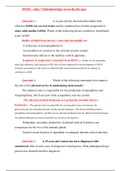
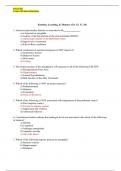
MN551 – Quiz 7 Pathophysiology across the life span Question 1. A 4-year-old boy has had otitis media with effusion (OME) for several weeks and his condition has recently progressed to acute otitis media (AOM). Which of the following factors could have contributed to his AOM? Reflux of fluid from the boy's nose into his middle ear A deficiency in immunoglobulin G Accumulation of cerumen in the external acoustic meatus Sensorineural deficits in the auditory control apparatus Exposure to respiratory syncytial virus (RSV)---- Reflux via the eustachian tubes, IgG deficiency, and exposure to RSV have all been implicated in the development of AOM. Cerumen accumulation in the outer ear, deficient IgM, and sensorineural deficits are unlikely to contribute to AOM. Question 2. Which of the following statements best captures the role of the adrenal cortex in maintaining homeostasis? The adrenal cortex is responsible for the production of epinephrine and norepinephrine, which are part of the sympathetic nervous system. The adrenal cortical hormones are primarily steroids and sex hormones. ---The adrenal cortex is responsible for secreting three types of hormones: the glucocorticoids, the mineralocorticoids, and the adrenal androgens. The adrenal medulla produces epinephrine and norepinephrine, and there are no alternate production sites for adrenal cortical hormones. The adrenal androgens are least responsible for normal sexual function. Redundant, secondary production of adrenal cortical hormones can compensate for the loss of the adrenal glands. Normal sexual function is dependent on adequate adrenal cortical function. Question 3. A 29-year-old woman has been diagnosed with otosclerosis after several years of progressive hearing loss. What pathophysiologic process has characterized her diagnosis? New, sclerotic / spongy bone has been formed around her stapes and oval window. Otosclerosis begins with resorption of bone in one or more foci. During active bone resorption, the bone structure appears spongy and softer than normal (i.e., osteospongiosis). The resorbed bone is replaced by an overgrowth of new, hard, sclerotic bone. Distortion of neural pathways, resorption of the temporal bone, and filling of the tympanic cavity do not occur with otosclerosis. Her incus, malleus, and stapes have become disconnected from her normal neural pathways. Her temporal bone is experiencing unusually rapid resorption. Her tympanic cavity is becoming filled with bone due to inappropriate osteogenesis.
Written for
Document information
- Uploaded on
- August 20, 2020
- Number of pages
- 23
- Written in
- 2019/2020
- Type
- Exam (elaborations)
- Contains
- Unknown
Subjects
- mn551qui
-
mn551quiz 7mn551 – quiz 7 pathophysiology across the life
-
mn551quiz 7 pathophysiology across the life span
-
mn551quiz 7mn551 – quiz 7 pathophysiology
-
mn551quiz 7mn551 quiz 7 pathophysiology

Also available in package deal