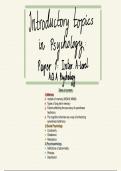
Introductory topics
in
Psychology
:
1 A-Level Inter
PaperAQA : .
Psychology
Table of content:
1) Memory
• models of memory (MSM & WMM)
• Types of long term memory
• Factors affecting the accuracy of eyewitness
testimony
• The cognitive interview as a way of enhancing
eyewitness testimony
2) Social Psychology
• Conformity
• Obedience
• Resistance
3) Psychopathology
• Definitions of abnormality
• Phobias
• Depression
,Memory
, &
it is made of three separate &
The model suggests
the most well known model's of memory.
*
= one of
created by Atkinson and shiffrin in the year
The Multi-store distinct stores (SR , STM , LTM).
* All the different stores differe in ,
capacity & duration coding
1968 They the flow of
memory system Model of sequential model meaning
Memory
.
saw as a * the model is linear , a that
,
information divided into different
being Each store
a series of information
conditions
will pass from store to store in order (if certain
met And the same
interacting memory stores having a different
are
goes for that into will
.
.
be lost in conditions arn't met...)
.
purpose and having different codings capacities & durations . rehearsa,
1
, ,
how the information is
Encoding
~
is :
processed from the senses into the
memory
.This
itself is how the information will be
External
stored
ultimately recalled. attention short-term Transfer
long-term
and
Stimulus
sensory
Registers
>
- - >
memory memory
↓ ↓ trieval
↓
information lost
Long-termmoved
Information
Memory
from
:
Sensory Registers Information lost is STM to LTM
Information
: via
lost
I
-
maintanance rehearsal At the rehearsal
information will enter the diff (vision touch smell beginning
↑
5 Senses
Memory
,
Short-Term
.
.
,
:
, ,
the info in STM , but the more its rehearsed,
taste and
is separated
hearing) and then enter
sensory memory which
into different stores called ters
our
-
Information will decay here if it isn't rehearsed if too or
keeps
then it will be moved to LiM. It is is
Each deal will info from particular senses :
Sensory Regis .
many
memories are put into this store Displacement. =
permanent store where limitless amounts of
capacity 7+ /-2 items info stored for a
long timee.
:
Sonic
3
is
register (vision ( All these passive stores : don't control A
-
are we
of the memories
seconds
are
nutgoes in ButMany
~ those that
out .
don't disentegrate · Duration : 18-30
capacity potentially unlimitted
:
-Echoic (sound
register
s .
ort
mean attention
gen
theyare SensoryalonRegisters encoded :
accoustically Duration potentially unlimited
D
·
is :
very
Haptic register (touch).
So if attention given then the info moves to STM.
& Peterson (1959) Duration of STM's .
semantically
is
Peterson
-
Encoded
. -
,
:
Capacity possibly unlimited with either letters
I
LTM
:
Presented participants of
triagrams -
Duration :
may
be lost in 5 sees on numbers and asked to memories it while
were Procedural Declarative
Encoded counting backwards in threes from a random number this memory :memory,
visually &
accoustically
:
to prevent them from rehersing
S
was And then the participants
Sperlingcapacity
. -cerabellum
& durationa ionic memory
were
12
,
asked to repeat the triagram after intervals of 3 6 9
and 18 seconds. Participants could recall , , , & &
- 80 % of the Semantic Episodic
shorter intervals While it
His participants shown G of triag ~ am in the
got to
.
10 %
Memorreral memory
:
diagram
were
sby second interval .... in fo at
a the 18 disapears (or
events'
letters for rapidly STM when decays) very
only
left prefrontal
rehersing to
Hippocampus
millisecond and then told to recall. from
prevented
-
50
-
were is . context
# high levels of control - Bahrich et al Duration of LTM
Withoutralising the letters funded further into their memory before
.
easy replicate .
-
psychology students
for their
,
could recall 3 or 4 letters.
· 24 were
participants = ↑ demand
We tested 393
graduets of American highschool
they
an
being able to recall it. As only characteristics
(guessing) They
former classmates. tested their memories for another
This second trial , them to 3
is
why in the speeling trained * Low
Ecological validity = > not real life
student in their
yearbooks ,
via
matching names & photos
tones and look at specific now depending its tore. with picture are Participants at 34 years
recalling
on names
.
a & no .
190 % accurate) and at 48 years gone 750 % accurate)
because of this the participants were able to recall 75%
, ·
=> accurate in mal life
of the letters
,
# high ecological validity
as
they would only look at smaller
poportions * low control variables = saw each other? Was only
of letters rather than at once. there in school for 1
year .
time
Doesn't explain why memories get worse over
.
#
# high levels of control = can replicate & is reliable :·
=>
ecological validity not applicable to real life > lacks
validity .
* if the same
diagram shown results bound , are to be better ...
reliable?
, Encoding of STM & LTM
(1966)
A case
study supporting
Multi-store model
the Brain &
Memory
Damage(1966)
Loss :
-
Baddeley et al :
-
Milner
He wanted to how LiM & STM
prove process
information in different ways . A man called HM had suppered from
Epilepsy and therefore
He constructed pool of short & similar words into
underwent brain surgery of
removing
the
hippocampus The
surgery
a .
4 categories. with his but left a permanent
helped epilepsy damage his
dissimilar 3 sounding
notsame set on
accoustically similar
accoustically annoninims (same /not
memory
semantically similar 3 tall-high meaning able to remember his life but couldn't
dissimilar
·
He was early
semantically
for each category , he presented
5 words
randomly .
remember anything from 10
years before the surgery &
after them couldn't retain info.
STM
them
:
asked porti to write rightminute intervals
presenting also new
asked to write down after able rember 6 numbers order that
20 to
LTM :
· he was in were
SiM : codes
accoustically they only
similar worlds
as rememberal
presented
-
suggesting his STM was
relatively infant .
accousticly .
But he didn't realise that he
similar word
.
· was
reading the same
LTM : codes semantically as semantically and & didn't recognise the
remembered betterr. newspaper over over
again
were with him .
same psychologists working
- supported Conrad (1964)
by but with letters => as a result his siM was still
relatively intent , but his
did the (only siM) defectivea could
= same
LTM was
permanently no
longer lay
↓
Supports the MSM because each memory is
down new memories or retrieve them.
separate and different
.
lacks real conducted HM before
ecological validity
a : not tests were on
m no
memory So we
don't know if he hada
the surgery
.
with
good memory
to begin
store
> proves that STM and
# LTM operate memory
ar e
and"supports the MSM.
in
Psychology
:
1 A-Level Inter
PaperAQA : .
Psychology
Table of content:
1) Memory
• models of memory (MSM & WMM)
• Types of long term memory
• Factors affecting the accuracy of eyewitness
testimony
• The cognitive interview as a way of enhancing
eyewitness testimony
2) Social Psychology
• Conformity
• Obedience
• Resistance
3) Psychopathology
• Definitions of abnormality
• Phobias
• Depression
,Memory
, &
it is made of three separate &
The model suggests
the most well known model's of memory.
*
= one of
created by Atkinson and shiffrin in the year
The Multi-store distinct stores (SR , STM , LTM).
* All the different stores differe in ,
capacity & duration coding
1968 They the flow of
memory system Model of sequential model meaning
Memory
.
saw as a * the model is linear , a that
,
information divided into different
being Each store
a series of information
conditions
will pass from store to store in order (if certain
met And the same
interacting memory stores having a different
are
goes for that into will
.
.
be lost in conditions arn't met...)
.
purpose and having different codings capacities & durations . rehearsa,
1
, ,
how the information is
Encoding
~
is :
processed from the senses into the
memory
.This
itself is how the information will be
External
stored
ultimately recalled. attention short-term Transfer
long-term
and
Stimulus
sensory
Registers
>
- - >
memory memory
↓ ↓ trieval
↓
information lost
Long-termmoved
Information
Memory
from
:
Sensory Registers Information lost is STM to LTM
Information
: via
lost
I
-
maintanance rehearsal At the rehearsal
information will enter the diff (vision touch smell beginning
↑
5 Senses
Memory
,
Short-Term
.
.
,
:
, ,
the info in STM , but the more its rehearsed,
taste and
is separated
hearing) and then enter
sensory memory which
into different stores called ters
our
-
Information will decay here if it isn't rehearsed if too or
keeps
then it will be moved to LiM. It is is
Each deal will info from particular senses :
Sensory Regis .
many
memories are put into this store Displacement. =
permanent store where limitless amounts of
capacity 7+ /-2 items info stored for a
long timee.
:
Sonic
3
is
register (vision ( All these passive stores : don't control A
-
are we
of the memories
seconds
are
nutgoes in ButMany
~ those that
out .
don't disentegrate · Duration : 18-30
capacity potentially unlimitted
:
-Echoic (sound
register
s .
ort
mean attention
gen
theyare SensoryalonRegisters encoded :
accoustically Duration potentially unlimited
D
·
is :
very
Haptic register (touch).
So if attention given then the info moves to STM.
& Peterson (1959) Duration of STM's .
semantically
is
Peterson
-
Encoded
. -
,
:
Capacity possibly unlimited with either letters
I
LTM
:
Presented participants of
triagrams -
Duration :
may
be lost in 5 sees on numbers and asked to memories it while
were Procedural Declarative
Encoded counting backwards in threes from a random number this memory :memory,
visually &
accoustically
:
to prevent them from rehersing
S
was And then the participants
Sperlingcapacity
. -cerabellum
& durationa ionic memory
were
12
,
asked to repeat the triagram after intervals of 3 6 9
and 18 seconds. Participants could recall , , , & &
- 80 % of the Semantic Episodic
shorter intervals While it
His participants shown G of triag ~ am in the
got to
.
10 %
Memorreral memory
:
diagram
were
sby second interval .... in fo at
a the 18 disapears (or
events'
letters for rapidly STM when decays) very
only
left prefrontal
rehersing to
Hippocampus
millisecond and then told to recall. from
prevented
-
50
-
were is . context
# high levels of control - Bahrich et al Duration of LTM
Withoutralising the letters funded further into their memory before
.
easy replicate .
-
psychology students
for their
,
could recall 3 or 4 letters.
· 24 were
participants = ↑ demand
We tested 393
graduets of American highschool
they
an
being able to recall it. As only characteristics
(guessing) They
former classmates. tested their memories for another
This second trial , them to 3
is
why in the speeling trained * Low
Ecological validity = > not real life
student in their
yearbooks ,
via
matching names & photos
tones and look at specific now depending its tore. with picture are Participants at 34 years
recalling
on names
.
a & no .
190 % accurate) and at 48 years gone 750 % accurate)
because of this the participants were able to recall 75%
, ·
=> accurate in mal life
of the letters
,
# high ecological validity
as
they would only look at smaller
poportions * low control variables = saw each other? Was only
of letters rather than at once. there in school for 1
year .
time
Doesn't explain why memories get worse over
.
#
# high levels of control = can replicate & is reliable :·
=>
ecological validity not applicable to real life > lacks
validity .
* if the same
diagram shown results bound , are to be better ...
reliable?
, Encoding of STM & LTM
(1966)
A case
study supporting
Multi-store model
the Brain &
Memory
Damage(1966)
Loss :
-
Baddeley et al :
-
Milner
He wanted to how LiM & STM
prove process
information in different ways . A man called HM had suppered from
Epilepsy and therefore
He constructed pool of short & similar words into
underwent brain surgery of
removing
the
hippocampus The
surgery
a .
4 categories. with his but left a permanent
helped epilepsy damage his
dissimilar 3 sounding
notsame set on
accoustically similar
accoustically annoninims (same /not
memory
semantically similar 3 tall-high meaning able to remember his life but couldn't
dissimilar
·
He was early
semantically
for each category , he presented
5 words
randomly .
remember anything from 10
years before the surgery &
after them couldn't retain info.
STM
them
:
asked porti to write rightminute intervals
presenting also new
asked to write down after able rember 6 numbers order that
20 to
LTM :
· he was in were
SiM : codes
accoustically they only
similar worlds
as rememberal
presented
-
suggesting his STM was
relatively infant .
accousticly .
But he didn't realise that he
similar word
.
· was
reading the same
LTM : codes semantically as semantically and & didn't recognise the
remembered betterr. newspaper over over
again
were with him .
same psychologists working
- supported Conrad (1964)
by but with letters => as a result his siM was still
relatively intent , but his
did the (only siM) defectivea could
= same
LTM was
permanently no
longer lay
↓
Supports the MSM because each memory is
down new memories or retrieve them.
separate and different
.
lacks real conducted HM before
ecological validity
a : not tests were on
m no
memory So we
don't know if he hada
the surgery
.
with
good memory
to begin
store
> proves that STM and
# LTM operate memory
ar e
and"supports the MSM.