GBE Exam #2
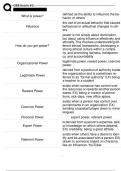
defined as the ability to influence the be-
What is power?
havior of others
the use of an actual behavior that causes
Influence behavioral or attitudinal changes in oth-
ers
power is not simply about domination,
but about using influence effectively and
ethically. This involves understanding dif-
How do you get power? ferent ethical frameworks, developing a
strong ethical culture within a compa-
ny, and promoting fairness, transparen-
cy, and accountability
legitimate power, reward power, coercive
Organizational Power
power.
derived from a position of authority inside
the organization and is sometimes re-
Legitimate Power
ferred to as "formal authority" EX) being
a teacher to a student
exists when someone has control over
the resources or rewards another person
Reward Power
wants. EX) being in control of promo-
tions, sick days, new office space.
exists when a person has control over
punishments in an organization. EX)
Coercive Power
sending a baseball player down to minor
leagues
Personal Power expert power, referent power
is derived from a person's expertise, skill,
Expert Power or knowledge on which others depend.
EX) credibility, being a great athlete.
exists when others have a desire to iden-
tify and be associated with a person EX)
Referent Power
drawn to someone based on charisma
like an influencer, YouTuber.
, GBE Exam #2
An authority figure tells participants to
What was the Milgram Experiment? administer shocks to the "learner" when
learner gives wrong answers
most people during this experiment were
blindly obedient to authority figures and
people with power. Two important sen-
What can we learn from Milgram about
tences: "the experiment requires that you
power and ethics?
must continue" and "I (the scientist) take
full responsibility). No where explicitly
saying to keep going.
In the Milgram experiment, organization-
al power is evident through legitimate
power, as the authority figure (the ex-
perimenter in the lab coat) derives pow-
er from their institutional role, and co-
ercive power, as participants fear con-
What power dimensions can we identify
sequences for disobedience. Personal
from the Milgram experiment?
power is present through expert pow-
er, as the experimenter is perceived as
knowledgeable and credible, and refer-
ent power may play a minor role if partic-
ipants feel drawn to obey due to respect
or admiration for scientific authority.
Practical advice --> recognize the pow-
er managers hold as legitimate authority
What can we teach managers/organiza- figures, as experts, as people who con-
tions after these findings? trol rewards. Use this power to set high
ethical standards. Model and communi-
cate ethical behavior.
displacement of responsibility (the scien-
tist is taking all responsibility), moral jus-
tification (the experiment requires it), at-
Other class concepts implied during Mil-
tribution of blame, euphemistic language
gram
Psychological distance - the participant
does not see the target.
Moral emotions; moral distress
What type of power structure was Mil-
gram experiment?
, GBE Exam #2
Dyadic power structure - refer to the dy-
namic relationships between two individ-
uals, often focusing on how each person
perceives and uses power in their inter-
actions and relationships. These struc-
tures can be equal, unequal, or bal-
anced, and they impact how individuals
influence each other, make decisions,
and experience the relationship.
Most of the time, we work in groups/in-
stitutions. influence communication pat-
terns, feelings of psychological safety,
What does power do to us when we work
and organizational culture. Negative ex-
in groups?
periences with power dynamics in the
workplace can cause employee stress
and high turnover.
Phil Zimbardo's study on the situa-
tional/environmental influences on hu-
man behavior and the fulfillment of
What was Stanford Prison Experiment roles. Created a mock prison and put
healthy (physically and mentally) stu-
dents in prison environments. Randomly
assigned: 12 guards 12 prisoners.
Displayed that social roles have a strong
influence over peoples behaviors and
that people elicit unexpectedly cruel, yet
'situationally appropriate' behavior. Con-
cluded that situational pressures can
Results of Stanford prison experiment?
lead normal, decent people to behave in
sinister, repugnant ways. After 36 hours,
prisoners had mental breakdowns after
mistreatment and humiliation. Was termi-
nated after 1 week.
What are the psychological processes Groups ’ In-group bias, conformity, group-
when we are: think
-Put in groups Power ’ Less empathy, risk of corruption
-Given power over others Roles ’ Role absorption, obedience, loss
-Asked to fulfill assigned roles of personal morals
defined as the ability to influence the be-
What is power?
havior of others
the use of an actual behavior that causes
Influence behavioral or attitudinal changes in oth-
ers
power is not simply about domination,
but about using influence effectively and
ethically. This involves understanding dif-
How do you get power? ferent ethical frameworks, developing a
strong ethical culture within a compa-
ny, and promoting fairness, transparen-
cy, and accountability
legitimate power, reward power, coercive
Organizational Power
power.
derived from a position of authority inside
the organization and is sometimes re-
Legitimate Power
ferred to as "formal authority" EX) being
a teacher to a student
exists when someone has control over
the resources or rewards another person
Reward Power
wants. EX) being in control of promo-
tions, sick days, new office space.
exists when a person has control over
punishments in an organization. EX)
Coercive Power
sending a baseball player down to minor
leagues
Personal Power expert power, referent power
is derived from a person's expertise, skill,
Expert Power or knowledge on which others depend.
EX) credibility, being a great athlete.
exists when others have a desire to iden-
tify and be associated with a person EX)
Referent Power
drawn to someone based on charisma
like an influencer, YouTuber.
, GBE Exam #2
An authority figure tells participants to
What was the Milgram Experiment? administer shocks to the "learner" when
learner gives wrong answers
most people during this experiment were
blindly obedient to authority figures and
people with power. Two important sen-
What can we learn from Milgram about
tences: "the experiment requires that you
power and ethics?
must continue" and "I (the scientist) take
full responsibility). No where explicitly
saying to keep going.
In the Milgram experiment, organization-
al power is evident through legitimate
power, as the authority figure (the ex-
perimenter in the lab coat) derives pow-
er from their institutional role, and co-
ercive power, as participants fear con-
What power dimensions can we identify
sequences for disobedience. Personal
from the Milgram experiment?
power is present through expert pow-
er, as the experimenter is perceived as
knowledgeable and credible, and refer-
ent power may play a minor role if partic-
ipants feel drawn to obey due to respect
or admiration for scientific authority.
Practical advice --> recognize the pow-
er managers hold as legitimate authority
What can we teach managers/organiza- figures, as experts, as people who con-
tions after these findings? trol rewards. Use this power to set high
ethical standards. Model and communi-
cate ethical behavior.
displacement of responsibility (the scien-
tist is taking all responsibility), moral jus-
tification (the experiment requires it), at-
Other class concepts implied during Mil-
tribution of blame, euphemistic language
gram
Psychological distance - the participant
does not see the target.
Moral emotions; moral distress
What type of power structure was Mil-
gram experiment?
, GBE Exam #2
Dyadic power structure - refer to the dy-
namic relationships between two individ-
uals, often focusing on how each person
perceives and uses power in their inter-
actions and relationships. These struc-
tures can be equal, unequal, or bal-
anced, and they impact how individuals
influence each other, make decisions,
and experience the relationship.
Most of the time, we work in groups/in-
stitutions. influence communication pat-
terns, feelings of psychological safety,
What does power do to us when we work
and organizational culture. Negative ex-
in groups?
periences with power dynamics in the
workplace can cause employee stress
and high turnover.
Phil Zimbardo's study on the situa-
tional/environmental influences on hu-
man behavior and the fulfillment of
What was Stanford Prison Experiment roles. Created a mock prison and put
healthy (physically and mentally) stu-
dents in prison environments. Randomly
assigned: 12 guards 12 prisoners.
Displayed that social roles have a strong
influence over peoples behaviors and
that people elicit unexpectedly cruel, yet
'situationally appropriate' behavior. Con-
cluded that situational pressures can
Results of Stanford prison experiment?
lead normal, decent people to behave in
sinister, repugnant ways. After 36 hours,
prisoners had mental breakdowns after
mistreatment and humiliation. Was termi-
nated after 1 week.
What are the psychological processes Groups ’ In-group bias, conformity, group-
when we are: think
-Put in groups Power ’ Less empathy, risk of corruption
-Given power over others Roles ’ Role absorption, obedience, loss
-Asked to fulfill assigned roles of personal morals