
Consumer behavior book notes
Chapter 1 | Understanding
What is consumer behavior?
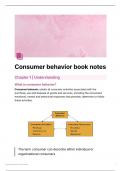
Consumer behavior: entails all consumer activities associated with the
purchase, use and disposal of goods and services, including the consumers
emotional, mental and behavioral responses that precede, determine or follow
these activities.
The term consumer can describe either individual or
organizational consumers
Consumer behavior book notes 1
, Individual consumer: consumers who purchase goods and services to satisfy
their own personal needs and want or to satisfy the needs of wants of others.
Organizational consumers: consumers who purchase goods and services in
order to produce other goods or services, resell them to other organizations or
to individual consumers, and to help manage and run their organization
Consumer behavior is broken down into:
1. Purchase activities: are those trough which consumers acquire goods and
services (gathering information and method of purchase etc.)
2. Use activities: describe where, when and how consumption takes place
3. Disposal activities: the ways consumers get rid of products and/or
packaging after consumption (discarding, recycling, reuse and resell)
Emotional or affective responses reflect a consumer’s
emotions, feelings, and moods. More specifically, moods are
states of mind at a particular time; feelings are the
expressions of our moods → Emotion is moods, plus
feelings, plus some type of psychological and physical
arousal.
Mental or cognitive responses include a consumer’s thought
processes, opinions, beliefs, attitudes, and intentions about
products and services.
Behavioral responses include a consumer’s overt decisions
and actions during the purchase, use, and disposal activities
identified earlier.
Consumer behavior book notes 2
, Public policy: the establishment of laws and regulations that govern business
practices in order to protect consumers.
Marketing concept: the idea that firms should discover and satisfy customer
needs and wants in an efficient and profitable manner, while benefiting the
longterm interests of the company’s stakeholders.
Successful organizations focus on delivering customer
perceived value and customer delight, which is essential for
long term succes.
→ Customer perceived value: The estimated net gain customers receive from
their sacrifice of time, money and effort expended to purchase, use and
dispose of s product or service.
→ Customer delight: Goes a step beyond customer perceived value ,
suggesting customer benefit that not only meet, but also exceed expectations
in unanticipated ways.
The steps of the marketing research process:
1. Define the problem or opportunity: The first step in the research process is
to define the research issue. What is the problem to be solved or the
opportunity to be explored? When this step is done accurately, the research
can ultimately yield valuable insights. This step also includes clearly
delineating the specific goals and objectives of the research project, which
guide the execution of the research.
2. Determine the research design: The design of the research depends on
how much and what kind of information is already known and what
information needs to be gathered. There are three main types of research
design: exploratory, descriptive, and causal research. If very little is known
about the research issue, exploratory research is likely needed. If the goal
of the research is to obtain precise information, then descriptive or causal
research may be warranted. These designs will be discussed in more depth
later in the chapter.
Consumer behavior book notes 3
, 3. Design data collection methods and forms: This step involves determining
what type of data will be collected, secondary or primary. Secondary data
(what already exists) are data that already exist and are readily accessible,
whereas primary data are new data collected specifically for the research
purpose at hand. If we have to collect primary data (new data specifically
collected for this research), we must decide what method will be used to
collect the information and how specific instruments will be designed.
These topics will also be expanded upon later in the chapter.
4. Sampling and data collection: In this step, the researcher must determine
from whom the information will be solicited and how many people must be
studied. Once this criteria is decided upon, the data can be collected.
5. Analysis and interpretation of results: A researcher may collect a large
amount of data, but those data are useless without precise and accurate
analysis and interpretation of the results. The data analysis method will
depend on the type of data collected. It should be noted that numbers and
analyses are simply inputs to decisions. Numbers don’t make decisions –
people do, and a good marketing researcher will temper research results
with judgment when making recommendations.
6. Recommendations: Leading from the analysis and interpretation of results,
the last step of the process is the formulation of recommendations.
Recommendations are usually presented in a research report, a formal
document that summarizes the research results and recommendations.
Consumer behavior book notes 4
Chapter 1 | Understanding
What is consumer behavior?
Consumer behavior: entails all consumer activities associated with the
purchase, use and disposal of goods and services, including the consumers
emotional, mental and behavioral responses that precede, determine or follow
these activities.
The term consumer can describe either individual or
organizational consumers
Consumer behavior book notes 1
, Individual consumer: consumers who purchase goods and services to satisfy
their own personal needs and want or to satisfy the needs of wants of others.
Organizational consumers: consumers who purchase goods and services in
order to produce other goods or services, resell them to other organizations or
to individual consumers, and to help manage and run their organization
Consumer behavior is broken down into:
1. Purchase activities: are those trough which consumers acquire goods and
services (gathering information and method of purchase etc.)
2. Use activities: describe where, when and how consumption takes place
3. Disposal activities: the ways consumers get rid of products and/or
packaging after consumption (discarding, recycling, reuse and resell)
Emotional or affective responses reflect a consumer’s
emotions, feelings, and moods. More specifically, moods are
states of mind at a particular time; feelings are the
expressions of our moods → Emotion is moods, plus
feelings, plus some type of psychological and physical
arousal.
Mental or cognitive responses include a consumer’s thought
processes, opinions, beliefs, attitudes, and intentions about
products and services.
Behavioral responses include a consumer’s overt decisions
and actions during the purchase, use, and disposal activities
identified earlier.
Consumer behavior book notes 2
, Public policy: the establishment of laws and regulations that govern business
practices in order to protect consumers.
Marketing concept: the idea that firms should discover and satisfy customer
needs and wants in an efficient and profitable manner, while benefiting the
longterm interests of the company’s stakeholders.
Successful organizations focus on delivering customer
perceived value and customer delight, which is essential for
long term succes.
→ Customer perceived value: The estimated net gain customers receive from
their sacrifice of time, money and effort expended to purchase, use and
dispose of s product or service.
→ Customer delight: Goes a step beyond customer perceived value ,
suggesting customer benefit that not only meet, but also exceed expectations
in unanticipated ways.
The steps of the marketing research process:
1. Define the problem or opportunity: The first step in the research process is
to define the research issue. What is the problem to be solved or the
opportunity to be explored? When this step is done accurately, the research
can ultimately yield valuable insights. This step also includes clearly
delineating the specific goals and objectives of the research project, which
guide the execution of the research.
2. Determine the research design: The design of the research depends on
how much and what kind of information is already known and what
information needs to be gathered. There are three main types of research
design: exploratory, descriptive, and causal research. If very little is known
about the research issue, exploratory research is likely needed. If the goal
of the research is to obtain precise information, then descriptive or causal
research may be warranted. These designs will be discussed in more depth
later in the chapter.
Consumer behavior book notes 3
, 3. Design data collection methods and forms: This step involves determining
what type of data will be collected, secondary or primary. Secondary data
(what already exists) are data that already exist and are readily accessible,
whereas primary data are new data collected specifically for the research
purpose at hand. If we have to collect primary data (new data specifically
collected for this research), we must decide what method will be used to
collect the information and how specific instruments will be designed.
These topics will also be expanded upon later in the chapter.
4. Sampling and data collection: In this step, the researcher must determine
from whom the information will be solicited and how many people must be
studied. Once this criteria is decided upon, the data can be collected.
5. Analysis and interpretation of results: A researcher may collect a large
amount of data, but those data are useless without precise and accurate
analysis and interpretation of the results. The data analysis method will
depend on the type of data collected. It should be noted that numbers and
analyses are simply inputs to decisions. Numbers don’t make decisions –
people do, and a good marketing researcher will temper research results
with judgment when making recommendations.
6. Recommendations: Leading from the analysis and interpretation of results,
the last step of the process is the formulation of recommendations.
Recommendations are usually presented in a research report, a formal
document that summarizes the research results and recommendations.
Consumer behavior book notes 4



