SUMMARY OF CONNECTION BETWEEN DADA, SURREALISM, ABSTRACT
EXPRESSIONISM, POP ART, MINIMALISM & SUPER REALISM
DADA
DADA (1916 – 1922)
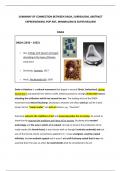
o Arp, Collage with Squares Arranged
According to the Laws of Chance,
1916-1917
o Duchamp, Fountain, 1917
o Höch, The Beautiful Girl, 1920
Dada or Dadaism is a cultural movement that began in neutral Zürich, Switzerland, during
World War I and peaked from 1916 to 1920. DADA possessed a strongly destructive stance,
attacking the civilization which had caused the war. The leading artist of the DADA
movement was Marcel Duchamp. Duchamp’s artworks are often satirical, and he is best
known for his “ready-mades” and anti-art stance, e.g. “Fountain”.
Duchamp subverts the traditions of art and purposely pokes fun at society. He aimed to
show that he rejected the traditions and ideas of his society. Duchamp also mocked
technology and the way in which art is valued. He had no hand in the production of his
ready-mades (he found them), it was chosen with no thought (entirely randomly) and not
one of the formal artistic conventions applied to it - it was unoriginal, could be copied
infinitely, had no aesthetic appeal and it wasn’t art until Duchamp stated that it was. He
asserted that if he was an artist, he could decide what he considered to be art.
, Dada artists also embraced chance as a tool for liberating creativity from rational thought.
They rejected rational thought, traditional use of imagery and materials and the depiction of
illusionistic space. This was a protest against the society of rationality and tradition which
led to the horrors of the war. Some of their work is entirely meaningless except in its
context of the rejection of the rules of traditional, rational society.
DADA’S INFLUENCE ON FUTURE MOVEMENTS:
Although Dada was a fleeting phenomenon, lasting only from about 1914-1918 (and
coinciding with WWI), Dada succeeded in irrevocably changing the way we view art,
opening it up to a variety of experimental media, themes, and practices that still inform
art today. Duchamp’s idea of the readymade has been one of the most important
legacies of Dada.
DADA’S INFLUENCES ON SURREALISM
Surrealism was born out of a desire to build from the ruins of Dada. Surrealism attracted
many of the members of the Dada community, and Dada’s use of chance and irrationality
became one of the principles of Surrealism. Surrealism, like Dada, aimed to defy logic and
reason, but incorporated the ideas of dreams and spontaneous creation (automatism) into
their artistic production. The society at the time had great interest in psychology and dream
analysis as influenced by the psychoanalytical work of Freud and Jung. This led artists to
intentionally explore the subconscious mind. “Persistence of Memory” by Dali shows a
painted dreamscape with illogical juxtapositions of objects, and changes in the surface and
texture of object, e.g. making metal clocks soft and organic, which causes discomfort in the
viewer, also an influence of Dada.
DADA’S INFLUENCES ON ABSTRACT EXPRESSIONISM
Abstract Expressionism, particularly Action Painters, drew on Dada’s influence of chance.
Artists gave their emotions free rein in the act of painting. They used art as a form of
expression where they allowed their subconscious emotions to flow onto the canvas.
Pollock would splash, pour, flick and throw paint on canvas in an almost violent way
showing his disillusionment with society, also similar to the destructiveness and
EXPRESSIONISM, POP ART, MINIMALISM & SUPER REALISM
DADA
DADA (1916 – 1922)
o Arp, Collage with Squares Arranged
According to the Laws of Chance,
1916-1917
o Duchamp, Fountain, 1917
o Höch, The Beautiful Girl, 1920
Dada or Dadaism is a cultural movement that began in neutral Zürich, Switzerland, during
World War I and peaked from 1916 to 1920. DADA possessed a strongly destructive stance,
attacking the civilization which had caused the war. The leading artist of the DADA
movement was Marcel Duchamp. Duchamp’s artworks are often satirical, and he is best
known for his “ready-mades” and anti-art stance, e.g. “Fountain”.
Duchamp subverts the traditions of art and purposely pokes fun at society. He aimed to
show that he rejected the traditions and ideas of his society. Duchamp also mocked
technology and the way in which art is valued. He had no hand in the production of his
ready-mades (he found them), it was chosen with no thought (entirely randomly) and not
one of the formal artistic conventions applied to it - it was unoriginal, could be copied
infinitely, had no aesthetic appeal and it wasn’t art until Duchamp stated that it was. He
asserted that if he was an artist, he could decide what he considered to be art.
, Dada artists also embraced chance as a tool for liberating creativity from rational thought.
They rejected rational thought, traditional use of imagery and materials and the depiction of
illusionistic space. This was a protest against the society of rationality and tradition which
led to the horrors of the war. Some of their work is entirely meaningless except in its
context of the rejection of the rules of traditional, rational society.
DADA’S INFLUENCE ON FUTURE MOVEMENTS:
Although Dada was a fleeting phenomenon, lasting only from about 1914-1918 (and
coinciding with WWI), Dada succeeded in irrevocably changing the way we view art,
opening it up to a variety of experimental media, themes, and practices that still inform
art today. Duchamp’s idea of the readymade has been one of the most important
legacies of Dada.
DADA’S INFLUENCES ON SURREALISM
Surrealism was born out of a desire to build from the ruins of Dada. Surrealism attracted
many of the members of the Dada community, and Dada’s use of chance and irrationality
became one of the principles of Surrealism. Surrealism, like Dada, aimed to defy logic and
reason, but incorporated the ideas of dreams and spontaneous creation (automatism) into
their artistic production. The society at the time had great interest in psychology and dream
analysis as influenced by the psychoanalytical work of Freud and Jung. This led artists to
intentionally explore the subconscious mind. “Persistence of Memory” by Dali shows a
painted dreamscape with illogical juxtapositions of objects, and changes in the surface and
texture of object, e.g. making metal clocks soft and organic, which causes discomfort in the
viewer, also an influence of Dada.
DADA’S INFLUENCES ON ABSTRACT EXPRESSIONISM
Abstract Expressionism, particularly Action Painters, drew on Dada’s influence of chance.
Artists gave their emotions free rein in the act of painting. They used art as a form of
expression where they allowed their subconscious emotions to flow onto the canvas.
Pollock would splash, pour, flick and throw paint on canvas in an almost violent way
showing his disillusionment with society, also similar to the destructiveness and