SURREALISM
SECTION 2 In 1924 the Bureau of Surrealist Research
SURREALISM was established and Andre Breton’s
Surrealist Manifesto was published. Many
young writers and artists were attracted
https://www.youtube.com/watch?v=bP2J
to the new movement, which aimed to
S4vDvNc defy logic and reason, concentrating
instead on dreams and spontaneous
Surrealism has a complex relationship to creation (automatism).
Dada. Surrealism was born out of a desire
to positively build from the ruins of Dada. The Surrealist Manifesto described
Dada, in negating everything, had to Surrealism as “a pure psychic
ultimately negate itself: “the true Dadaist automatism” through which artists
is against Dada”. Dada ended in 1922 expressed their thoughts with no
because of its absurdity. conscious control of the mind – (outside
of all moral or aesthetic concerns.)
Surrealism began as a literary movement
in France, founded in 1924 by André
Breton. The movement attracted many of
the members of the Dada community, and
Dada’s use of chance and irrationality
became one of the principles of
Surrealism.
The years between 1922 and 1924 were
known as the “periode des somneils” (the
period of dreams), with artists exploring
the ideas of dreams and automatism.
Surrealism was not anarchic, but in
theory, still continued to attack
traditional forms of art and bourgeoisie
values.
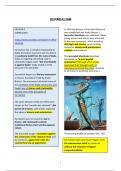
The Surrealist sough a revolution against The burning giraffe by Salvador Dali, 1937.
the constraints of the rational mind, and
by extension, against the rules of a Surrealism style uses visual imagery from
society they saw as oppressive. the subconscious mind to create art
without the intention of logical
comprehensibility.
1
, Influenced by the psychoanalytical work Children’s games were played in the
of Freud and Jung, the artists intentionally creation of the “exquisite corpse”
explored the unconscious mind. Freud's drawings, whereby one person draws a
section of a body, fold it so that it cannot
work with free association, automatic
be seen, allowing for the next person to
writing exercises, dream analysis and the draw another (ill-fitting) part of the body.
hidden unconscious was of the utmost
importance to the Surrealists in
developing methods to tap into the
creative potential of the subconscious
mind.
According to Freud, our dreams are a
direct expression of the unconscious
mind – which shows our desires, thoughts
and fears. For artists, dreams were a way
of unblocking supressed thoughts.
An example of an exquisite corpse
Some of the greatest artists of the 20th
century became involved in the Surrealist
movement, and the group included
Giacometti, Man Ray, René Magritte,
Salvador Dali, Joan Miro, Max Ernst and
many others.
Sigmund Freud
Surrealist Art encompassed a wide variety
of art mediums, and was influenced
by the art of children, so-called
“primitives” and the mentally disturbed, Women with her throat cut
all of which were considered to be more by Giacometti, 1932
direct and real.
(cast into bronze 1949)
2
SECTION 2 In 1924 the Bureau of Surrealist Research
SURREALISM was established and Andre Breton’s
Surrealist Manifesto was published. Many
young writers and artists were attracted
https://www.youtube.com/watch?v=bP2J
to the new movement, which aimed to
S4vDvNc defy logic and reason, concentrating
instead on dreams and spontaneous
Surrealism has a complex relationship to creation (automatism).
Dada. Surrealism was born out of a desire
to positively build from the ruins of Dada. The Surrealist Manifesto described
Dada, in negating everything, had to Surrealism as “a pure psychic
ultimately negate itself: “the true Dadaist automatism” through which artists
is against Dada”. Dada ended in 1922 expressed their thoughts with no
because of its absurdity. conscious control of the mind – (outside
of all moral or aesthetic concerns.)
Surrealism began as a literary movement
in France, founded in 1924 by André
Breton. The movement attracted many of
the members of the Dada community, and
Dada’s use of chance and irrationality
became one of the principles of
Surrealism.
The years between 1922 and 1924 were
known as the “periode des somneils” (the
period of dreams), with artists exploring
the ideas of dreams and automatism.
Surrealism was not anarchic, but in
theory, still continued to attack
traditional forms of art and bourgeoisie
values.
The Surrealist sough a revolution against The burning giraffe by Salvador Dali, 1937.
the constraints of the rational mind, and
by extension, against the rules of a Surrealism style uses visual imagery from
society they saw as oppressive. the subconscious mind to create art
without the intention of logical
comprehensibility.
1
, Influenced by the psychoanalytical work Children’s games were played in the
of Freud and Jung, the artists intentionally creation of the “exquisite corpse”
explored the unconscious mind. Freud's drawings, whereby one person draws a
section of a body, fold it so that it cannot
work with free association, automatic
be seen, allowing for the next person to
writing exercises, dream analysis and the draw another (ill-fitting) part of the body.
hidden unconscious was of the utmost
importance to the Surrealists in
developing methods to tap into the
creative potential of the subconscious
mind.
According to Freud, our dreams are a
direct expression of the unconscious
mind – which shows our desires, thoughts
and fears. For artists, dreams were a way
of unblocking supressed thoughts.
An example of an exquisite corpse
Some of the greatest artists of the 20th
century became involved in the Surrealist
movement, and the group included
Giacometti, Man Ray, René Magritte,
Salvador Dali, Joan Miro, Max Ernst and
many others.
Sigmund Freud
Surrealist Art encompassed a wide variety
of art mediums, and was influenced
by the art of children, so-called
“primitives” and the mentally disturbed, Women with her throat cut
all of which were considered to be more by Giacometti, 1932
direct and real.
(cast into bronze 1949)
2