

100% satisfaction guarantee Immediately available after payment Both online and in PDF No strings attached 4.2 TrustPilot
logo-home
Exam (elaborations)

CHAPTER 30: Fundamentals of Nursing, 2nd Edition – Active Learning for Collaborative Practice by Yoost & Crawford

Rating
-
Sold
-
Pages
10
Grade
A+
Uploaded on
06-05-2025
Written in
2024/2025

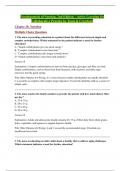
Fundamentals of Nursing, 2nd Edition – Active Learning for Collaborative Practice by Yoost & Crawford Chapter 30: Nutrition Multiple Choice Questions 1. The nurse is providing education to a patient about the difference between simple and complex carbohydrates. Which statement by the patient indicates a need for further education? A. "Simple carbohydrates give me quick energy." B. "Complex carbohydrates come from fruit." C. "Complex carbohydrates take longer to break down." D. "Simple carbohydrates come from milk products." Answer: B Explanation: Complex carbohydrates are derived from starches, glycogen, and fiber, not fruit. Simple carbohydrates, such as those from fruit (fructose), milk (lactose), and table sugar (sucrose), provide quick energy. Why Other Options Are Wrong: A is correct because simple carbohydrates are rapidly absorbed. C is accurate as complex carbs require longer digestion. D correctly identifies milk as a source of simple carbs. 2. The nurse teaches the family member to provide the patient with how much dietary fiber per day? A. 25 to 35 g B. 20 to 35 g C. 25 to 40 g D. 20 to 40 g Answer: B Explanation: Adults and adolescents should consume 20–35 g of fiber daily from whole grains, fruits, vegetables, and legumes to support digestive health. Why Other Options Are Wrong: A and C exceed the recommended range. D includes an insufficient lower limit. 3. The nurse is educating an older adult about a healthy diet to address aging challenges. Which statement indicates a need for further education? A. "I should choose foods that are nutrient dense." B. "High-fiber foods minimize the risk of constipation." C. "I should eat more calories to avoid malnutrition." D. "I can add spices to enhance the taste of food." Answer: C Explanation: Older adults require fewer calories due to decreased activity and lean muscle mass; nutrient-dense foods are prioritized over calorie quantity. Why Other Options Are Wrong: A, B, and D are appropriate strategies for aging-related dietary needs. 4. When caring for an adolescent with anorexia nervosa, the nurse knows what would be the best treatment option? A. Hospitalization with skilled nursing care B. Compulsory tube feedings C. Individually determined by a collaborative team D. Outpatient treatment Answer: C Explanation: Treatment plans should be collaborative, involving physicians, nurses, counselors, and family, tailored to the patient’s physical and psychological needs. Why Other Options Are Wrong: A and D may be components but are not universally applicable. B is invasive and not first-line. 5. A new UAP is measuring a patient’s height. Which step indicates a need for further education? A. The UAP instructs the patient to remove shoes. B. The UAP measures from the top of the head to the bottom of the foot arch. C. The UAP positions the head against the measuring device. D. The UAP ensures the patient stands erect. Answer: B Explanation: Height is measured from the top of the head to the heel, not the foot arch, for accuracy. Why Other Options Are Wrong: A, C, and D are correct procedural steps. 6. The nurse notices a beefy-red tongue during an oral exam and identifies this as characteristic of what condition? A. Anorexia nervosa B. Malnutrition C. Bulimia D. Pernicious anemia Answer: D Explanation: A beefy-red tongue is a hallmark of pernicious anemia due to vitamin B12 deficiency, impairing chewing and digestion. Why Other Options Are Wrong: A and B may cause oral changes but not this specific finding. C is unrelated to tongue appearance. 7. The nurse delegates feeding a post-stroke patient to a UAP. Which action by the UAP requires correction? A. Uses thickened liquids. B. Elevates the bed at 25 degrees. C. Encourages slow eating. D. Alternates food and fluid sips. Answer: B Explanation: The bed should be elevated to 30–45 degrees to prevent aspiration during feeding. Why Other Options Are Wrong: A, C, and D are appropriate for dysphagia management. 8. The nurse recognizes which outcome as appropriate for the nursing diagnosis Impaired swallowing? A. Patient consumes 50% of each meal. B. Patient gains 2 lb weekly. C. Patient shows no signs of aspiration during meals. D. Patient uses an assistive device to self-feed. Answer: C Explanation: The primary goal for impaired swallowing is to prevent aspiration, evidenced by clear lungs and stable respirations. Why Other Options Are Wrong: A and B relate to nutritional intake, not swallowing. D addresses self-feeding, not aspiration risk. 9. The nurse explains to a UAP that a patient is on a full-liquid diet. Which UAP statement indicates a misunderstanding? A. "I can give the patient orange juice." B. "I can give the patient yogurt." C. "I can give the patient oatmeal." D. "I can give the patient milk." Answer: C Explanation: Oatmeal is not part of a full-liquid diet, which includes liquids or foods that liquefy at room/body temperature. Why Other Options Are Wrong: A, B, and D are permissible full-liquid items. 10. The nurse educates a patient about a renal diet. Which statement indicates a need for further teaching? A. "I need to eat a low-sodium diet." B. "I can have limited amounts of meat." C. "I can drink unlimited diet cola." D. "I should avoid bananas." Answer: C Explanation: Renal diets restrict phosphorus, found in colas, even if sugar-free. Why Other Options Are Wrong: A, B, and D are correct renal diet restrictions. 11. The nurse knows which method is the only reliable way to verify nasogastric tube placement? A. Auscultation of an air bolus B. pH measurement of aspirate C. Radiographic image D. Visual inspection of aspirate Answer: C Explanation: Radiography is the gold standard for confirming tube placement, as other methods are unreliable, especially with antacid use. Why Other Options Are Wrong: A is outdated. B and D are insufficient alone. 12. The nurse attempts to unclog a PEG tube. Which intervention requires re-education? A. Flushes the tube with air. B. Uses a 50–60 mL syringe with warm water. C. Reinserts the stylet to break up clots. D. Flushes with an enzyme solution. Answer: C Explanation: Reinserting the stylet risks intestinal perforation and is never permitted. Why Other Options Are Wrong: A, B, and D are safe declogging methods. 13. When caring for a patient on TPN, the nurse changes the tubing at what interval? A. Every 72 hours B. Every 48 hours C. Every 24 hours D. Every 12 hours Answer: C Explanation: TPN tubing must be changed every 24 hours to prevent infection, while dressings are changed every 48 hours. Why Other Options Are Wrong: A and B increase infection risk. D is unnecessarily frequent. 14. The nurse prepares to insert an NG tube. Which step indicates a need for correction? A. Lubricates 4 inches of the tube. B. Marks the tube length with a permanent marker. C. Measures from nose-earlobe-xiphoid process. D. Uses clean gloves. Answer: B Explanation: Permanent markers should only be used after placement confirmation; tape is preferred initially. Why Other Options Are Wrong: A, C, and D are correct procedural steps. 15. The nurse discontinues an NG tube. Which action requires re-education? A. Clears the tube with air. B. Stops the tube feeding. C. Instructs the patient to cough during removal. D. Clamps the tube while pulling. Answer: C Explanation: Coughing during removal suggests improper placement (e.g., in the lungs). The patient should hold their breath. Why Other Options Are Wrong: A, B, and D are appropriate discontinuation steps. MULTIPLE RESPONSE QUESTIONS 1. Based on research, improper nutrition in aging may result in which diseases? (Select all that apply.) A. Type 2 diabetes B. Atherosclerosis C. Osteoporosis D. Rheumatoid arthritis E. Chronic asthma Answer: A, B, C Explanation: Poor nutrition contributes to diabetes, atherosclerosis, and osteoporosis via metabolic and musculoskeletal changes. Why Other Options Are Wrong: D is autoimmune, and E is respiratory, neither directly caused by diet. 2. The nurse explains macronutrients to a patient. Which items are macronutrients? (Select all that apply.) A. Water B. Potassium C. Starches D. Fiber E. Riboflavin Answer: A, C, D Explanation: Macronutrients include water, carbohydrates (starches, fiber), proteins, and fats. Why Other Options Are Wrong: B is a mineral, and E is a vitamin (micronutrients). 3. The nurse educates a patient about complex carbohydrates. Which foods should be included? (Select all that apply.) A. Green peas B. Bananas C. Beans D. Potatoes E. Apples Answer: A, C, D Explanation: Complex carbs are found in legumes (beans, peas) and starchy vegetables (potatoes). Why Other Options Are Wrong: B and E are simple carbohydrates (fruits). 4. The nurse discusses omega-3 fatty acids with a patient. Which foods are good sources? (Select all that apply.) A. Salmon B. Flaxseed C. Mackerel D. Steak E. Crayfish Answer: A, B, C Explanation: Omega-3s are abundant in fatty fish (salmon, mackerel) and flaxseed. Why Other Options Are Wrong: D and E lack significant omega-3 content. 5. When planning dietary education, which food-label considerations should the nurse address? (Select all that apply.) A. Ask if the patient reads labels routinely. B. Assess understanding of label content. C. Encourage label reading. D. Explain that all labels differ. E. Assess knowledge of daily allowances. Answer: A, B, C, E Explanation: Effective education includes assessing habits, comprehension, and encouraging label use, with standardized labels (D is false). Why Other Options Are Wrong: D is incorrect because labels follow uniform standards. 6. A vitamin C deficiency can result in which conditions? (Select all that apply.) A. Stiff joints B. Osteopenia C. Petechiae D. Loose teeth E. Bleeding gums Answer: A, C, D, E Explanation: Vitamin C deficiency causes scurvy, manifesting as gum bleeding, loose teeth, petechiae, and joint pain. Why Other Options Are Wrong: B results from calcium deficiency, not vitamin C. 7. The nurse teaches about obesity risks. As BMI increases, so does the risk for which conditions? (Select all that apply.) A. Increased blood pressure B. Increased HDL C. Increased total cholesterol D. Atherosclerosis E. Decreased triglycerides Answer: A, C, D Explanation: Higher BMI correlates with hypertension, hyperlipidemia, and atherosclerosis, while HDL decreases and triglycerides rise. Why Other Options Are Wrong: B and E are inversely related to BMI. 8. During a nutrition assessment, which considerations are important? (Select all that apply.) A. Include cultural influences. B. Use a 24-hour recall instead of a 3–5 day journal. C. Be nonjudgmental. D. Consult a dietitian if needed. E. Gather anthropometric measurements. Answer: A, C, D, E Explanation: Assessments should be holistic (cultural, objective, and collaborative), with multi day journals (B) being more accurate than 24-hour recalls. Why Other Options Are Wrong: B is less reliable for typical intake patterns. 9. The nurse describes metabolic syndrome as including which symptoms? (Select all that apply.) A. Elevated blood glucose B. High waist circumference C. History of smoking D. Hypertension E. Elevated serum cholesterol Answer: A, B, D, E Explanation: Metabolic syndrome involves abdominal obesity, insulin resistance, dyslipidemia, and hypertension. Why Other Options Are Wrong: C is a cardiovascular risk factor but not part of the syndrome. 10. After feeding a patient on aspiration precautions, which items should the nurse document? (Select all that apply.) A. Coughing or gagging B. Hesitation to eat C. Amount consumed D. Aspiration protocol used E. Respiratory status Answer: A, B, C, D, E Explanation: Comprehensive documentation includes behavioral cues, intake, protocols, and respiratory status to guide care. Why Other Options Are Wrong: All are relevant for aspiration risk monitoring. 11. When caring for a patient on enteral feedings, which tasks can the nurse delegate to a UAP? (Select all that apply.) A. Verify tube placement B. Perform oral care C. Administer tube feeding D. Obtain vital signs E. Measure oxygen saturation Answer: B, C, D, E Explanation: UAPs may assist with feeding, oral care, and vital signs under RN supervision, but tube placement verification requires nursing judgment. Why Other Options Are Wrong: A is outside the UAP’s scope.

Show more Read less
Institution
Fundamentals Of Nursing
Course
Fundamentals of Nursing


Whoops! We can’t load your doc right now. Try again or contact support.

Written for

Institution
Fundamentals of Nursing
Course
Fundamentals of Nursing

Document information

Uploaded on
May 6, 2025
Number of pages
10
Written in
2024/2025
Type
Exam (elaborations)
Contains
Questions & answers

Content preview

Fundamentals of Nursing, 2nd Edition – Active Learning for
Collaborative Practice by Yoost & Crawford
Chapter 30: Nutrition
Multiple Choice Questions
1. The nurse is providing education to a patient about the difference between simple and
complex carbohydrates. Which statement by the patient indicates a need for further
education?
A. "Simple carbohydrates give me quick energy."
B. "Complex carbohydrates come from fruit."
C. "Complex carbohydrates take longer to break down."
D. "Simple carbohydrates come from milk products."

Answer: B

Explanation: Complex carbohydrates are derived from starches, glycogen, and fiber, not fruit.
Simple carbohydrates, such as those from fruit (fructose), milk (lactose), and table sugar
(sucrose), provide quick energy.

Why Other Options Are Wrong: A is correct because simple carbohydrates are rapidly absorbed.
C is accurate as complex carbs require longer digestion. D correctly identifies milk as a source of
simple carbs.


2. The nurse teaches the family member to provide the patient with how much dietary fiber
per day?
A. 25 to 35 g
B. 20 to 35 g
C. 25 to 40 g
D. 20 to 40 g

Answer: B

Explanation: Adults and adolescents should consume 20–35 g of fiber daily from whole grains,
fruits, vegetables, and legumes to support digestive health.

Why Other Options Are Wrong: A and C exceed the recommended range. D includes an
insufficient lower limit.


3. The nurse is educating an older adult about a healthy diet to address aging challenges.
Which statement indicates a need for further education?

, A. "I should choose foods that are nutrient dense."
B. "High-fiber foods minimize the risk of constipation."
C. "I should eat more calories to avoid malnutrition."
D. "I can add spices to enhance the taste of food."
Answer: C

Explanation: Older adults require fewer calories due to decreased activity and lean muscle mass;
nutrient-dense foods are prioritized over calorie quantity.
Why Other Options Are Wrong: A, B, and D are appropriate strategies for aging-related dietary
needs.


4. When caring for an adolescent with anorexia nervosa, the nurse knows what would be
the best treatment option?
A. Hospitalization with skilled nursing care
B. Compulsory tube feedings
C. Individually determined by a collaborative team
D. Outpatient treatment

Answer: C

Explanation: Treatment plans should be collaborative, involving physicians, nurses, counselors,
and family, tailored to the patient’s physical and psychological needs.

Why Other Options Are Wrong: A and D may be components but are not universally applicable.
B is invasive and not first-line.


5. A new UAP is measuring a patient’s height. Which step indicates a need for further
education?
A. The UAP instructs the patient to remove shoes.
B. The UAP measures from the top of the head to the bottom of the foot arch.
C. The UAP positions the head against the measuring device.
D. The UAP ensures the patient stands erect.

Answer: B

Explanation: Height is measured from the top of the head to the heel, not the foot arch, for
accuracy.

Why Other Options Are Wrong: A, C, and D are correct procedural steps.
Get to know the seller

Seller avatar
Reputation scores are based on the amount of documents a seller has sold for a fee and the reviews they have received for those documents. There are three levels: Bronze, Silver and Gold. The better the reputation, the more your can rely on the quality of the sellers work.
bmm7203 Harvard University
View profile
Follow You need to be logged in order to follow users or courses
Sold
105
Member since
3 year
Number of followers
81
Documents
789
Last sold
2 weeks ago

3.0

24 reviews

5
8
4
3
3
3
2
1
1
9

Why students choose Stuvia

Created by fellow students, verified by reviews

Quality you can trust: written by students who passed their tests and reviewed by others who've used these notes.

Didn't get what you expected? Choose another document

No worries! You can instantly pick a different document that better fits what you're looking for.

Pay as you like, start learning right away

No subscription, no commitments. Pay the way you're used to via credit card and download your PDF document instantly.

Student with book image

“Bought, downloaded, and aced it. It really can be that simple.”

Alisha Student

Frequently asked questions
