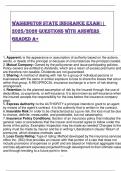
1. Apparent: is the appearance or assumption of authority based on the actions,
words, or deeds of the principal or because of circumstances the principal created.
2. Mutual Company: Owned by the policyowner and issue participating policies.
Policy owners are entitled to dividends, which are a return of excess premiums and
are therefore non-taxable. Dividends are not guaranteed.
3. Sharing: A method of dealing with risk for a group of individual persons or
businesses with the same or similar exposure to loss to share the losses that occur
within that group. A RECIPROCAL insurance exchange is a form of risk-sharing
arrangement.
4. Retention: Is the planned assumption of risk by the insured through the use of
deductibles, co-payments, or self-insurance. It is also known as self-insurance when
the insured accepts the responsibility for the loss before the insurance company
pays.
5. Express Authority: Is the AUTHORITY a principal intends to grant to an agent
by means of the agent's contract. It is the authority that is written in the contract.
6. Insurable Risk: In order to be characterized as a pure risk, the loss must be due
to chance, definite, measurable, and predictable, but not catastrophic.
7. Insurance Policy Conditions: Section of an insurance policy that indicates the
general rules or procedures that the insurer and insured agree to follow under the
terms of the policy. Examples: Inspection may be made as needed/ Changes to the
policy must be made by insurer and be in writing/ Liberalization clause/ Return of
premiums, which dictates methods used.
8. Loss Costs Rating: Type of rating: Method developed by the insurance services
office Inc. (ISO) that provides an insurer with that portion of a rate that does not
include provisions of expenses or profit and are based on historical aggregate loss
and loss adjustment expenses projected through development to their ultimate value
and through trending to a future point in time.
, 9. Strict Liability: Is commonly applied in product liability cases. The business is
then liable for defective products, regardless of fault or negligence.
10. Insuring Agreement: The part of the policy structure that describes the insured
perils and the method of indemnification.
11. Conditions: States the legal obligations and duties of the parties to the contract.
12. Valued Policy: Provides for payment of the full policy amount in the event of a
total loss WITHOUT regard to actual value or depreciation.
13. Contributory Negligence: In states that have this, the defendant must have
been 100% at fault for an accident and the claimant free of fault if the claimant is to
be successful in collecting damages.
14. Agreed Value: A property policy with provisions agreed upon by the insurer
and insured as to the amounts of insurance that represents a fair valuation for the
words, or deeds of the principal or because of circumstances the principal created.
2. Mutual Company: Owned by the policyowner and issue participating policies.
Policy owners are entitled to dividends, which are a return of excess premiums and
are therefore non-taxable. Dividends are not guaranteed.
3. Sharing: A method of dealing with risk for a group of individual persons or
businesses with the same or similar exposure to loss to share the losses that occur
within that group. A RECIPROCAL insurance exchange is a form of risk-sharing
arrangement.
4. Retention: Is the planned assumption of risk by the insured through the use of
deductibles, co-payments, or self-insurance. It is also known as self-insurance when
the insured accepts the responsibility for the loss before the insurance company
pays.
5. Express Authority: Is the AUTHORITY a principal intends to grant to an agent
by means of the agent's contract. It is the authority that is written in the contract.
6. Insurable Risk: In order to be characterized as a pure risk, the loss must be due
to chance, definite, measurable, and predictable, but not catastrophic.
7. Insurance Policy Conditions: Section of an insurance policy that indicates the
general rules or procedures that the insurer and insured agree to follow under the
terms of the policy. Examples: Inspection may be made as needed/ Changes to the
policy must be made by insurer and be in writing/ Liberalization clause/ Return of
premiums, which dictates methods used.
8. Loss Costs Rating: Type of rating: Method developed by the insurance services
office Inc. (ISO) that provides an insurer with that portion of a rate that does not
include provisions of expenses or profit and are based on historical aggregate loss
and loss adjustment expenses projected through development to their ultimate value
and through trending to a future point in time.
, 9. Strict Liability: Is commonly applied in product liability cases. The business is
then liable for defective products, regardless of fault or negligence.
10. Insuring Agreement: The part of the policy structure that describes the insured
perils and the method of indemnification.
11. Conditions: States the legal obligations and duties of the parties to the contract.
12. Valued Policy: Provides for payment of the full policy amount in the event of a
total loss WITHOUT regard to actual value or depreciation.
13. Contributory Negligence: In states that have this, the defendant must have
been 100% at fault for an accident and the claimant free of fault if the claimant is to
be successful in collecting damages.
14. Agreed Value: A property policy with provisions agreed upon by the insurer
and insured as to the amounts of insurance that represents a fair valuation for the