,
,
, Managerial 10e – Chapter 1 – Solutions Manual
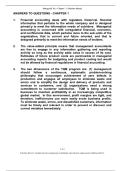
10. The effects of cost classification on the financial statements can
have important implications with respect to the following:
(1) The availability of financing - Investors and creditors use
financial statement data to predict businesses’ future
earnings. Favorable financial statements provide evidence of
favorable future performance whereas unfavorable financial
statements are an indication of possible poor future financial
performance. A company with favorable financial
performance is more likely to generate sufficient cash flows
to make interest payments, to repay the principal balance of
its liabilities, and to pay dividends. Hence, investors and
creditors believe they have a greater probability of receiving
interest payments, the return of principal, and return on
investment when companies show favorable financial
statements. Since expenses reduce profit and financial
performance, classifying a cost as an expense will inhibit the
company’s ability to obtain financing. Classifying a cost as
an asset, which will increase profit, total assets, and equity,
enhances businesses’ ability to obtain financing.
(2) Management motivation - Executive compensation may be
affected by financial statement data. Many managers’
bonuses are based on a percentage of net income. If costs
are classified as expenses, net income will be reduced which
in turn affects managerial income. Managers may even be
tempted to misclassify costs in order to manipulate financial
statement data to their advantage.
(3) Income tax considerations - With respect to taxes, managers
prefer to classify costs as expenses rather than assets.
Classifying a cost as an expense reduces net income and in
turn reduces income taxes, which are determined by
computing a designated percentage of taxable income.
1-b-4
© McGraw Hill LLC. All rights reserved. No reproduction or distribution without the prior written consent of McGraw Hill LLC.
,
, Managerial 10e – Chapter 1 – Solutions Manual
10. The effects of cost classification on the financial statements can
have important implications with respect to the following:
(1) The availability of financing - Investors and creditors use
financial statement data to predict businesses’ future
earnings. Favorable financial statements provide evidence of
favorable future performance whereas unfavorable financial
statements are an indication of possible poor future financial
performance. A company with favorable financial
performance is more likely to generate sufficient cash flows
to make interest payments, to repay the principal balance of
its liabilities, and to pay dividends. Hence, investors and
creditors believe they have a greater probability of receiving
interest payments, the return of principal, and return on
investment when companies show favorable financial
statements. Since expenses reduce profit and financial
performance, classifying a cost as an expense will inhibit the
company’s ability to obtain financing. Classifying a cost as
an asset, which will increase profit, total assets, and equity,
enhances businesses’ ability to obtain financing.
(2) Management motivation - Executive compensation may be
affected by financial statement data. Many managers’
bonuses are based on a percentage of net income. If costs
are classified as expenses, net income will be reduced which
in turn affects managerial income. Managers may even be
tempted to misclassify costs in order to manipulate financial
statement data to their advantage.
(3) Income tax considerations - With respect to taxes, managers
prefer to classify costs as expenses rather than assets.
Classifying a cost as an expense reduces net income and in
turn reduces income taxes, which are determined by
computing a designated percentage of taxable income.
1-b-4
© McGraw Hill LLC. All rights reserved. No reproduction or distribution without the prior written consent of McGraw Hill LLC.