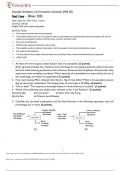
Sustainable Development and Environmental Stewardship (ENGR 202)
Final Exam – Winter 2024
Date: April 26, 2024 Time: 3 hours
Grading: 100 pts.
Weight: 40% of the total course grade
INSTRUCTIONS
• Do not start until instructed by the invigilator.
• If you believe there is an error in a question, make an assumption and continue based on that assumption. Be sure to
argue your assumption clearly in writing to have a chance at partial credit.
• This exam is closed book.
• ENCS Faculty-approved calculator may be used.
• The invigilators will not attempt to interpret or clarify a question, only handle administrative issues.
• The exam has 23 questions.
• You must take the exam paper with you when you are finished. Only submit the booklet with your responses!
• GOOD LUCK!
1. A) Name the three aspects (triple bottom line) of sustainability. (3 points)
B) An agricultural facility has created a novel technology for increasing production yield on the same
land area while lowering production costs. However, because of the complexity of the process, they
experience more workplace accidents. Which aspect(s) of sustainability are improved by the use of
this technology, and which are jeopardized? (3 points)
2. How much energy (MJ) is released when there is 10g of mass defect? What is the equivalent amount
(kg) of natural gas combustion? The heating value of natural gas is 50 MJ/kg. (6 points)
3. True or false? “The majority of municipal wastes in North America is recycled”. (2 points)
4. Which of the following case studies were relevant to the “Land Pollution”? (2 points)
(a) Chernobyl (b) Love Canal (c) New York City Smog
(d) Aral Sea (e) Ontario Land Disaster
5. Calculate the (a) waste composition and (b) Feed flowrate in the following separation units (all
percentages are in mass). (6 points)
Product, 200 kg/h
-90% MeOH
Feed, 1000 kg/h -10% Water
-30% MeOH
-70% Water Separation
Waste
-?% MeOH
-?% Water
(a) (b)
1
This study source was downloaded by 100000898495062 from CourseHero.com on 05-04-2025 17:20:48 GMT -05:00
https://www.coursehero.com/file/249168081/Final-Exam-Winter-2024pdf/
, 6. (8 points) A company that produces pens is interested to perform a life-cycle assessment of their
product. They provide you with the following data:
TABLE 1: PEN ASSEMBLY (UNIT PROCESS) DATA
Pen 1 unit
Pen body -1 unit
Ink -4 mL
CO2 0g
SOx 0g
NOx 0g
TABLE 2: PEN BODY PRODUCTION (UNIT PROCESS) DATA
Pen 0 unit
Pen body 100 unit
Ink 0 mL
CO2 40 g
SOx 1.2 g
NOx 0.3 g
TABLE 3: INK PRODUCTION (UNIT PROCESS) DATA
Pen 0 unit
Pen body 0 unit
Ink 50 mL
CO2 22 g
SOx 0.05 g
NOx 0.21 g
a. For a functional unit of ‘Production of 12 pens’, calculate the life-cycle inventory.
b. Which data would be considered reference flows?
7. A company approaches you to perform a life-cycle assessment on their product, a bottle of hand
sanitizer. In particular, they are interested in comparing it to a system that uses ultra-violet light to
sanitize hands. Propose a good function and functional unit for the study. (5 points)
8. What is ‘burden-shifting’ and how does LCA help to avoid it? (4 points)
9. What are the three questions that should be addressed in the ‘goal’ of an LCA? (3 points)
2
This study source was downloaded by 100000898495062 from CourseHero.com on 05-04-2025 17:20:48 GMT -05:00
https://www.coursehero.com/file/249168081/Final-Exam-Winter-2024pdf/
Final Exam – Winter 2024
Date: April 26, 2024 Time: 3 hours
Grading: 100 pts.
Weight: 40% of the total course grade
INSTRUCTIONS
• Do not start until instructed by the invigilator.
• If you believe there is an error in a question, make an assumption and continue based on that assumption. Be sure to
argue your assumption clearly in writing to have a chance at partial credit.
• This exam is closed book.
• ENCS Faculty-approved calculator may be used.
• The invigilators will not attempt to interpret or clarify a question, only handle administrative issues.
• The exam has 23 questions.
• You must take the exam paper with you when you are finished. Only submit the booklet with your responses!
• GOOD LUCK!
1. A) Name the three aspects (triple bottom line) of sustainability. (3 points)
B) An agricultural facility has created a novel technology for increasing production yield on the same
land area while lowering production costs. However, because of the complexity of the process, they
experience more workplace accidents. Which aspect(s) of sustainability are improved by the use of
this technology, and which are jeopardized? (3 points)
2. How much energy (MJ) is released when there is 10g of mass defect? What is the equivalent amount
(kg) of natural gas combustion? The heating value of natural gas is 50 MJ/kg. (6 points)
3. True or false? “The majority of municipal wastes in North America is recycled”. (2 points)
4. Which of the following case studies were relevant to the “Land Pollution”? (2 points)
(a) Chernobyl (b) Love Canal (c) New York City Smog
(d) Aral Sea (e) Ontario Land Disaster
5. Calculate the (a) waste composition and (b) Feed flowrate in the following separation units (all
percentages are in mass). (6 points)
Product, 200 kg/h
-90% MeOH
Feed, 1000 kg/h -10% Water
-30% MeOH
-70% Water Separation
Waste
-?% MeOH
-?% Water
(a) (b)
1
This study source was downloaded by 100000898495062 from CourseHero.com on 05-04-2025 17:20:48 GMT -05:00
https://www.coursehero.com/file/249168081/Final-Exam-Winter-2024pdf/
, 6. (8 points) A company that produces pens is interested to perform a life-cycle assessment of their
product. They provide you with the following data:
TABLE 1: PEN ASSEMBLY (UNIT PROCESS) DATA
Pen 1 unit
Pen body -1 unit
Ink -4 mL
CO2 0g
SOx 0g
NOx 0g
TABLE 2: PEN BODY PRODUCTION (UNIT PROCESS) DATA
Pen 0 unit
Pen body 100 unit
Ink 0 mL
CO2 40 g
SOx 1.2 g
NOx 0.3 g
TABLE 3: INK PRODUCTION (UNIT PROCESS) DATA
Pen 0 unit
Pen body 0 unit
Ink 50 mL
CO2 22 g
SOx 0.05 g
NOx 0.21 g
a. For a functional unit of ‘Production of 12 pens’, calculate the life-cycle inventory.
b. Which data would be considered reference flows?
7. A company approaches you to perform a life-cycle assessment on their product, a bottle of hand
sanitizer. In particular, they are interested in comparing it to a system that uses ultra-violet light to
sanitize hands. Propose a good function and functional unit for the study. (5 points)
8. What is ‘burden-shifting’ and how does LCA help to avoid it? (4 points)
9. What are the three questions that should be addressed in the ‘goal’ of an LCA? (3 points)
2
This study source was downloaded by 100000898495062 from CourseHero.com on 05-04-2025 17:20:48 GMT -05:00
https://www.coursehero.com/file/249168081/Final-Exam-Winter-2024pdf/