IGCSE Physics\Turning Effect of Forces\Important Concepts
IGCSE PHYSICS
TURNING EFFECT OF FORCES: IMPORTANT CONCEPTS
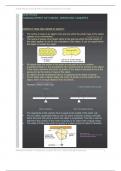
CENTRE OF MASS AND CENTRE OF GRAVITY
The centre of mass of an object is the point at which the whole mass of the object
appears to be concentrated. gravitational force / pull
The centre of gravity of an object refers to the point at which the total weight of
the object appears to act for any orientation of the object. It can be located within
the object or outside the object.
All objects near the surface of the earth are assumed to be in a uniform
gravitational field (i.e. the gravitational force experienced by all parts of the object
is the same), therefore the centre of gravity of any object is assumed to be at the
same point as the centre of mass of the object.
An object will only be balanced when it is supported at its centre of gravity.
For an object with a regular shape, the centre of gravity is at the centre of the
object, which is at equal distance from all vertices.
equal weight distribution
Example: uniform metre rule
x: centre of gravity/ centre of mass
Normal
Reaction Reaction
50 cm 50 cm 50 cm 50 cm
x x
Weight Weight
Metre rule balances Metre rule topples clockwise
The magnitude of the reaction force is equal to the weight of the metre rule.
For any object suspended freely at rest, its centre of gravity is always vertically
below the pivot (the point at which the object is suspended). This fact is used to
determine the position of the centre of gravity of an object with irregular shape.
The steps of finding the centre of gravity of a plane lamina of uniform thickness:
pivot/ fulcrum:
fixed point which does not move
when the object moves
_____________________________________________________________________________
Nakazawa EduServ. Created by Jackson Tik, B.Sc. (NUS). ©All rights reserved. 1
, IGCSE Physics\Turning Effect of Forces\Important Concepts
(a) Three holes are made as far apart as possible near the edge of the lamina.
(b) The lamina is suspended using a pin through one of the holes.
(c) A line showing the position of the plumbline which is hung from the pin is
drawn on the lamina.
(d) The step is repeated by suspending the lamina through the other two holes to
obtain respective positions of the plumbline.
(e) The point of intersection of the three lines obtained is the centre of gravity of
the lamina.
Test Yourself:
Mark with a cross (X) the position of the centre of gravity of the objects below:
MOMENT/ TORQUE OF A FORCE
Turning effect
When a force is applied to an object through its centre of gravity (centre of mass),
the object moves in the direction of the force.
centre of mass
force
x
object moves
If the force is applied to the object not through its centre of gravity, the object
experiences a turning effect.
object rotates
centre of mass
x
force
The turning effect produced by a force which is not acting through the centre of
gravity of an object is known as the moment of the force or the torque of the force.
The moment or the torque of a force is defined as the product of the force applied
and the perpendicular distance from the line of action of the force to the pivot.
_____________________________________________________________________________
Nakazawa EduServ. Created by Jackson Tik, B.Sc. (NUS). ©All rights reserved. 2
IGCSE PHYSICS
TURNING EFFECT OF FORCES: IMPORTANT CONCEPTS
CENTRE OF MASS AND CENTRE OF GRAVITY
The centre of mass of an object is the point at which the whole mass of the object
appears to be concentrated. gravitational force / pull
The centre of gravity of an object refers to the point at which the total weight of
the object appears to act for any orientation of the object. It can be located within
the object or outside the object.
All objects near the surface of the earth are assumed to be in a uniform
gravitational field (i.e. the gravitational force experienced by all parts of the object
is the same), therefore the centre of gravity of any object is assumed to be at the
same point as the centre of mass of the object.
An object will only be balanced when it is supported at its centre of gravity.
For an object with a regular shape, the centre of gravity is at the centre of the
object, which is at equal distance from all vertices.
equal weight distribution
Example: uniform metre rule
x: centre of gravity/ centre of mass
Normal
Reaction Reaction
50 cm 50 cm 50 cm 50 cm
x x
Weight Weight
Metre rule balances Metre rule topples clockwise
The magnitude of the reaction force is equal to the weight of the metre rule.
For any object suspended freely at rest, its centre of gravity is always vertically
below the pivot (the point at which the object is suspended). This fact is used to
determine the position of the centre of gravity of an object with irregular shape.
The steps of finding the centre of gravity of a plane lamina of uniform thickness:
pivot/ fulcrum:
fixed point which does not move
when the object moves
_____________________________________________________________________________
Nakazawa EduServ. Created by Jackson Tik, B.Sc. (NUS). ©All rights reserved. 1
, IGCSE Physics\Turning Effect of Forces\Important Concepts
(a) Three holes are made as far apart as possible near the edge of the lamina.
(b) The lamina is suspended using a pin through one of the holes.
(c) A line showing the position of the plumbline which is hung from the pin is
drawn on the lamina.
(d) The step is repeated by suspending the lamina through the other two holes to
obtain respective positions of the plumbline.
(e) The point of intersection of the three lines obtained is the centre of gravity of
the lamina.
Test Yourself:
Mark with a cross (X) the position of the centre of gravity of the objects below:
MOMENT/ TORQUE OF A FORCE
Turning effect
When a force is applied to an object through its centre of gravity (centre of mass),
the object moves in the direction of the force.
centre of mass
force
x
object moves
If the force is applied to the object not through its centre of gravity, the object
experiences a turning effect.
object rotates
centre of mass
x
force
The turning effect produced by a force which is not acting through the centre of
gravity of an object is known as the moment of the force or the torque of the force.
The moment or the torque of a force is defined as the product of the force applied
and the perpendicular distance from the line of action of the force to the pivot.
_____________________________________________________________________________
Nakazawa EduServ. Created by Jackson Tik, B.Sc. (NUS). ©All rights reserved. 2